


Staying active during pregnancy doesn't have to be complicated or intimidating. Pregnancy exercise ball workouts offer a safe, low-impact way to strengthen your core, ease back pain, improve pelvic floor strength, and prepare your body for labor—all from the comfort of home. Whether you're in your first trimester or counting down the weeks, an exercise ball can be one of your most supportive workout partners throughout the entire journey.
Why Use an Exercise Ball for Pregnancy Workout?
During pregnancy, an exercise ball (also called a stability ball or birth ball) becomes one of the most versatile tools you can have at home. It supports your body through comfort, movement, and active preparation for labor.
It supports your changing body. As your belly grows, your center of gravity shifts. Sitting or moving on a ball encourages your pelvis to stay in a neutral position, which naturally reduces lower back tension, one of the most common complaints during pregnancy.
It activates your core gently. Unlike traditional core exercises that compress the abdomen, stability ball pregnancy workout moves engage your deep stabilizing muscles without strain. This builds the foundation your body needs to carry extra weight and recover postpartum.
It helps prepare you for labor. Gentle bouncing, pelvic rocking, and hip-opening movements on the ball can encourage your baby into an optimal position and help your body become more familiar with the sensations of early labor.
It's adaptable to every trimester. From seated marching in the first trimester to pregnancy hip circles and supported squats in the third, exercise ball pregnancy stretches and strengthening moves can be modified to suit wherever you are in your pregnancy.
Safety Tips Before Starting Exercise Ball Pregnancy Exercises
Before you begin, keep these guidelines in mind to make sure every session feels safe and supportive:
- Check with your doctor first. Always get clearance from your healthcare provider before starting or continuing any exercise routine during pregnancy.
- Choose the right ball size. A 65 cm (25.6 inch) ball is ideal for most pregnant women of average height (5'4"–5'7" / 163–170 cm). When seated, your hips should be level with or slightly above your knees.
- Use a ball base or non-slip surface. Place your ball on a yoga mat or use a stability ring base to prevent rolling, especially during seated or lying-down exercises.
- Avoid lying flat on your back after 20 weeks. From mid-pregnancy onward, prolonged supine positions can compress the vena cava. Modify or skip moves that require this position.
- Stop if anything feels wrong. Dizziness, shortness of breath, pelvic pain, or any unusual sensation is a signal to stop, rest, and contact your provider if needed.
- Stay hydrated. Keep water nearby and take regular sips throughout your session.
- Move at your own pace. These workouts are not about intensity. Slow, controlled movements with steady breathing will always serve you better than speed or range.
15 Pregnancy Ball Exercises
The following 15 exercises are drawn from the Momcozy BirthEase course curriculum, organized by trimester. Each one comes with detailed guidance based on the expert-led voiceover scripts from the program.
First Trimester (Weeks 1–12)
Exercise 1: Ball Lift with Cross-Back Lunge
Target: Lower-body stability, coordination
Hold the ball with both hands and stand tall with your left toes lightly touching the floor. As you exhale, step your left leg diagonally back behind the right, placing the top of your foot on the mat and letting the right knee bend slightly. This movement strengthens the glutes and legs while activating the whole body. Keep your core gently engaged and breathe smoothly throughout. Perform 5 reps per side.

Exercise 2: Supported Squat with the Ball
Target: Lower-body strength, pelvic stability
Place the ball against the wall so the bottom aligns with your hips, and let your lower back rest comfortably against it. Step your feet forward, slightly wider than shoulder-width. Inhale as you slowly lower into a squat, letting the ball roll gently along your spine. Pause when your thighs are near parallel to the floor, then exhale to press back up. Keep your knees tracking in line with your toes and your core softly engaged. Aim for 8 reps per set.

Exercise 3: Dead Bug (Basic Version)
Target: Deep core strength, pelvic stability
Lie on your back with the ball held between your palms and knees. As you exhale, gently engage your core and pelvic floor, pressing your palms down into the ball while your knees lift up to meet it—keeping the ball still. Inhale to soften. Keep your lower back connected to the mat throughout. Do 5 reps per set.

Exercise 4: Pelvic Tilt (Seated on Ball)
Target: Pelvic mobility, lower back release
Sit in the center of the ball with both feet grounded hip-width apart. As you inhale, gently tilt the pelvis forward, allowing a soft arch through the lower back with the chest opening. As you exhale, draw the pelvis back, tucking the tailbone under, and feel the lower back lengthen with ease. Let your breath lead the movement and keep the chest steady throughout. Alternate for 8 reps.

Exercise 5: Supine Windshield Wiper
Target: Pelvic floor stretch, lumbar rotation
Lie on your back with knees bent and arms resting by your sides. As you exhale, slowly lower both knees to the right, keeping the upper back and shoulders grounded. Inhale to return to center, then exhale to lower the knees to the left. Move slowly and with control, like smooth windshield wipers, with your core gently engaged to support the lower back. This exercise releases tension along the sides of the waist and the lumbar spine. Alternate for 6–8 reps per side.

Second Trimester (Weeks 13–26)
Exercise 6: Ball-Supported Forward Fold
Target: Core activation, spinal release, back pain relief
Come into an all-fours position with knees hip-width apart. Hold the ball with both hands and gently rest your upper chest onto it, letting your torso come parallel to the floor. Using natural breathing, let your hips guide your upper body to roll the ball in slow clockwise circles for 30 seconds, then switch to counterclockwise. This movement adapts to your growing belly, helps you find your new center of gravity, and gently stretches the muscles around your spine, making it an effective exercise ball pregnancy stretch for mid-pregnancy back tension.

Exercise 7: Dynamic Tiger Pose
Target: Core strength, pelvic floor exercises, balance
Come into a tabletop position with hands shoulder-width apart and your back in a neutral curve. Eyes look softly downward. On an exhale, gently press the ball back with your right foot until the leg extends straight behind you. Stay for five steady breaths, then slowly return. Imagine your pelvic floor gently lifting to keep your core stable and light. Keep the hips level and avoid rotating or collapsing the lower back. Do 6 reps per side.

Exercise 8: Dynamic Dragon Pose
Target: Hip flexibility, pelvic floor elasticity
Step your left leg forward into a lunge and ground the right knee firmly into the mat. Place both hands on the inside of the ball for support. As you inhale, lengthen upward through the spine. As you exhale, let the hips sink softly forward, feeling a gentle opening through the front of the left hip and thigh. With each exhale, gently push the ball a little farther forward, gradually opening the hips. Keep the abdomen lightly engaged and the front knee behind the toes. Do 8 reps per side.

Exercise 9: Goddess Pose Ball Squat
Target: Hip mobility, lower-body strength
Spread your feet to about twice shoulder-width apart, toes pointing outward. Hold the ball in front of you. As you exhale, slowly bend your knees and send your hips back and down as if sitting into an invisible chair. Inhale to rise. Squat only to a depth that feels safe. Keep breathing steadily and avoid putting pressure on the abdomen. Aim for 8 reps.

Exercise 10: Shoulder Bridge with Ball
Target: Glute activation, pelvic stability, core strength
Lie on your back and place your feet on the ball with a gentle bend in the knees. Make sure the ball is secured in its base. As you exhale, slowly lift your hips until your body forms a straight line from shoulders to knees. Inhale to lower back down. Press your heels gently into the ball to keep it steady, and let the effort come mainly from the glutes, not the lower back or hamstrings. Do 10 reps.

Third Trimester (Weeks 27–40)
Exercise 11: Seated Spinal Rotation
Target: Spinal mobility, pelvic stability
Sit evenly on top of the ball with feet slightly wider than hip-width and knees tracking over your toes. As you inhale, sweep your arms out to the sides and lift them overhead, palms facing each other, feeling your spine lengthen upward. As you exhale, keep your lower body stable and let your arms guide your torso into a gentle twist to the right—right hand rests against the outside of your right thigh, left hand stays on the ball. Do 6 reps per side.

Exercise 12: Seated-on-Ball Rocking
Target: Lower back and sacral pain relief, pelvic floor exercises
Sit in the center of the ball, feet slightly wider than shoulder-width, hands gently behind your head. As you exhale, draw your lower belly in and lift up through the pelvic floor. At the same time, tuck your chin, round through your back, and let the ball roll slightly forward. On the inhale, lengthen back through the original path, opening your elbows to the sides. This move works like a gentle massage for the lower back. It eases the sacral discomfort common in the third trimester. Keep movements slow and avoid bouncing. Do 6 reps.

Exercise 13: Dynamic Squat
Target: Pelvic floor and lower-body strength, labor preparation
Stand in front of the ball with feet slightly wider than shoulder-width, hands on hips. Inhale to open through the chest, then exhale as you slowly send your hips back, allowing them to gently tap the ball. Press through your feet to come back up, and avoid hyperextending your knees at the top. Keep the movement soft—this is about building endurance and pelvic awareness, not depth. Do 6–8 reps.

Exercise 14: Pelvic Rocking (Pendulum)
Target: Swelling relief, constipation relief, pelvic stability
Sit in the center of the ball with hands resting on your knees. Take a deep breath in, then as you exhale, gently lift the right side of your pelvis while grounding through the right foot and letting the left leg naturally lengthen. Alternate sides with small, steady side-to-side sways, like a clock pendulum. Keep the core lightly engaged and avoid shrugging your shoulders. These small pelvic lifts improve circulation in the legs, ease late-pregnancy swelling, and support smoother bowel movement. Do 8 reps per side.

Exercise 15: Seated-on-Ball Bouncing (After Full Term Only — 37+ Weeks)
Target: Labor preparation, baby positioning, pelvic floor tension release
Important: Only practice this exercise after 37 weeks of pregnancy.
Sit in the center of the ball with feet flat on the floor and knees braced gently. Inhale as you push off the ground slightly; exhale as you lower back down in a controlled manner. If it feels comfortable, gradually let the pelvis lift a little with the ball. There's no need to go high. This gentle bouncing encourages your baby to descend and relieves pressure on the pelvis. Keep it light, steady, and comfortable. If you feel unstable, hold onto a fixed surface. Do 16 light bounces per set.

When to Avoid Ball Exercises for Pregnancy
Exercise ball workouts are generally safe and beneficial, but there are situations where you should pause and check in with your provider:
- Placenta previa or low-lying placenta — Certain movements may not be appropriate.
- Preterm labor risk or cervical insufficiency — Avoid any bouncing or vigorous movement until cleared.
- Severe pelvic girdle pain (PGP) or symphysis pubis dysfunction (SPD) — Wide-stance exercises like Goddess Pose may aggravate symptoms.
- High blood pressure or preeclampsia — Physical activity should be evaluated individually.
- After any fall or injury — Wait for a medical evaluation before resuming.
- If you feel dizziness, chest pain, vaginal bleeding, or unusual swelling — Stop immediately and contact your healthcare provider.
When in doubt, check with your provider before resuming.
Momcozy BirthEase Maternity Exercise Ball Set
The Momcozy BirthEase Maternity Ball Set is built for the full pregnancy journey, from preconception through labor preparation and postpartum recovery. Unlike standard gym balls, every detail is designed with a pregnant body in mind.

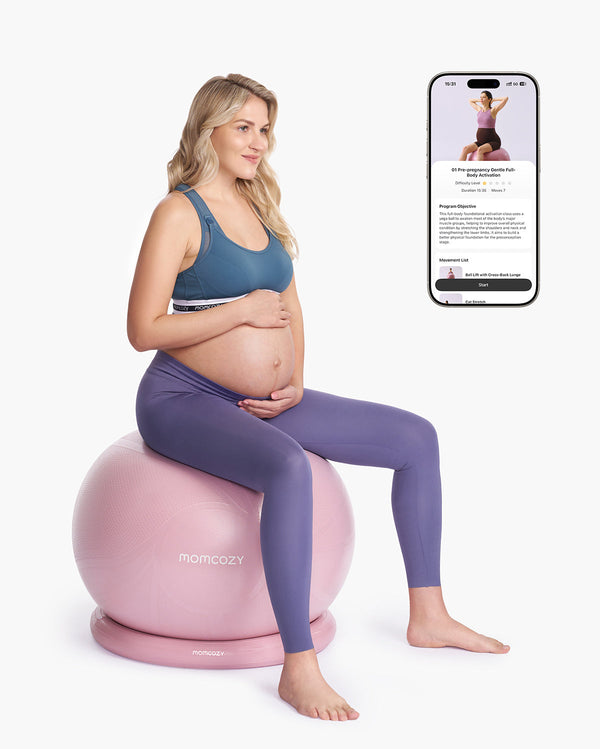


Stage-Based, Full-Journey Courses in the Momcozy App. Every exercise in this article comes from the expert-led video courses available through the Momcozy App. Courses are organized by trimester, so you always know you're doing the right moves for where you are in your pregnancy.
Personalized Training Plans with Smart Guidance. The app creates personalized workout plans, tracks your progress, and offers community support so you never feel like you're figuring it out alone.
Ergonomic Design with Enhanced Stability. The 65 cm (25.6 inch) ball features a textured, anti-slip surface and a reinforced base ring, so it stays put during movement. It supports up to 330 lb (150 kg) and is designed to accommodate your body as it changes.
Maximum Safety with BPA-Free Materials. Made from premium, eco-friendly, BPA-free PVC with anti-burst technology, the BirthEase is built to handle the demands of regular pregnancy use without compromising safety.
Graceful Charm, Effortless Start. The soft floral design brings a touch of calm and femininity to your space, and the included foot pump means you can be set up and ready in minutes.
Your purchase also includes access to the Cozy Mom lifestyle & self-care guide, with curated content on wellness, nutrition, and style to support you throughout your pregnancy.
Try Pregnancy Exercise Ball Workouts
Pregnancy exercise ball workouts give you a gentle, effective way to stay strong, comfortable, and prepared throughout your pregnancy. From the first trimester's core-awakening moves to the third trimester's labor-prep exercises, each session is a small investment in your wellbeing and your baby's. Listen to your body, move at your own pace, and remember: every mindful movement counts.








