


Before a hotel stay, a visit to grandparents, or a road trip, decide where your baby will sleep, who will provide the equipment, and whether the setup will physically fit the room. A portable playard can offer one familiar approved sleep space for baby sleep at hotel stays and repeat visits, but it cannot guarantee that your baby will sleep the same way in a new place. Momcozy portable playards should be considered alongside the room, transport, and product instructions before you leave home.
Key Takeaways
- Choose your baby’s away-from-home sleep space before the trip. Hotel cribs, rental equipment, portable playards, and grandparents’ gear can vary in condition, size, and setup.
- A familiar portable sleep setup can make the equipment feel less new, but it cannot guarantee your baby will sleep the same way in an unfamiliar room.
- For hotel stays, check both the sleep product and the room around it: inspect the sleep-space condition, available floor area, nearby cords, windows, furniture, and adult access.
- If your family visits grandparents often, a dedicated, known sleep setup kept at their house may be easier than transporting unfamiliar or borrowed gear each time.
- Road-trip families may prioritize repeatable setup, folded size, trunk fit, and familiar equipment. Frequent flyers may need a lighter, travel-first sleep product instead.
- Use only the exact product’s approved sleep mode, original sleep surface, and allowed accessories. Do not modify the setup to make it softer or more familiar.
Start With One Question: Where Will the Baby Actually Sleep?
Before you think about bedtime timing, decide where your baby will physically sleep at the destination. This is a sleep-space decision, not a schedule decision: the goal is to choose and prepare an appropriate place for your baby to sleep away from home.
Most families are choosing among four practical paths:
- A hotel-provided crib or other sleep product
- A portable playard or travel sleep product brought from home
- Baby gear rented for the destination
- A dedicated sleep setup kept at grandparents’ house
The right option depends on how you are traveling, how much clear floor space the destination has, whether you know the equipment’s condition, how manageable the setup is, and how often your family visits. A road trip may make it practical to bring familiar gear, while frequent visits to grandparents may justify keeping a known setup there. If you are relying on hotel or rental equipment, plan to inspect the exact product and its sleep surface when you arrive.
Once the physical sleep space is decided, keeping your baby’s sleep routine steady while traveling can help you plan the routine around that setup.
Hotel Crib, Bring Your Own Playard, or Rent? Compare Before You Arrive
No one option is best for every trip. Compare luggage limits, the equipment’s known condition, destination room fit, setup logistics, and how often your family will repeat the trip before deciding who will provide the sleep space.
| Option | Best-Fit Trip | Main Advantage | What to Verify | Main Drawback |
|---|---|---|---|---|
| Hotel-provided crib or playard | Flying or minimal-luggage trips | No large item to transport | Availability, exact model, condition, assembly, and approved sleep surface | Availability and condition can be uncertain |
| Bring your own portable playard | Road trips, repeat hotel stays, or family visits | Known equipment and a repeatable setup | Weight, folded size, trunk and room fit, and approved mode | More gear to transport |
| Rent baby gear | Flying or longer destination stays | Avoids transporting bulky gear | Exact model, condition, instructions, and delivery or pickup timing | Dependence on rental logistics |
| Dedicated grandparents’ setup | Frequent repeat visits | Known equipment already waiting | Storage, current manual, recalls, condition, and stage limits | Second-unit cost and storage |
Bringing your own playard may be practical when familiar equipment and repeatable setup matter most. A hotel crib or rental can be the better fit when carrying bulky gear would complicate the trip. The important step is to choose the option that gives your family a usable, appropriate sleep space at the destination—not simply the option that seems easiest to pack.
What to Check in a Hotel Room Before Setting Up Baby's Sleep Space
A hotel sleep setup should leave a clear path for adults and place your baby's approved sleep product in a stable, hazard-free spot. A dark room can help create a calmer environment, but it does not solve a crowded layout or an unsafe placement.
Start by looking at the room as it will actually be used: with the adult bed, luggage, doors, closet, and normal walking routes in place. Mark the open footprint before unpacking a playard or other sleep product, and make sure it will not block bedside access, the exit, or the path to the bathroom. If the fit is close, use these playard dimensions and room-fit details to assess the space without relying on guesswork.
If the hotel provides a crib or playard, inspect that exact unit before use. Confirm that its setup, components, and sleep surface are appropriate under the current product instructions and applicable safety standards. Do not add an extra mattress, pad, or substitute component to make the setup feel more comfortable.
Then scan the area around the sleep space. Keep it away from loose cords, window coverings, windows, radiators, fans, unstable furniture, and anything a baby could reach or pull. When room-sharing, choose a location that lets you reach your baby easily while keeping exits and essential walking paths clear.
Why an Unfamiliar Sleep Space Can Feel Different to a Baby
A different room or sleep space can feel more noticeable when a baby briefly wakes. New surroundings, unfamiliar equipment, and changed room cues may make it easier for that short wake-up to become a fuller one. That does not mean anything is wrong with your baby’s sleep or that a new sleep space will always lead to a difficult night.
When practical, reduce physical novelty by using a known sleep space, the same approved configuration, familiar sleep clothing, and familiar room cues. Use only the product’s original sleep surface and approved accessories, even when you are trying to make the setup feel more like home. Familiarity may make the environment feel more consistent, but it cannot promise that night waking or sleep changes will not happen.
Once the physical setup is in place, travel sleep routine support can help with the routine side of an away-from-home stay.
Practice the Equipment, Not a New Sleep Routine
Before a road trip or repeat family visit, set up the exact portable playard at home. The goal is equipment readiness: caregivers should know how to open it, secure any required locks, change approved modes, and fold it again according to the current product instructions.
If the product and your child’s stage make it appropriate, a brief supervised familiarization with the approved setup can make the equipment less new before the first destination night. This is not a sleep-training plan or a reason to create a new bedtime routine.
Use the practice session to catch small problems while you still have time to fix them: a wrong sheet, missing part, confusing lock, awkward fold, or accessory that is not practical to transport. A setup-and-fold practice run should support the current manual, not replace it.
Grandparents' House: Bring the Playard, Leave One There, or Use Existing Gear?
For repeat visits, choose the option that gives you the most equipment certainty with the least ongoing friction. Bringing the same playard each time can make sense when you want one known setup and can manage the loading, transport, and unpacking. Keeping a dedicated unit at grandparents’ house may be more practical when visits are frequent and there is enough storage for its folded footprint.
Existing or borrowed gear is a separate decision branch. Before relying on it, check for recalls, find the current manual, inspect for damage, confirm that no parts are missing or substituted, and test the locking mechanisms. Use only the original or approved sleep surface. If you cannot confirm the equipment’s condition, components, and approved setup, do not assume it is ready for use.
When grandparents have limited storage, a compact folded size and a setup process caregivers can repeat correctly become part of the choice. The same newborn playard safe-use limits apply whether the equipment travels with you or stays at their house.
Road Trips Favor a Different Setup Than Frequent Flying
Car travel and air travel create different equipment constraints. For road trips, a home-first portable playard can be practical when it fits the trunk, sets up quickly at the destination, folds for storage, and also serves your family’s regular at-home needs between trips.
Frequent flyers may need to give much more weight to total carry weight, backpack-style transport, and travel-first packed dimensions. A product can be portable for moving between rooms, loading into a car, or visiting relatives without being equally practical for airport travel.
Choose the transport mode first, then compare the product type. These home-versus-travel sleep-space tradeoffs help separate a car-friendly, home-first setup from a lighter option designed around frequent flights.

Small Hotel Rooms and Guest Rooms Need a Floor-Plan Check
Before you unpack, picture the room at its busiest: the adult bed is made, luggage is open, and everyone needs to move around. A playard may fit in the room but still be frustrating if it blocks the door, closet, luggage area, bathroom path, or the space beside the bed.
If you plan to fold the playard during the day, check both its open and folded footprint. Decide where the folded unit will go and whether you can get it there without moving luggage or blocking a walkway. That simple check can help you avoid rearranging the whole room once you arrive.
For a closer look at choosing a playard for a small apartment or bedroom, compare your expected room layout before choosing a setup.
A Familiar Setup Should Stay an Approved Setup
A hotel, rental, or borrowed sleep space does not become safer because it feels more like home. Before you set up an unfamiliar playard, a newborn pack-and-play safety check keeps the focus on the approved sleep surface, correct configuration, and whether a fitted sheet is allowed. Do not add a thicker mattress, topper, pillow, loose blanket, or other unapproved accessory. If you cannot verify the setup or assemble it correctly, choose another approved sleep option.
Where the Momcozy One-Click Foldable Baby Playard with Bassinet Fits in an Away-From-Home Setup
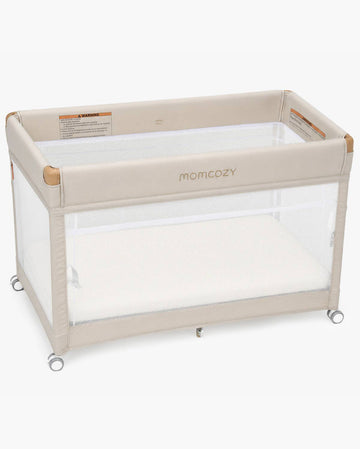
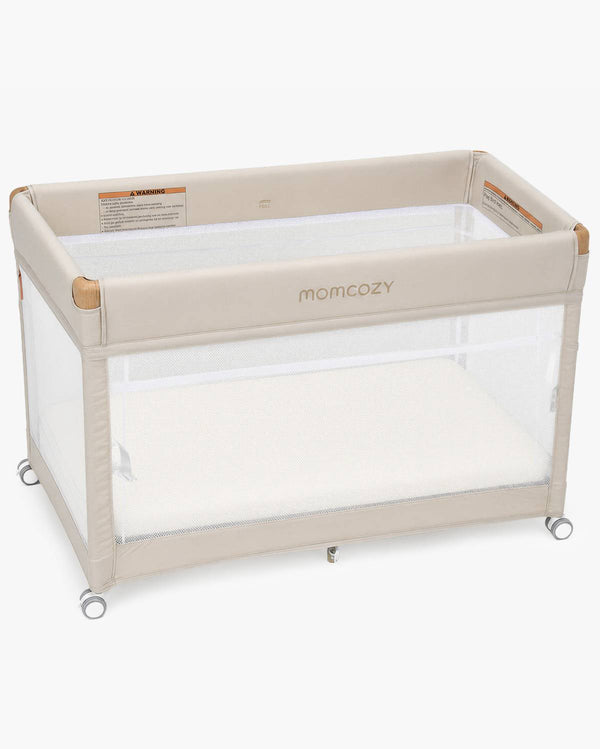
For home-first families who mainly travel by car, visit grandparents, use a second home, or take short hotel or Airbnb stays, the Momcozy One-Click Foldable Baby Playard with Bassinet can provide one familiar physical setup across locations. Our One-Click Foldable Baby Playard with Bassinet measures 112 × 62 × 78 cm when open and folds to 63.5 × 16 × 78 cm, weighing 10.3 kg. We pair no-tool setup, Bassinet and Playard modes, and four lockable wheels to support repeat stays when your trunk and destination room have enough space.
At 10.3 kg, the One-Click Foldable Baby Playard with Bassinet is not positioned as a lightweight, flight-first travel crib. Its value is less uncertainty around the equipment you bring and a repeatable setup from home to car to grandparents’ house or a hotel room. It may make the physical setup feel more familiar, but it cannot guarantee better sleep in a new environment.
Build an Away-From-Home Sleep Setup Checklist
Before you leave, use this checklist to confirm that your baby’s sleep space is appropriate, complete, and practical for the destination.
- Confirm where your baby will sleep before the trip; do not assume a hotel or relative has suitable equipment.
- Ask for the exact model or dimensions of hotel, rental, or grandparents’ equipment whenever possible.
- Measure the usable floor space at the destination, especially in a small or shared room.
- Practice opening, locking, switching approved modes, and folding your own portable playard before departure.
- Pack only the product’s approved sleep-surface components and any sheets or accessories the instructions allow.
- Check recalls, damage, missing parts, and current instructions before using older or borrowed equipment.
- For a road trip, compare folded dimensions with the trunk opening and the luggage space you will still need.
- Decide whether frequent visits to grandparents justify keeping a second known setup at their home.
FAQs About Baby Sleep Away From Home
Should I Trust a Hotel Crib or Bring My Own Playard?
Trust hotel equipment only when the model, condition, and approved parts are confirmed.
What Should I Ask a Hotel Before Requesting a Crib?
Ask whether it is guaranteed, which model it is, and its assembled footprint.
Is Renting a Crib Easier Than Flying With a Playard?
Rental can be easier when the model, delivery, and pickup windows are confirmed.
Should Grandparents Keep a Separate Playard at Their House?
Yes, for frequent stays if it is stored complete, clean, and current.
How Do I Check Whether an Older Playard Is Still Usable?
Match its model number to a current manual and recall notice, then inspect the locks.
Can I Use the Same Playard at Home and at a Hotel?
Yes, if instructions allow the use and the destination has safe floor space.
How Much Hotel-Room Space Does a Portable Playard Need?
Measure the open footprint plus a clear walking path around doors and luggage.
Is a 20+ lb Playard Practical for a Road Trip?
Yes, if it fits the trunk and can be comfortably loaded; it is not flight-first.
Conclusion: Choose the Sleep Space Before You Pack
Away-from-home sleep planning starts with choosing a known, appropriate physical sleep setup that fits the destination and can be assembled correctly. Focus on equipment choice, room fit, condition checks, and a repeatable setup before you leave. For schedules, naps, time zones, and bedtime consistency, use Momcozy’s travel sleep routine support. When you need one familiar setup across home and away, Explore Momcozy portable playards.








