


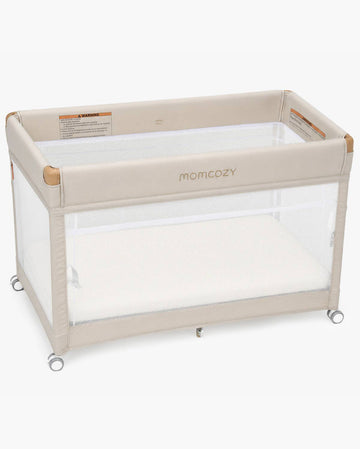
Pack and Play dimensions vary from one model to another, so the most useful fit check starts with the exact product you are considering. Open dimensions tell you how much room it needs during use, while folded dimensions help you judge closets, corners, car trunks, and other storage spaces. When comparing Momcozy portable playards, check the open footprint, folded shape, weight, and accessory dimensions against the space where you actually plan to use or store the product.

Key Takeaways
- Pack and Play dimensions vary by model, so general examples should never replace the measurements for the exact product you plan to buy.
- Open dimensions tell you how much space the playard occupies during use; folded dimensions tell you how much room it needs for storage or transport.
- Exterior frame size, interior area, mattress or pad size, sheet size, product weight, and child-use limits are different measurements.
- A playard can fit the intended room but still be too wide for a doorway, hallway turn, or route between rooms.
- Mini and compact models may reduce the exterior footprint, but usable interior space can change too.
- Changers, organizers, canopies, and other attachments may increase the largest in-use dimensions.
How Big Is a Pack and Play?
Pack and Play size is model-specific. Some playards provide a larger interior area, while others use a narrower footprint or fold into a slimmer shape for storage. This is why exact product specifications are more useful than trying to find one category-wide set of Pack and Play dimensions.
For most fit decisions, collect four pieces of information: open length × width × height, folded length × width × height, product weight, and the dimensions of any accessories you plan to keep attached. Before comparing dimensions, make sure you are looking at the same product form, since Pack and Play, playard, playpen, and travel crib are not exact synonyms.
Measure the destination first, then compare it with the exact model. That gives you a more reliable answer than using another Pack and Play as a size reference.
Which Measurement Answers Which Question?
A product page may show several different numbers for the same playard. Each one answers a different question, so choosing the right measurement prevents a mattress size or child limit from being mistaken for the overall product dimensions.
| Measurement | What It Tells You | Real Fit Question | Common Confusion |
|---|---|---|---|
| Overall open dimensions | Full exterior footprint | Will it fit in the room? | Confused with mattress size |
| Interior floor / sleep-play area | Usable space inside the frame | How much interior room is available? | Assumed to equal the exterior footprint |
| Mattress / pad size | Size of the supplied sleep-surface component | What size is the sleep surface? | Used as the overall product size |
| Fitted-sheet size | Sheet compatibility | Which fitted sheet fits? | Assumed to be universal |
| Folded dimensions | Complete stored or transport shape | Will it fit in a closet or trunk? | Only one folded dimension is checked |
| Product weight | How much the unit weighs | How manageable is it to lift or carry? | Treated as proof of compactness |
| Child height / weight limits | Product-use eligibility | Is the child still within the model limits? | Confused with frame height |
Open Dimensions vs. Folded Dimensions: Why Both Matter
Open dimensions answer the everyday room-fit question. Compare the product’s full open length and width with the exact area where you expect to use it, including the space needed to move around nearby furniture.
Folded dimensions answer a separate storage and transport question. A playard may become very slim when folded but remain relatively tall or long, so checking only the smallest folded number can be misleading. Compare all three dimensions with the exact closet, storage corner, or trunk space you plan to use.
Upright storage can also matter in homes with limited floor space. If that feature is important, check how the specific model is designed to stand and store when folded rather than assuming every foldable playard behaves the same way.
Will This Exact Playard Fit the Room?
Measure the precise area where you want the playard to stand rather than relying on broad labels such as “small bedroom” or “large nursery.” Compare the available length and width with the full open footprint, then look at how much usable space remains around it.
A bedroom fit check should also account for normal movement. Make sure you can still reach the bed, open drawers and closet doors, and move around nearby furniture without squeezing through awkward gaps. A playard can technically fit inside the room while making the layout inconvenient in everyday use.
Will It Fit Through the Doorway or Hallway?
Room fit does not automatically mean route fit. A fully assembled playard may fit comfortably once it reaches the bedroom but still be too wide for the narrowest doorway or hallway turn along the way.
Measure the clear opening, not just the nominal door size. Door angle, trim, handles, nearby furniture, and tight hallway corners can all reduce the usable passage. Compare that clearance with the widest relevant part of the assembled playard.
Wheels can make room-to-room repositioning easier, but they do not guarantee that the frame will clear every doorway. If you expect to move the playard while assembled, check the entire route before purchase instead of judging mobility from the presence of wheels alone.
Will Folding Actually Solve the Storage Problem?
A foldable playard only solves a storage problem when the complete folded shape fits somewhere useful. Terms such as compact, slim, and space-saving can describe a design, but the actual length, width, and height determine whether it fits your closet or storage corner.
A unit can fold very slim in one direction while still being too tall or too long for the intended storage spot. Compare all three folded dimensions rather than judging storage fit from the smallest number alone.
If you expect to fold the playard away every day, also consider whether the folded unit is practical to move and store in that particular room. The measurements may fit on paper, but the storage spot still needs to work with your normal access and furniture layout.
Will It Fit the Car, Hotel, Cruise Cabin, or Grandparents' House?
Destination fit starts with the place the playard needs to go. For a road trip, compare the complete folded dimensions with the trunk opening and usable cargo depth, not simply the vehicle's advertised cargo capacity. A stroller, luggage, and other baby gear can reduce the space that remains.
At a hotel, grandparents' house, or cruise cabin, switch back to the open dimensions. Check the usable floor area after beds, chairs, luggage, and other furniture are in place. A room's total square footage may sound generous while leaving very little clear space for a playard.
If frequent travel is a major part of your routine, size is only one factor to consider. Packed transport, carrying effort, and setup at the destination can also affect whether a home playard or a travel-focused format suits those trips better.
Standard vs. Mini or Compact Pack and Play: What Changes?
Words such as standard, mini, and compact do not represent fixed industry-wide dimensions. Two products described as compact can still differ substantially in open footprint, folded size, and usable interior area.
A smaller exterior footprint can help when you are trying to fit a playard beside a bed, into a compact room, or into a specific travel destination. The trade-off may be less interior space, so compare both exterior and usable interior measurements rather than focusing only on the smaller footprint.
The useful question is what the reduced size actually solves. If it clears a doorway or makes the product fit a real storage location, the smaller dimensions have clear value. If space is already sufficient, choosing the smallest possible model may offer little practical benefit.
Do Accessories Change the Final Dimensions?
Accessories can change the space a playard needs. A changing table, organizer, canopy, or other side-mounted attachment may increase width, length, height, or side overhang, so base-frame dimensions may not represent the largest configuration you will actually use.
Measure the setup you expect to keep assembled most often. If an accessory is only attached occasionally, you still need enough clearance for that configuration when it is in use. This is especially important in bedrooms, narrow spaces, or layouts where a few extra inches can block nearby furniture.
Also check whether each accessory is included or sold separately. An optional attachment should not be treated as part of the standard footprint when comparing two base products.
Does Product Height Mean the Same Thing as Baby Height or Weight Limits?
Exterior product height and child-use limits describe different things. Frame height tells you how physically tall the playard is, which matters for room fit and storage. Child height, weight, age, and developmental limits determine whether a particular mode remains appropriate for use.
For example, knowing that a playard stands 78 cm high does not tell you the maximum permitted child height or weight. Those limits should come from the instructions for the exact product and mode rather than being inferred from the frame dimensions.
Momcozy One-Click Foldable Baby Playard Size Example
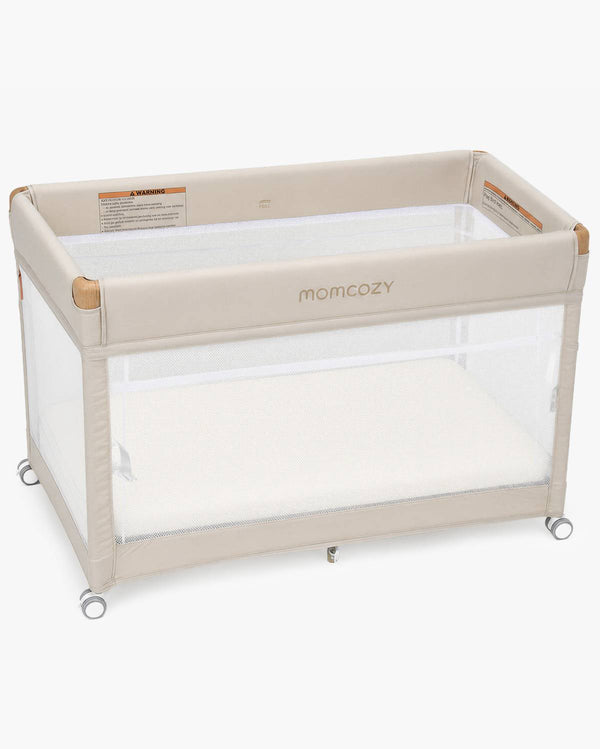
The Momcozy One-Click Foldable Baby Playard provides a useful example of how to apply the same size-and-fit method to a specific product. It measures 112 × 62 × 78 cm when open, 63.5 × 16 × 78 cm when folded, and has a net weight of 10.3 kg.

The 112 × 62 cm footprint helps you check whether it fits the intended room, while the complete 63.5 × 16 × 78 cm folded shape can be compared with a closet or car trunk. Its four swivel wheels with individual brakes support room-to-room repositioning, but the 62 cm frame width still needs to be checked against the actual doorway and route. The folded design can also stand upright for storage, which may help when the available storage area is narrow.
The optional Changing Table is sold separately and shows why accessory dimensions matter. It measures 68 × 44 × 14.5 cm, while the full playard-and-table configuration measures 113 × 68 × 85.5 cm. If you expect to keep the Changing Table attached, the larger configured dimensions are the ones to compare with your room.
Use This Size-and-Fit Checklist Before You Buy
A short measurement check can help prevent common fit problems:
- Record the exact open length, width, and height of the model.
- Separate exterior dimensions from interior area, mattress or pad size, sheet size, product weight, and child-use limits.
- Measure the actual floor space and the clearance needed to walk around the playard.
- Check the narrowest doorway, hallway turn, or furniture gap on the route.
- Compare all three folded dimensions with the exact closet, corner, or storage space.
- Measure the trunk opening and usable cargo depth if road travel is part of the routine.
- Check whether a changing table, organizer, canopy, or another accessory increases the largest in-use dimensions.
- Return to the exact model specifications instead of assuming another Pack and Play shares the same measurements.
The most reliable fit check puts your real destination measurements on one side and the exact product dimensions on the other.
FAQs About Pack and Play Dimensions
Are All Pack and Plays the Same Size?
No. Open footprint, height, folded dimensions, interior area, and weight can vary substantially by model. General examples are useful for early planning, but the final fit decision should use the exact measurements for the product you are considering.
What Is the Difference Between Overall Pack and Play Dimensions and Mattress Size?
Overall dimensions describe the exterior frame and footprint. Mattress or pad dimensions describe the sleep-surface component inside the playard. A pad measurement cannot tell you whether the complete product will fit beside your bed or through a doorway.
Do Mini Pack and Plays Use Different Sheet Sizes?
They can. A smaller exterior frame does not guarantee a particular mattress or fitted-sheet size, and “mini” is not a fixed dimension class. Check the sleep-surface measurements and sheet compatibility for the exact product.
Can a Pack and Play Fit Beside a Queen- or King-Size Bed?
The bed size alone cannot answer that question because the remaining floor area varies from one bedroom to another. Measure the exact bedside space, including walking clearance and access to nearby furniture, and compare it with the playard's open footprint.
Does Product Weight Include the Mattress or Carry Bag?
That depends on how the manufacturer defines the listed weight. Check the specifications for the exact product to see which components are included rather than assuming every brand calculates product weight the same way.
Can a Pack and Play Be Stored Standing Upright?
Some foldable models are designed for upright storage, including the Momcozy One-Click Foldable Baby Playard. For other products, check the exact instructions and make sure the folded unit remains stable in the storage location you plan to use.
Do Wheels Count Toward the Listed Width?
Specification methods can vary by product. When doorway clearance is tight, check the widest assembled point rather than assuming a listed frame width automatically includes every wheel or projecting component.
Where Can I Find Exact Dimensions for an Older Pack and Play Model?
Start with the manufacturer's product archive or manual using the exact model number. Retail listings can help identify a product, but dimensions from a similarly named or newer version should not be used as a substitute.
Conclusion: Measure the Destination, Then the Product
Pack and Play size depends on the exact model, so match the measurement to the fit question you actually need to answer. Check the open footprint for room and doorway use, the complete folded shape for storage and transport, and the largest configuration if you plan to keep accessories attached.
Measure the destination first and compare the exact product second. Words such as “compact” and “portable” can help describe a product, but dimensions show whether it fits. The same approach makes comparing Momcozy portable playards much more useful because you can judge each model against the room, route, storage space, or destination where you plan to use it.








