


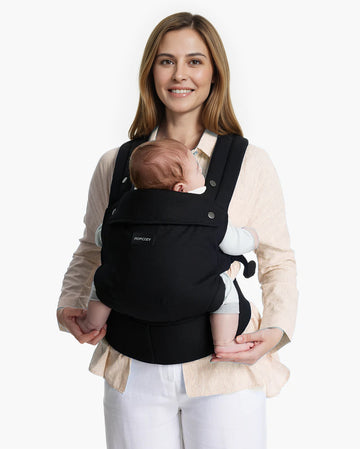
A baby carrier can feel completely different a few months after it first seemed to fit well. Dad may put on the same carrier, use what looks like the same settings, and immediately notice that the baby feels heavier. The baby may appear a little lower, the carrier may feel looser, or the straps may seem to require more adjustment than before.
That does not automatically mean Dad needs a different carrier.
When a baby grows, the relationship between the baby, the carrier, and the wearer changes. A setting that worked when the baby was smaller may no longer match the baby's current height, proportions, or the way the carrier supports the baby's body.
This is where baby carrier fit for dads becomes a question of comparison rather than starting from scratch. Instead of asking, "Which carrier should Dad buy now?" start with a more useful question and dig deeper on Momcozy Dad Baby Carrier Guide
Key Takeaways
- A baby feeling heavier does not automatically mean Dad needs a new carrier.
- Start by comparing today's setup with the last fit that worked reliably.
- Re-check baby height, seat or panel sizing, and the carrier's current instructions before making major wearer-side adjustments.
- After any baby-side reset, check whether Dad's waistband and shoulder settings still hold their previous position.
- Look for changes in centering or visible compensation rather than trying to correct posture.
- Test the updated fit for about 10–15 minutes before committing to a longer walk.
- If the fit cannot be restored, remains unstable, or cannot be reproduced consistently, treat that as a signal to investigate the appropriate next setup, carrier type, or support resource.

Why Can the Same Carrier Feel Different as Baby Grows?
The carrier has not necessarily changed just because the experience has.Baby has.
That distinction matters. Dad may have used the same carrier successfully for weeks or months, but the baby is no longer the same size as when that fit was established. Growth can change the way the baby's body occupies the carrier and how the combined load sits against Dad.
The carrier may therefore feel heavier even though Dad has not changed the straps significantly. There are several reasons this can happen.
If the question is whether to move from one carrier format to another, use when to switch from a wrap to a structured carrier — Momcozy guide.
Growth Changes Fit Before It Changes the Carrier
A posted product limit is only one part of the fit question. A carrier can remain within its stated limits while the baby's current proportions require a different approved setting.
For example, the baby's height may have changed enough that the previous panel or seat setting no longer looks the same. Leg positioning may look different. The amount of carrier fabric supporting the baby may have changed. The baby's center of mass may also feel different relative to Dad's body.
That means weight alone should not be the trigger for every adjustment.
Instead, compare the current setup with the previous successful one.
Ask:
- Where did the baby's head and upper body sit at the last good fit?
- What did the seat or panel setting look like?
- Where did the waistband sit?
- How did the shoulder straps feel?
- Did Dad have to compensate or repeatedly adjust anything?
- Did the setup remain stable while walking?
These questions create a useful before-and-after comparison.
Longer Duration Exposes Small Changes
A fit that seems acceptable while Dad is standing still may behave differently after several minutes of walking.
Normal movement can make small changes easier to notice. A waistband that gradually moves, shoulder straps that migrate, or a baby who settles into a lower position may not be obvious during a quick mirror check.
That is why the goal is not to decide whether a carrier feels perfect at minute zero. The goal is to determine whether the updated fit remains approved and stable during ordinary movement. Once that distinction is clear, move through the seven checks in order.
Fit Check #1: Is Baby Still High and Close to Dad?
The first comparison is the baby's overall position. If the baby used to sit in a stable, close position and now appears noticeably lower or farther away, do not immediately compensate by pulling every strap tighter.
First, re-seat the baby according to the carrier's current instructions. Then compare the result with Dad's last good fit.
Look for straightforward visual differences:
- Is the baby sitting at the same general height?
- Does the baby appear closer to Dad than before?
- Is the baby leaning differently?
- Has the carrier's panel position changed relative to the baby's body?
- Does the setup still follow the manufacturer's approved positioning guidance?
The purpose of this check is not to create a universal rule that every baby must sit at exactly one height. Different carriers have different designs and instructions.
Instead, use the carrier's approved fit as the standard and Dad's previous successful setup as the comparison point.
Re-seat Before Tightening
A common temptation is to interpret a lower-feeling baby as a shoulder-strap problem. That can put the adjustment process in the wrong order.
If the baby's position changes after growth, investigate the baby-side fit before making large adult-side corrections.
A useful question is:
"Did the baby's position change first, or did Dad's straps change first?"
If the baby's position changes after growth, re-seat and reassess first.
If a low position persists despite an approved setup and appears closely related to Dad's torso or body proportions, that becomes a different fit question and should be handled by the appropriate tall- or body-proportion-specific guidance rather than rebuilt here.
Fit Check #2: Has Baby's Sizing Setting Changed Since Dad's Last Good Fit?
This is the most important growth-specific check.
Dad may remember the carrier working well and therefore assume that the previous setting should continue to work.
But the old setting was matched to the baby at an earlier point in development.
The better question is:
Has the baby's current size changed enough that the carrier's baby-side setting needs to be rechecked?
Start with the last good fit.
Remember what the carrier looked like when it worked reliably. Then compare that setup with the baby's current size.
Look at the areas that the specific carrier identifies as adjustable.
Depending on the model, this may involve the seat, panel, width, height, or other baby-facing adjustment points. Do not assume that the adjustment sequence is universal across carriers.
If the question is developmental positioning, use baby carrier positions by age — Momcozy

What Changed Since the Last Good Fit?
|
Last good fit |
Current fit |
|
Baby's previous size |
Baby's current size |
|
Previous seat/panel setting |
Current seat/panel setting |
|
Previous leg support |
Current leg support |
|
Previous panel coverage |
Current panel coverage |
|
Stable position |
Any visible change after growth |
The purpose is not to make "bigger" equal "wider" or "looser."
More adjustment is not automatically better.
A setting that is too small can fail to match the baby's current size, but a setting that is too large can also create an unsuitable fit. The correct setting depends on the carrier's current instructions and the baby's actual size and developmental stage.
Verify the Current Manual
This is especially important when Dad is using a carrier that has adjustable baby-side settings.
Do not rely solely on memory from the previous wear.
Check the current manual or manufacturer instructions for:
- approved baby age or developmental stage;
- approved weight range;
- available adjustment positions;
- correct adjustment sequence;
- positioning requirements;
- current safety or use warnings.
This article helps Dad recognize that a baby-side setting may need to be revisited. It is not a replacement for the model-specific manual.
If Dad cannot identify the correct setting from the current instructions, verify that information before continuing.
Why This Check Comes Before Dad's Straps
It is tempting to solve a heavier-feeling baby by tightening the shoulder straps.
But if the baby-side setting is no longer appropriate, tightening the adult-side straps may only mask the original change.
Think of the process as resetting the system from the baby outward:
Baby growth → baby-side fit → waistband → shoulder balance → movement test.
That order keeps the troubleshooting connected to the event that started it.
Fit Check #3: After the Baby-Side Reset, Does Dad's Waistband Still Hold Its Position?
Once the baby-side setting has been verified and corrected if necessary, look at Dad's waistband.
Do not completely rebuild waistband fitting from scratch. Instead, compare today's position with the position Dad used during the last reliable fit.
The question is simple:
Does the waistband still hold the position it held before the baby grew?
Check it while standing and again after normal movement.
Dad can compare:
- where the waistband sits;
- whether it remains level;
- whether it shifts as he walks;
- whether he has to repeatedly tighten it;
- whether the baby's updated position changes how the waistband behaves.
A change here does not automatically mean the carrier is wrong.
It may simply mean the baby's updated position has changed the load relationship.
Do Not Solve Every Change by Tightening More
More tension is not always the answer.
If Dad keeps tightening the waistband because the carrier feels different, he may end up compensating for an unresolved baby-side adjustment.
Instead, identify what changed.
If the waistband was stable at the last good fit and now repeatedly moves after the baby-side reset, make only the adjustment allowed by the carrier's instructions and reassess.
If the issue is primarily related to Dad's torso, body shape, or another persistent wearer-specific fit problem, that belongs to a different troubleshooting path.
The goal here is narrower:
Does the waistband still hold the updated growth-related fit?
If yes, move on.
If not, correct the approved wearer-side adjustment and continue testing.
Fit Check #4: After the Growth Reset, Do Dad's Shoulder Straps Need Rebalancing?
Shoulder straps come after the baby-side setting and waistband check.
That order matters because shoulder straps should not be used to compensate for every other problem.
Suppose Dad's previous setup worked well, then the baby grew, and the baby-side setting needed to change. Once Dad makes that adjustment, the shoulder straps may no longer feel exactly as they did before.
That does not automatically mean they need to be tightened substantially.
Instead, compare them with the last good fit.
Check for Obvious Imbalance
Dad can ask:
- Does one shoulder strap feel noticeably different from the other?
- Has one strap migrated?
- Is there obvious slack that was not present before?
- Does the strap path still match the carrier's instructions?
- Does the setting remain stable after several minutes of walking?
Make only the necessary adjustments.
The goal is to restore the balanced setup that supports the updated baby-side fit—not to create maximum tension.
Avoid Using the Shoulder Straps as a Universal Fix
If the baby is too low because the baby-side setting is wrong, shoulder tightening does not necessarily solve the underlying problem.
If the waistband is moving because the wearer-side setup has changed, repeatedly tightening the shoulders may simply shift the problem upward.
This is why the seven-check process is sequential:
Baby position first.
Baby-side setting second.
Waistband third.
Shoulders fourth.
Once the shoulders are rebalanced, Dad can move to the next question: whether the baby remains centered without compensation.
Fit Check #5: After the Reset, Is Baby Still Centered on Dad Without Compensation?
Now step back and observe the whole setup.
Dad does not need to perform a posture assessment. This is simply a visual comparison between the current fit and the last good fit.
Ask:
Does Dad look and feel as though he is compensating for something that was not present before?
Possible signals include:
- visible leaning;
- baby shifting noticeably to one side;
- one side of the carrier appearing more loaded;
- Dad repeatedly adjusting the carrier while walking;
- Dad changed his body position to compensate for the carrier's movement.
A mirror can help. So can a partner's observation or a short video, provided Dad is using it simply to compare the current setup with the previous one. Do not turn this into posture coaching. If Dad notices a new asymmetry, return to the earlier checks.
Is the baby correctly positioned?
Is the baby-side setting correct?
Is the waistband stable?
Are the shoulder straps balanced?
If one of those answers is uncertain, solve that issue before trying to correct Dad's stance. A centered load can be a useful fit signal, but it is not a promise of zero fatigue or a medical treatment.
Fit Check #6: Do Dad's Updated Settings Still Hold After 10–15 Minutes?
This is the point where the longer walk becomes useful. Do not make the first test a 60-minute outing. After completing the growth-related reset, take a short walk for approximately 10–15 minutes.
The goal is not to prove that Dad can carry the baby comfortably for a particular number of hours. The goal is to find out whether the new settings stay in place during normal movement.
Minute 0: Record the Baseline
Before walking, make a quick mental or visual note of:
- baby's position;
- baby-side setting;
- waistband position;
- shoulder strap position;
- overall centering.
This is the starting point.
After 10–15 Minutes: Compare
Stop and ask the same questions again.
Has the baby moved significantly?
Has the waistband shifted?
Have the straps migrated?
Does Dad now need to compensate?
Is anything requiring repeated adjustment?
|
Check |
Minute 0 |
After 10–15 minutes |
|
Baby position |
Stable |
Still stable? |
|
Baby-side setting |
Verified |
Still holding? |
|
Waistband |
Stable |
Still positioned? |
|
Shoulder straps |
Balanced |
Still balanced? |
|
Centering |
No obvious compensation |
Still centered? |
A short test cannot guarantee that every longer outing will feel the same. What it can do is expose obvious fit drift before Dad commits to a much longer walk. If the updated setup remains stable, Dad can continue according to the carrier's instructions and baby's cues.
If the setup drifts, reset it once and determine which earlier check changed. If baby positioning becomes unsafe or Dad develops significant pain or other concerning symptoms, stop rather than trying to force the carrier to work.
Fit Check #7: Can Dad Reproduce the Updated Fit on the Next Wear?
A fit that works once but cannot be repeated is still a practical problem.
After the baby grows, Dad may discover that he can achieve a good setup with considerable trial and error—but then struggles to recreate it the next morning.
That is why repeatability is the final check.
Try the Setup Again
On the next wear, start from the beginning rather than chasing individual straps.
Check:
- Baby-side settings.
- Baby's position.
- Waistband.
- Shoulder straps.
- Centering.
- Short movement test.
Then compare the result with the previous successful wear.
If Dad can consistently reproduce the same stable setup, the growth reset has become part of the new routine.
If the result changes dramatically from one wear to the next, investigate what variable is changing.
It might be:
- clothing layers;
- who put the carrier on;
- baby positioning;
- adjustment sequence;
- carrier's baby-side settings;
- wearer-side setup.
Repeatability is not proof that one carrier is objectively better than another.
It is simply a practical measure of whether Dad has successfully moved from the old fit to a new fit that can actually be used in everyday life.
When the Updated Fit Still Doesn't Hold
Sometimes the seven checks reveal that the original carrier can no longer provide the same workable setup.
That does not mean Dad made a mistake.
It means the troubleshooting process found a meaningful change.

Keep the Current Carrier
The current carrier may still be appropriate if:
- baby's current size is within the manufacturer's approved parameters;
- correct baby-side setting can be verified;
- Dad can establish an approved position;
- waistband remains stable;
- shoulder straps remain appropriately balanced;
- baby stays centered;
- setup holds during normal movement;
- Dad can reproduce the fit on another wear.
In that situation, there may be no reason to replace the carrier simply because baby has become heavier.
The appropriate result may simply be a new setting that matches the baby's current size.
Consider a Different Setup
A different setup may need to be investigated if:
- baby no longer fits the carrier's approved parameters;
- an approved fit cannot be restored;
- current setup repeatedly loses stability;
- carrier no longer matches the intended carrying task;
- a different carrier format is now being considered;
- persistent pain or another health concern has become the main issue.
If the main concern has become back support or persistent discomfort, use the baby carrier fit and back-support guide — Momcozy Guide
And if Dad is now comparing current carrier options, he can compare baby carriers for the current stage and routine — Momcozy Baby Carrier Collection
The key is to let the failed fit check determine the next decision rather than turning every growth-related problem into a product recommendation.
Example: Applying the Same Last-Good-Fit Recheck to an Adjustable Structured Carrier
The same seven-check process can be applied when Dad is evaluating an adjustable structured carrier after identifying that his current setup no longer works.
For example, PureHug ergonomic baby carrier — Momcozy is presented as an adjustable structured carrier.

The current product information describes three adjustable sizes, padded adjustable shoulder and waist straps, an EVA lumbar-support component, and an X-shaped/cross-back design.
Those features are relevant to the same fit conversation, but they should not replace the fit checklist.
Dad would still need to ask:
- Does the carrier suit the baby's current developmental stage?
- Does the current baby-side setting match the manufacturer's instructions?
- Does the baby sit in the approved position?
- Does the waistband remain stable?
- Are the shoulder straps appropriately balanced?
- Does the setup stay stable during movement?
- Can Dad reproduce the fit later?
Product adjustability can support the process, but it does not remove the need to verify the fit.
Frequently Asked Questions
Does Dad need a different baby carrier just because the baby is getting heavier?
Not automatically.
First compare today's setup with Dad's last good fit. Recheck the baby's current position, baby-side settings, waistband, shoulder straps, and stability during movement.
A different carrier becomes a separate decision if Dad cannot restore an approved, stable, repeatable fit or if the carrier no longer matches the baby's current size or the carrying task.
Can a baby be too heavy for a carrier even if the baby is under the stated weight limit?
Yes.
A posted weight limit is an important guardrail, but it does not by itself prove that the current fit is correct.
Baby proportions, developmental stage, carrier settings, wearer fit, and intended task can all matter.
Being below a stated maximum does not eliminate the need to check the actual fit.
How often should Dad compare the baby-side settings with the last good fit?
There is no need to compare settings on an arbitrary daily schedule if the fit remains stable.
A comparison becomes particularly useful after noticeable growth or when today's setup no longer resembles the previous stable fit.
When the baby grows, use the current manufacturer instructions to verify whether a setting needs to change rather than simply returning to the old setting from memory.
Is a 30–60 minute walk too long for Dad to use a baby carrier?
There is no single duration that works as a universal rule for every baby, carrier, Dad, or situation.
Before a longer walk, a short movement test can help identify obvious fit drift.
Baby's developmental stage, approved carrier setup, temperature, baby's cues, Dad's comfort, and manufacturer's instructions all matter.
The purpose of the 10–15 minute check is not to declare a specific maximum carrying duration. It is to verify that the updated growth-related fit is holding.
Should Dad tighten the shoulder straps more as the baby gets heavier?
Not automatically.
First check whether the baby is positioned correctly and whether the baby-side setting still matches the baby's current size.
Then check the waistband.
Only after those checks should Dad determine whether the shoulder straps need rebalancing.
Tightening the shoulder straps first can compensate for the wrong problem rather than correcting the change caused by baby growth.
What if the baby still sits low on Dad after the growth reset?
Return to the first checks.
Confirm the baby-side setting and the carrier's approved positioning guidance. Then check whether the waistband and shoulder settings are behaving as expected.
If the low position persists and appears to be primarily related to Dad's torso or body proportions, that is a different fit question and should be routed to the appropriate tall- or body-proportion-specific guide rather than repeatedly tightening the carrier.
When should Dad stop using the current carrier?
Stop and verify the manufacturer's instructions when Dad cannot establish an approved fit.
The same applies when the baby no longer meets the carrier's requirements or when the setup repeatedly becomes unstable.
If significant pain, concerning symptoms, or an airway or positioning concern occurs, do not continue simply to complete the walk.
The purpose of a fit check is to determine whether the setup works—not to prove that it must work.
Conclusion
When a baby gets bigger, Dad may notice that a carrier that once felt easy suddenly feels heavier, lower, or less stable. The first response does not have to be buying something new. Start with the last good fit.
Compare the baby's current position and baby-side settings with the setup that worked before the growth change. Then check whether Dad's waistband and shoulder straps still hold the updated fit. Look for centering without compensation, take the new setup through a short 10–15 minute movement test, and finally see whether Dad can reproduce the same result on another wear.
For dads who are now comparing an adjustable structured option, the PureHug ergonomic baby carrier is one Momcozy example to investigate. Most importantly, baby carrier fit for dads should be treated as something that changes with the baby, not as a one-time adjustment made on the day the carrier is purchased.








