


MEDICALLY REVIEWED BY

Zola Zhang, MD, IBCLC, Breast Surgeon, Mother
Breast Surgeon | International Board Certified Lactation Consultant | Mother
As a dedicated Breast Surgeon and International Board Certified Lactation Consultant (IBCLC) with 21 years of clinical experience, my work is rooted in both medical expertise and the lived reality of motherhood—because I’m not just a clinician, but also a mother who exclusively breastfed my own child for two years. This dual perspective shapes every interaction, allowing me to blend scientific rigor with deep empathy for the joys and challenges of breastfeeding.
Empty your newborn diaper pail when it reaches the limit identified by its manufacturer—or sooner if the bag is tight, disposal is no longer smooth, odor is difficult to manage, or you notice a leak. Diaper size, bag type, pail design, and the contents of each bag all affect the right timing.
The simplest approach is to use two thresholds:
- Your pail’s stated full point—a fill line, viewing window, indicator, or instruction in the manual.
- Your earlier practical threshold—the point at which the pail is becoming difficult, messy, or unpleasant to use.
Find Your Pail’s Real Full Point
Not every diaper pail has a printed fill line or a visible full indicator. Check your model’s manual first, then look inside the pail, around the inner rim, in the bag compartment, or at any viewing window.
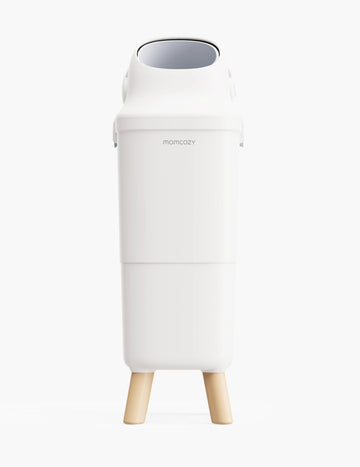
A manufacturer’s capacity is a ceiling, not a schedule. For example, the Momcozy Triple-Seal Diaper Pail is listed with a 22 L capacity and compatibility with standard 13-gallon trash bags. It is also listed as holding up to 60 newborn diapers, compared with up to 24 large diapers—an illustration of how diaper size can change the usable number of diapers in the same pail. 
“Up to” matters. A bag may reach its practical limit earlier depending on how diapers settle, how bulky they are, and what else is in the bag.
A Quick Way to Set Your Limit
Use this short check when setting up a new pail:
- Find the manual’s instructions for bag removal and maximum fill level.
- Look for a fill line, window, indicator, or other model-specific cue.
- Note whether the pail needs a particular liner style or bag size.
- Decide on an earlier personal threshold: empty when the bag is still easy to lift, tie, and remove without forcing it.
That earlier threshold is often more useful in daily life than waiting until every bit of visible space is filled.
Empty Now When Function or Hygiene Changes
A pail does not need to look completely full before it is time to empty it. Treat the following as “empty now” signals, even when the bag is below a marked limit.
Full or Nearly Full Signals
- The bag has reached the manufacturer’s fill line, window cue, or stated removal point.
- The opening is crowded enough that adding another diaper takes effort.
- The lid, flap, or disposal mechanism no longer closes or moves smoothly.
- The bag feels tightly packed or difficult to remove without pulling or forcing it.

Liner and Mess Signals
- The liner is stretched, torn, damaged, or showing signs of leakage.
- You can see contamination on the pail exterior, nearby floor, or changing area.
- Odor remains difficult to manage during normal use.
- The pail has become unpleasant enough that you are delaying diaper disposal or avoiding opening it.
These are practical reasons to change the bag early—not evidence that you have failed to use the pail correctly. A little unused space is usually preferable to a bag that is hard to handle.
If Your Pail Jams Before It Looks Full
A jam does not always mean the whole pail is full. The Momcozy Triple-Seal Diaper Pail’s rotating observation ball, for example, may jam during closure even while interior space remains. Its instructions say that gently shaking the pail can redistribute the diapers in that specific situation. 
That troubleshooting step is model-specific. For another pail, follow its own manual rather than forcing the lid, flap, or bag mechanism.
Why One Bag May Fill Faster Than Another
The right emptying interval can change from one bag to the next. Instead of aiming for a set number of days, notice what changed.
Factor |
What It Can Change |
Practical Response |
Larger diapers |
Fewer diapers may fit in the same space |
Check the bag sooner as your baby grows |
Bulky or heavily soiled diapers |
The bag may become difficult to manage earlier |
Empty earlier if removal, odor, or cleanliness becomes a concern |
Damaged liner |
A torn or punctured bag can leak |
Replace the bag promptly |
Different bag style |
A pail feature may not work with every compatible bag |
Follow your model’s liner instructions |
A pail with an indicator or window |
You have a model-specific visual cue |
Use that cue instead of a calendar rule |
For the Momcozy Triple-Seal Diaper Pail, standard 13-gallon bags can be used, but its bag-closure feature requires drawstring garbage bags. Its instructions also specify using bags that are free of cracks or holes. Those details apply to that pail, not to every diaper-pail system.
What About Poop Diapers?
Do not assume every stool diaper must be taken outside immediately. Follow your pail manual and local disposal requirements.
For disposable diapers, used wipes can be placed inside the dirty diaper before disposal in a plastic-lined, lidded receptacle. If you use cloth diapers, guidance differs: poop should be discarded in the toilet before the diaper goes into a trash can or cloth diaper pail.
For the Momcozy Triple-Seal Diaper Pail specifically, its instructions advise wrapping heavily soiled diapers in tissue or a paper bag before disposal to help prevent leaks and contamination. 
Make Bag Changes a Short Nursery Reset
Emptying the pail can be a quick reset rather than a major cleaning task. Keep it simple:
- Remove and secure the bag according to your pail’s instructions.
- Check the liner area for tears, drips, or visible mess before inserting a new bag.
- Keep dirty diapers and clothing away from surfaces that cannot be easily cleaned.
- Clean any visible spill or leak on the changing surface or nearby area before resuming diaper changes.
- Complete your usual hand-hygiene routine and make sure the new bag is seated correctly.
You do not need a universal weekly pail-emptying rule. Locate your pail’s fill indicator or manual today, watch for the early-emptying signals that matter in your home, and make bag changes part of a small newborn-care reset.









