


MEDICALLY REVIEWED BY

Una Qian, Registered Nurse, IBCLC
I am a Registered Nurse and International Board Certified Lactation Consultant (IBCLC) based in Beijing, China. With 16 years of experience in obstetrics and gynecology, I currently provide clinical breastfeeding support. Over the past few years, I have obtained the Level II Certification in the French WAFF Perinatal Rehabilitation Method and the BFE Level I Certification in Pelvic Floor Rehabilitation (European Level I), which qualifies me to guide both prenatal and postpartum mothers in appropriate exercise programs and provide evidence-based postpartum rehabilitation.
Sometimes, yes, but only if the swing is the right model, has no recalls, and is still complete and sturdy. Even then, it should be used for supervised awake time only, not sleep.
If you are standing in the nursery wondering whether a hand-me-down swing is a smart save or a quiet risk, that hesitation makes sense. A swing can look perfectly fine and still have a missing strap, an outdated design, or a recall history that changes everything. Here is the practical way I would sort it out before using one at home.
What “Current Standards” Really Mean
The current federal framework for infant and cradle swings is not just about how the seat looks. A government agency regulates these products under infant swing guidance, and the rules now point to a current safety standard for products manufactured after September 14, 2024.

That matters because “meets current standards” is only the starting point. Standards help with design and warnings, but they do not tell you whether a used swing has worn straps, a cracked frame, a wobbly base, or parts that went missing over time.
Why standards are not the whole story
Baby gear changes because safety information changes. A pediatric organization has noted that swing rules followed hundreds of reported incidents over a few years, including deaths and injuries, which is a reminder that older gear may not line up with what we know now. A recent government agency warning about infant swings also shows why you cannot judge a swing by appearance alone.
So yes, a secondhand swing can be fine if it truly meets current standards. But it still needs to pass a hands-on inspection, and it still needs to be used the right way once it gets home.
How to Check a Secondhand Swing Before You Use It
The first thing I would do is find the exact model number and manufacture date. Then I would check the government recall page, where portable baby swings are listed as their own category, because that is where you will catch safety problems that are not obvious from a quick glance.

If the seller cannot give you the model number, original manual, or a clear photo of the label, that is already a warning sign. You want to know exactly what you are looking at before your baby ever sits in it.
What I would inspect in person
- The harness buckles cleanly and feels secure.
- All straps are present, not stretched out, and not frayed.
- The frame sits flat and does not wobble on a hard floor.
- The seat moves smoothly without grinding, jerking, or sticking.
- The recline mechanism locks properly and does not slip.
- The fabric is clean, dry, and free of mildew, tears, or hard stains.
- The power cord, adapter, batteries, and remote are intact if the swing uses them.
- The labels are still readable, including weight limits and warning labels.
If the swing has a remote or uses button-cell batteries, I would be extra careful about the warnings and covers around the battery compartment. Missing labels or loose battery access are not small details when the product is going to be near a baby.
Red Flags That Make Me Skip It
Some flaws are not worth talking yourself around. If the swing has any recall history, missing restraint parts, a bent frame, or a seat that does not hold its shape, I would pass. If you can see rust, cracks, broken plastic, or a base that does not feel stable on the floor, that is enough reason to stop.
A few things that matter more than people think
One of the biggest red flags is a swing that was designed or marketed for sleep. A government agency has warned parents to stop using certain infant swings with an incline greater than 10 degrees because that kind of setup can create a suffocation hazard. If a swing looks deeply reclined or seems intended as a sleep spot, I would not treat it like safe overnight gear.

I also get cautious when the seller does not know how old the swing is or whether any parts were replaced. With baby gear, uncertainty usually means the safest answer is no. If you cannot verify the model, the manual, and the condition of the parts that actually keep your baby secure, it is not worth guessing.
How to Use It Safely if It Passes the Check
If the swing clears the recall search and the physical inspection, then you still need to use it with some discipline. The safest swings are for awake, supervised time only. A pediatric organization’s safe sleep tips are very clear about moving a sleeping baby to a firm sleep surface as soon as possible.
That means no swing naps, even short ones that seem harmless. If your baby dozes off while you are making a bottle or folding laundry, transfer them to a flat crib or bassinet right away.
The habits that help most
- Use the most reclined position for very young babies, especially under about 4 months.
- Fasten the harness snugly every single time.
- Put the swing on a flat floor, not on a bed, couch, or rug pile that makes it unstable.
- Keep sessions short and purposeful instead of letting the swing become a parking spot.
- Stop using the swing once your baby can sit up unassisted, roll over, or try to climb out, even if the weight limit has not been reached.

A lot of parents like swings because they can buy you a few hands-free minutes. That is fine. What you do not want is a seat that becomes the default place for naps, long stretches, or unsupervised time.
Practical Next Steps
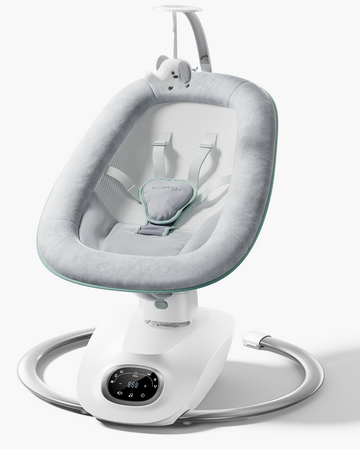
If you are deciding about a secondhand baby swing today, I would use a simple three-part test: can you verify the exact model, can you confirm it is not recalled, and does it pass a close inspection for wear and missing parts? If the answer to any of those is no, the swing is not a good hand-me-down, and it may be more practical to compare the cost against a current new swing such as the Momcozy electric baby swing instead of repairing parts or guessing about a used swing’s condition.
If it passes those checks, then treat it like a helper for awake, supervised time only. The moment it stops feeling stable, complete, or easy to verify, I would walk away and keep your baby on safer ground.








