


MEDICALLY REVIEWED BY

Zola Zhang, MD, IBCLC, Breast Surgeon, Mother
Breast Surgeon | International Board Certified Lactation Consultant | Mother
As a dedicated Breast Surgeon and International Board Certified Lactation Consultant (IBCLC) with 21 years of clinical experience, my work is rooted in both medical expertise and the lived reality of motherhood—because I’m not just a clinician, but also a mother who exclusively breastfed my own child for two years. This dual perspective shapes every interaction, allowing me to blend scientific rigor with deep empathy for the joys and challenges of breastfeeding.
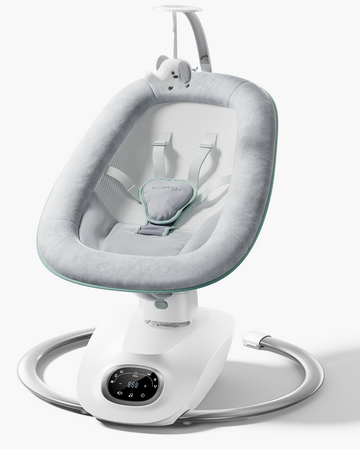
Use your swing’s model-specific manual as the controlling instruction. Disconnect power or remove batteries before cleaning, remove only parts the manufacturer says are removable, and use the approved cleaning method for each material. Keep liquid away from electronics and do not put the swing back into service until residue and odor are gone, every cleaned area is completely dry, and the harness, buckles, labels, and swing function have been checked.
Dried formula can cling in seams because formula contains proteins, fats, and minerals. The goal is not to flood those narrow spaces in an attempt to dissolve it; it is to reach and lift the residue without soaking padding, restraint parts, or the swing’s mechanical and electrical areas.

Start With Safe Access
Before cleaning, locate the product label and find the official manual and care instructions for that exact swing model. Cleaning directions can differ between swings, including which covers are removable, whether a cover may be washed, and which settings or products are permitted.
- Disconnect power first. Unplug an electrically powered swing or remove batteries before cleaning. Follow the manual’s instructions for safe battery removal if needed.
- Identify the affected part. Is the formula on a removable seat cover, a fixed padded section, harness webbing, a buckle opening, the plastic frame, or near controls and wiring?
- Remove only approved components. A seat pad or cover may be designed to come off, but that does not mean the harness, buckle, foam, frame, or motorized parts should be removed.
- Take photos of permitted removal steps. Photos can help you remember how an approved cover or pad was fitted, but follow the manual—not your photos—when reassembling the swing.
- Leave housings and wiring alone. Do not open motor housings, battery compartments, controls, adapters, or wiring channels to chase residue unless the manufacturer specifically instructs you to do so.
If the formula is hidden beneath non-removable padding or inside a seam you cannot reach without dismantling the swing beyond the manual’s instructions, pause there. Manufacturer support is the safer next step.
Match the Cleaning Method to the Component
A removable cover is not automatically machine washable, and instructions for a cover do not automatically apply to straps, buckles, foam, labels, or fixed upholstery.
Area |
Safer approach |
Removable cover or pad |
Wash only if the care tag or manual permits it. Follow the stated machine-wash or hand-wash instructions and use mild detergent where directed. |
Fixed upholstery or non-removable padding |
Clean in place only with the low-moisture method the manufacturer allows. Avoid saturating seams or padding. |
Plastic or metal frame away from electronics |
If your manual permits, wipe with mild liquid soap on a non-abrasive cloth, then dry with a clean cloth. |
Harness webbing and buckles |
Follow the model-specific instructions. Do not assume that a cover’s laundering instructions apply to restraint parts. |
Controls, motor housing, battery area, power cord, or wiring |
Keep liquids out. Do not spray, soak, steam-clean, or wipe into openings. Seek manufacturer guidance if formula may have entered them. |
Avoid harsh chemicals unless the manual explicitly identifies a compatible product. Bleach, alcohol, solvents, abrasive cleaners, stain treatments, and disinfecting wipes may not be suitable for the swing’s fabric, printed labels, foam, finishes, or restraint system.
Work Dried Formula Out of Seams and Crevices
For accessible residue on a wipe-clean component, work slowly and use as little moisture as possible.

A controlled cleaning sequence
- Expose the seam or gap. Open folds in the seat cover or gently move the fabric aside only as far as the design allows. Do not pull hard on seams, straps, or labels.
- Lift loose residue first. If the manual permits it, a vacuum with a curtain or brush attachment may help remove loose dust or crumbs from a non-detachable cover. It is not a reliable way to remove formula embedded in padding or deep inside a seam.
- Apply cleaner to the tool, not the swing. For an accessible plastic seam or frame section away from electronics, put the manufacturer-approved cleaner or mild soap solution on a non-abrasive cloth rather than pouring or spraying it directly onto the swing.
- Clean in small passes. Use the dampened portion of the cloth to lift residue from the surface, changing to a clean area as formula transfers.
- Dry immediately. Follow with a clean, dry cloth on wipe-clean frame areas. Check nearby seams and folds so moisture is not left sitting in them.
Steam is a poor choice around a powered swing: available swing-cleaning guidance does not establish steam-cleaner safety for motors, cords, controls, or other electronic components.
Harnesses, Buckles, and Hidden Padding Need Extra Caution
Formula in a buckle opening or along harness webbing deserves close attention because these are safety components. Clean only as the manufacturer directs, and do not soak the buckle or straps unless the manual expressly allows it.

After cleaning, inspect the restraint system for:
- remaining sticky residue in or around the buckle;
- webbing that looks frayed, damaged, stiff, or altered;
- seams that have pulled apart;
- labels that are loose, unreadable, or damaged; and
- a buckle that does not operate normally.
If formula remains trapped under fixed foam or inaccessible padding, do not try to compensate by adding more liquid, steam, or stronger chemicals. The swing should stay out of service until the manufacturer can advise whether the part can be cleaned, replaced, or otherwise addressed.
Is Disinfection Necessary?
Cleaning and sanitizing are separate steps for infant feeding items; sanitizing is an additional germ-removal measure. However, that guidance does not create a disinfecting procedure for baby swings. See the CDC’s explanation of cleaning and sanitizing infant feeding items.
For a formula spill on a swing, do not assume that bleach or another disinfectant is required—or compatible. First remove the formula completely using the model-approved method. If your swing’s manual does not specify a compatible disinfecting product and you believe additional treatment is needed, ask the manufacturer rather than applying a product intended for bottles, countertops, or other surfaces.
Keep the Swing Out of Service When Cleaning Cannot Be Confirmed
Do not use the swing until you have manufacturer guidance, an approved replacement part, repair, or replacement if any of the following apply:
- You see mold or cannot remove a persistent odor after cleaning and complete drying.
- Formula remains under non-removable padding, deep inside an unreachable seam, or within a mechanism.
- The harness, buckle, webbing, stitching, safety labels, foam, or seat structure is damaged or no longer functions normally.
- Formula or cleaning liquid may have entered controls, wiring, the motor housing, battery compartment, adapter, or power cord.
- You are unsure whether a part may be removed, washed, soaked, or reinstalled.
Do not restore power for a function check if you suspect liquid reached electrical components.
Dry Fully Before Reassembly
Air-dry removable covers completely before any dryer use that the care instructions permit. There is no universal drying time for a swing: internal seams, folds, padding, and harness areas may take longer than a surface that feels dry at first touch.

Before reinstalling anything, inspect the underside of the pad, seam channels, buckle openings, and folded fabric. Reassemble only according to the manufacturer’s instructions, then check that each approved component is seated correctly.
Before your baby uses the swing again
- The manual and care instructions were checked for this model.
- All visible and reachable formula residue has been removed.
- No formula odor remains.
- The seat pad, seams, folds, harness, and buckles are fully dry.
- The harness webbing, buckles, stitching, labels, foam, and seat structure are intact.
- No liquid reached the motor, controls, battery compartment, wiring, cord, or adapter.
- Reassembly follows the manufacturer’s instructions, and normal function can be confirmed safely.
If any item on that list is uncertain, keep the swing out of service until the manufacturer provides guidance or the affected part is replaced.








