


MEDICALLY REVIEWED BY

Talia, OBGYN, master’s degree holder, IBCLC
A board-certified OBGYN, master’s degree holder, and IBCLC. As a mom who exclusively breastfed for 2 years, I bring both clinical expertise and real parenting empathy to my work.
I’ve supported 20,000+ postpartum parents with evidence-based breastfeeding guidance—from latching & positioning to lactation medication safety. 90% of my clients build sustainable feeding routines, and I’ve partnered with 2,000+ families to boost breastfeeding rates and satisfaction.
Usually, the answer is: only if the swing is built and used within its tested limits, and even then it is not a substitute for active supervision. According to CPSC.gov and the federal safety standard for infant and cradle swings, swing standards do include stability testing for loaded swings under specific conditions, but they do not test a real baby’s unpredictable, vigorous movement.
What “stable enough” means in a portable baby swing
For a baby swing, stability is about resisting tip-over, unintended folding, or loss of balance when the seat is loaded and moved in a standardized way. According to CPSC.gov and the federal safety standard for infant and cradle swings, the test methods include a 50 lb test weight, horizontal force, and repeated motion cycles, with failure if the swing tips or loses structural integrity.

That matters because a baby who wiggles, twists, or pushes hard can shift the center of gravity in ways a parent can feel right away. The standards try to simulate active motion, but they still use a dummy and a controlled motion pattern, not a live infant doing random movements.
What swing features matter most for an active awake baby
A few features are the main stability and safety checks to look at:
- A wide, stable base that resists tipping
- A properly attached crotch strap and waist belt or a 3-point or 5-point harness
- Automatic locking or stop features for reclining or folding parts
- A weight limit that your baby stays within
- Use only on a flat, stable floor surface
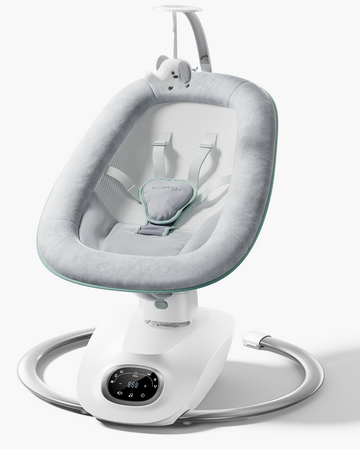
Those are the parts most directly tied to keeping a swing upright during use. Federal guidance requires restraint systems and stability testing under load, and pediatric advice in the review literature emphasizes a stable, flat floor and correct harness use. A portable swing such as the Momcozy CocoSway 3D-Motion Electric Baby Swing still comes back to the same practical checks: base width, harness fit, weight limit, and floor stability.

What the evidence does and does not tell you
There is evidence that swings can meet formal stability requirements under test conditions, including tilt and cyclic motion tests. One standard uses a 50 lb test weight with repeated motion at 60 cycles per minute for 1,000 cycles, and another requires no tip-over during 100,000 cycles at maximum speed.
But that is not the same as proving the swing will stay stable for every vigorously moving baby at home. The standards do not simulate a real child’s erratic, asymmetrical thrashing, and PubMed notes in the responsive parenting intervention literature that they do not measure stability for vigorous awake movement.
When a portable swing is a poor fit
A portable baby swing is a poor choice if your baby is moving so strongly that you notice sliding, leaning, or bouncing against the harness. That is also the point where “portable” should not be confused with “safe for active play.”
It is also not a safe sleep space. Cattaraugus County Website’s suffocation hazard guidance says swings marketed for sleep with an incline greater than 10 degrees have been cited as suffocation hazards, and the safest sleep setup is a firm, flat surface in a crib, bassinet, or play yard with only a fitted sheet. If a baby falls asleep in a swing, the baby should be moved to a firm, flat sleep surface.

A serious injury can happen from a seemingly small fall, especially if an infant’s body pivots and gains momentum before impact. A case report described a fatal head injury after a fall from about two feet.
Practical way to judge use at home
Use this quick check before and during a session:
- Put the swing on a flat, stable floor
- Buckle the harness correctly every time
- Keep the baby within the swing’s listed weight and size limit
- Watch for leaning, sliding, or the seat shifting more than expected
- Stop if the swing rocks, tips, folds unexpectedly, or the baby starts to slump
That last point matters. If the baby is moving vigorously enough that the swing seems to lose position or the harness no longer keeps the body centered, the swing is no longer doing the job you want from it. The formal safety standards treat tip-over or structural failure as a fail condition.
If your baby is very active, what usually works better
If your baby is awake and wants to move a lot, a swing is usually better used for short, supervised soothing time rather than as a place for active movement. PubMed's responsive parenting intervention literature notes that baby swings are intended for supervised, short-duration use, and another safety source for children’s sitting and carrying devices says infants and toddlers should never be left unsupervised in them.

For a vigorous baby, supervised floor time on a firm, safe surface is often the better fit because it gives more room to kick, roll, and shift without relying on the swing’s frame to hold position. That is a practical inference from the stability limits in the standards, not direct swing-testing data.
Bottom line
A portable baby swing can be stable enough for some awake use, but only within its tested weight, harness, and surface requirements, and not as a solution for a baby who moves vigorously for long periods. If your baby is pushing hard, twisting a lot, or starting to slump, use the swing less and switch to a safer supervised setup instead.








