


MEDICALLY REVIEWED BY

Talia, OBGYN, master’s degree holder, IBCLC
A board-certified OBGYN, master’s degree holder, and IBCLC. As a mom who exclusively breastfed for 2 years, I bring both clinical expertise and real parenting empathy to my work.
I’ve supported 20,000+ postpartum parents with evidence-based breastfeeding guidance—from latching & positioning to lactation medication safety. 90% of my clients build sustainable feeding routines, and I’ve partnered with 2,000+ families to boost breastfeeding rates and satisfaction.
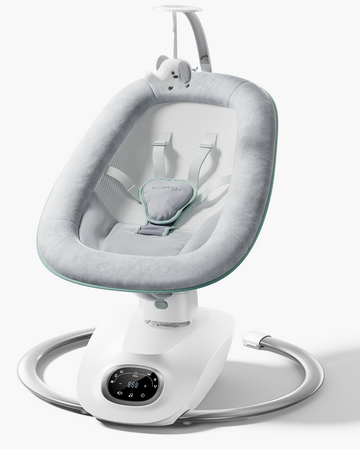
If you need to move a baby swing in a multi-level home, the safest approach is to do it only when the swing is empty, keep the carry route simple and quiet, and move a sleeping baby to a firm, flat sleep surface as soon as you can. The New York State Department of Health says that if your baby dozes off in the swing, the safer sleep guidance is to place them in a safety-approved crib to finish sleeping.
First, decide whether moving the swing is the right move
If the swing is staying put for only a short stretch of time, it may be easier to leave it on one floor and bring the baby to that room instead. That avoids extra lifting, stair carrying, and reassembly.
CPSC.gov notes that a baby swing is meant for a seated infant or, in the case of a cradle swing, an infant lying flat, but it still has to be used according to the manufacturer’s assembly and safety instructions. Federal safety standards for infant and cradle swings are enforced under 16 CFR part 1223, and the specific technical requirements are in ASTM F2088-24.

Before you move it, check the swing and the baby’s position
Do not try to carry the swing with the baby inside it. Moving baby gear while the baby is in it raises handling risk, especially on stairs, and the safest sleep guidance still says to transfer a sleeping baby to a firm, flat surface. That means crib, bassinet, or play yard with only a fitted sheet.
Before you lift anything, make sure the swing is empty, powered off, and fully stable. If you are setting up the crib or bassinet for sleep, a taut fitted crib sheet is part of that safe sleep setup, and Momcozy Muslin Fitted Crib Sheets - 2 sizes are made for standard crib and bassinet mattresses. If the swing uses a remote with a coin battery, keep that remote out of reach and follow local hazardous-waste disposal rules if it needs to be discarded.
Quick check before lifting
- Baby is not in the swing
- Swing is switched off or unplugged, if applicable
- All loose parts are secured
- Your route between floors is clear
- One hand is free for balance on stairs
Use the quietest, most stable route between floors
The quietest move is usually the simplest one: clear the route first, carry the swing in one controlled trip, and avoid setting it down halfway unless you have to. Keep your steps slow and deliberate so the frame does not bump walls, railings, or door frames.

If the swing is a low-profile or travel-style model, its underside of the seat bottom may sit within 6 inches of the floor at some point in its motion range, which can make it easier to reposition on a flat surface after the move. Even then, the key is still stable placement, not speed.
A good rule of thumb is to treat the staircase like the only risky part of the job. On stairs, keep one hand on the rail when possible and hold the swing close to your body so it does not swing or twist.
Set it down on the new floor the safe way
Once you reach the other level, place the swing on a flat, level surface right away. Federal safety standards for infant and cradle swings cover stability and related safety requirements, so the swing should not be left where it can rock, roll, or shift.
After you set it down, check that it sits evenly and does not move across the floor or fold in on itself. A swing should stay stable during use, and the restraint system has to support the baby as they grow.

After-placement check
- All feet are fully on the floor
- The frame sits level
- Nothing is under the base
- The swing does not wobble
- Cords and controls are out of reach
If the baby is asleep, transfer to a flat sleep surface
If your baby falls asleep in the swing, move them to a safety-approved crib, bassinet, or play yard with a firm, flat surface and only a fitted sheet. That is the clearest safe-sleep guidance in the sources, and it matters more than keeping the nap uninterrupted.
Some swing safety warnings also emphasize that inclined sleep is unsafe because it can create a suffocation hazard. In one CPSC warning, an infant swing with an incline angle greater than 10 degrees was flagged as a hazard, and another warning noted the seat angle exceeded the allowable 10-degree maximum.

When to stop and check the manual or product label
Stop and verify the product’s label or manual if the swing does not match the standard safety setup you expect. CPSC guidance says infant and cradle swings sold in the United States must comply with ASTM F2088-24, and the product’s technical details are defined in that standard rather than in the regulation text itself.
It is also worth stopping if the swing lacks basic safety features. CPSC warnings have cited products with unsafe seat angles, missing passive crotch straps, and missing warning labels.
Stop and do not use until checked if you notice:
- The seat angle looks too upright
- The swing is unstable after moving
- Any strap, harness, or restraint seems incomplete
- Warning labels are missing
- The swing was built or sold as a sleep space rather than a supervised baby seat
The simplest low-noise routine for a multi-level home
If you move the swing often, keep one floor set up as the main swing spot and only relocate it when you truly need to. That lowers the number of stair trips and reduces the chance of waking your baby with extra handling.
For a one-time move, the practical order is simple: empty the swing, clear the route, carry it steadily, set it on a flat surface, and transfer a sleeping baby to a firm, flat sleep space as soon as possible. That keeps the process quiet and stays aligned with the safest guidance in the evidence.
Takeaway: move the swing empty, move it slowly on a clear route, and if baby falls asleep, finish the nap on a firm, flat sleep surface.








