


Key Takeaways
- Twin diapering works more smoothly when ready supplies, reserve stock, and used diaper containment each have a fixed location and refill rule.
- Track each baby's actual diaper use for seven days before setting working quantities, because age, feeding, size, and routines vary.
- Twins may wear different diaper sizes or need different products, so label shared storage clearly instead of assuming identical supplies.
- A small disposable backup can preserve the routine during laundry delays, travel, illness, or unexpected changes without requiring an all-or-nothing system.
- Used diaper capacity and bag availability deserve planning because frequent changes can fill ordinary nursery waste containers more quickly.
Why Twins Need a Throughput System, Not Twice the Clutter

Think of diapering as a flow: supplies move from sealed reserve, to ready stock, to a completed change, and finally to the correct dirty endpoint. With one baby, that flow is easy to manage by instinct.
With twins, doubling every supply without a system tends to create the opposite of convenience: overflowing bins, mismatched sizes mixed, two half-open packs instead of one full one, and no clear signal for when to restock.
The fix isn't more stuff. It's one guiding principle: keep frequently used supplies closest at hand, keep bulk stock sealed and out of the way until needed, and make sure dirty diapers leave the space predictably rather than piling up.
This article stays focused on that logistics question, meaning how supplies and used diapers move through your space, rather than repeating a standard diaper changing walkthrough. If you need the basics, our step-by-step guide on how to change a diaper covers the essentials.
Map Four Twin Diapering Zones
A twin diapering setup works best when it's organized into four distinct zones:
- Ready zone: the small, easily grabbed supply meant to last the next several changes.
- Reserve zone: sealed diapers, wipes, bags, and any backup products, stored away from the immediate work surface.
- Baby-specific zone: labeled space for Twin A and Twin B (or whatever names or identifiers your family uses), reflecting any differences in size or product.
- Dirty zone: the pail or wet bag endpoint, positioned after the changing surface and kept separate from clean stock.
Keeping these four zones distinct, rather than one big shared pile, is what prevents a caregiver from grabbing the wrong size at 3 a.m. or discovering the ready stock is empty mid-change.
Set Working Stock With a Seven-Day Capacity Table
Rather than relying on a generic online average, record each baby's actual diaper use separately for seven ordinary days. Use the table below as a starting template.
Twin Diapering Capacity Table
| Track separately | 7-day observation | Working level | Refill trigger | Reserve rule |
|---|---|---|---|---|
| Twin A diapers | Record actual changes by size/type | Average for chosen refill window + modest buffer | Refill before one full window remains | Keep sealed backup separate. |
| Twin B diapers | Record independently; do not assume same size/use | Average for chosen refill window + modest buffer | Refill before one full window remains | Label size and owner clearly. |
| Wipes/cleanup | Note packs opened and unusually heavy days | Enough for routine resets | Open next pack only at visible minimum | Keep one sealed pack in reserve. |
| Pail bags/liners | Record bag changes and fill point | One installed plus accessible replacement | Replace supply when last backup enters use | Use compatible bags; avoid overfilling. |
| Cloth / hybrid option | Record clean rotation and delays | Family-specific rotation only | Trigger before clean stock reaches one cycle | Keep disposable fallback if desired. |
Your working stock should cover your chosen refill window plus a modest buffer, not every package currently in the nursery. Set a refill trigger that's visible before the last diaper, wipe pack, bag, or cloth option is reached, so no one discovers an empty bin in the middle of a change. Revisit the table whenever sizes, routines, childcare arrangements, or diaper type change.
Decide What Can Be Shared and What Must Stay Baby Specific

Some supplies can live in one shared spot:
- Wipes, when appropriate for both babies
- Disposal bags
- General changing surface and cleanup textiles
Other supplies need to stay separate or clearly labeled:
- Diaper sizes (twins often size up at different rates)
- Any creams or products chosen for one baby specifically
- Open packs and consumption notes
- Daycare or travel bundles assembled for each baby
Use visual labels a tired caregiver can read at a glance, such as color-coded bins, initials, or simple stickers, rather than relying on memory during back-to-back changes. For any persistent skin or health concern, defer to a qualified pediatric clinician rather than general planning advice.
Build a Refill System That Prevents Midnight Shortages
Pick a fixed reset time, once or twice a day, to move stock forward and swap the pail bag before the next high-demand stretch (often overnight or first thing in the morning). Mark a minimum line or label in the ready bin so any caregiver, not just the primary one, can recognize when it's time to refill.
Where possible, open only one package per baby or size at a time. This keeps stock counts accurate and prevents three half-used packs from cluttering the shelf. Keep a small emergency reserve tucked away separately from your everyday working stock, so a busy week never leaves you fully out.
Use One Main Station and One Minimal Backup Kit
Designate one station as the source of truth. This is where labels, reserve stock, bag supply, and the dirty diaper endpoint all live. Add a second, minimal, portable kit only if another floor, a second caregiver, or a regular feeding spot genuinely requires it.
Refill that backup kit from the main reserve, and return unused items to the main station afterward, rather than maintaining two full parallel inventories.
You can put the Momcozy playard near here. It can switch between playard mode and bassinet mode with one touch. More importantly, it pairs with the Momcozy changing table to create a full changing station.
Diaper Disposal
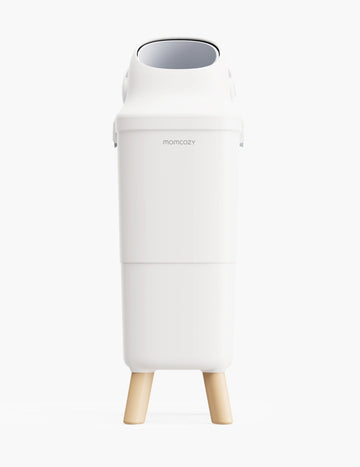
Consider using an odor-locking diaper pail for diaper disposal. The Momcozy Triple Seal Diaper Pail is among your best options. Its design features a rotational lid that keeps the smell in when you're dropping new diapers and when it's on stand by. The extra-wide 5.71 × 5.12-inch opening makes dropping diapers easy, which moms with twins will appreciate.
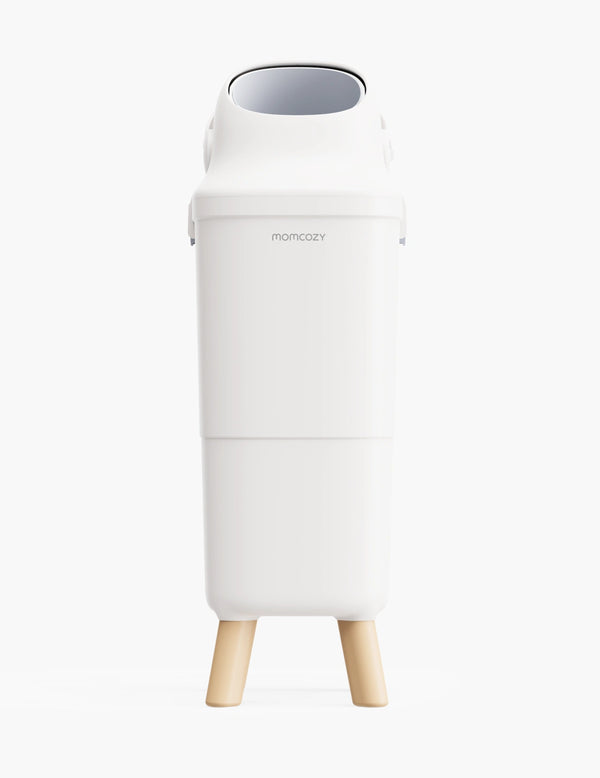
On top of that, the bag opening stays clamped and lifts with the pail lid during removal. It helps prevent the smell from escaping and affecting your nursery. There's also a Child Safety Lock that prevents toddlers from opening the diaper pail.
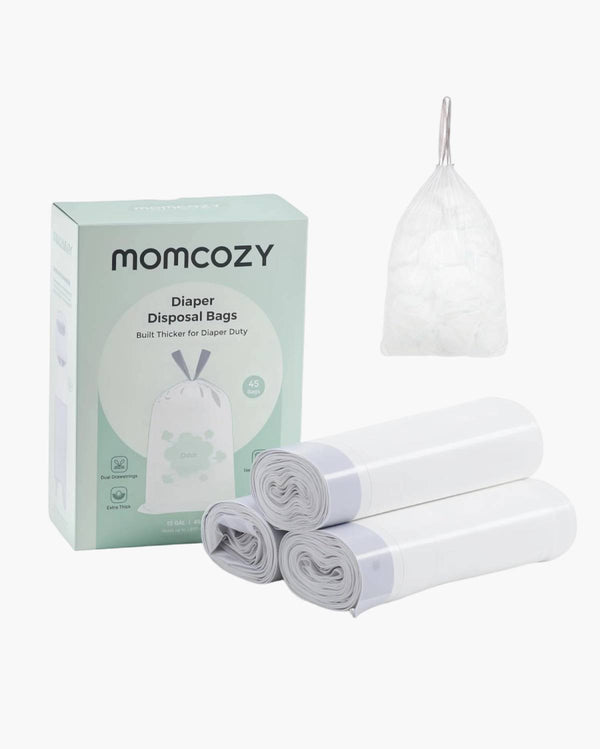
Twins may make diaper pails fill faster than normal. This diaper is well-equipped to handle that. It can hold up to 60 newborn diapers or 24 larger diapers. You can use any 13-gallon trash bag.
If you want to know more, see our guides on choosing a diaper pail and what a diaper pail actually does.

Handle Back-to-Back Changes Without Mixing Supplies
Before placing one baby on the changing surface, have that baby's correct diaper and supplies ready and set aside. Keep the other baby in a separate, safe location during the change; see our guidance on safe sleep and safe placement basics for placement guidance. Complete and secure one baby fully before starting the next. Never place two babies on a single changing surface unless the manufacturer explicitly states it's designed for that.
Between changes, reset the surface and pull the second baby's labeled supplies before beginning. Always follow your changing surface and product instructions, including keeping a hand on the baby whenever the manufacturer calls for it.
Choose Disposable, Cloth, or Hybrid Without Overcommitting
Each approach comes with real tradeoffs, and none of them require an all-or-nothing decision:
- Disposable: less laundry, but it requires ongoing purchasing, a reserve supply, bags, and planning for used diaper capacity.
- Cloth: needs enough clean rotation on hand and a working wash routine. For wash-specific guidance, look to a dedicated cloth diapering resource rather than treating this as a laundering tutorial.
- Hybrid: often useful during newborn sizing changes, overnight stretches, travel, childcare transitions, or unusually heavy diaper days.
A short trial period, with real observation of what fits your household, tends to work better than committing fully to one method upfront. There's no need for moralizing or guaranteed savings claims either way. What matters is what actually holds up in your routine.
Plan Used Diaper Capacity and Odor Containment
Once you have a week of real data, use it to estimate how quickly used diapers accumulate and choose an emptying rhythm that keeps things from overfilling. Stool handling should follow your local guidance and the instructions that come with your products.

Keep replacement bags stocked right at the station, and move each tied bag promptly to your household's approved waste endpoint rather than letting it sit.
For the containment step itself, the Momcozy Triple Seal Diaper Pail is built with a patented clamp bag seal, a hands-free wide opening, a transparent window, an easy-clean interior, and a child safety lock, and it holds 22L using standard 13-gallon bags. Together, these features help contain odors and help reduce odor release between bag changes. No diaper pail eliminates odor, so plan your emptying rhythm around your household's actual volume rather than expecting a "set it and forget it" outcome.
Review the System After One Week
At the end of the first week, compare a few things day by day: diapers actually used, any emergency refills needed, sizes that got mixed up, how quickly the pail filled, how often bags were changed, and any supplies that went untouched.
Adjust only the category that's actually creating a bottleneck. There's no need to increase every supply just because one ran low. Move rarely used products out of the ready zone, and update labels the moment either baby changes size. Plan to repeat this review whenever childcare starts, you travel, illness hits, or your routine shifts in a bigger way.
FAQs
- Do twins always use the same diaper size? Not necessarily. Twins often grow at different rates, so it's common for one baby to size up before the other. Track each baby separately rather than assuming shared sizing.
- Should I buy two diaper pails for twins? Most families do fine with one well-placed, higher-capacity pail rather than two smaller ones, as long as it's emptied on a rhythm that matches your actual used diaper volume.
- Can I combine cloth and disposable diapers for twins? Yes. Many families use a hybrid approach, especially during newborn sizing changes, travel, or illness, without treating it as an all-or-nothing choice.
- How often should I restock a twin diaper station? That depends on your household's refill window and buffer, which is best set using a short observation period rather than a fixed universal number.
- How do I keep caregivers from mixing up diaper sizes? Clear, visible labels on baby-specific zones, by name, initials, or color, tend to work better than relying on memory during a busy or late-night change.
- What should stay in a portable backup kit for twins? A minimal set refilled from the main reserve, sized for a short trip away from the main station, rather than a full duplicate of your everyday supplies.
Conclusion
Diapering twins comes down to four flows working together: ready stock, reserve stock, baby-specific supplies, and a clear path to disposal, each with a visible refill trigger. Measuring your household's actual use and adjusting from there will serve you better than chasing a universal quantity claim or simply doubling every supply on a checklist. For the disposal end of that system, a well-sealed, higher-capacity option like the Momcozy Triple Seal Diaper Pail can be one practical part of keeping up with the added volume.








