


MEDICALLY REVIEWED BY

Shelly Umstot, BSN, RN
Shelly Umstot is a BSN and has been a registered nurse for over 35 years. She lives in North East Ohio and is a freelance health content writer. Her passion is bringing understanding to those with questions and concerns regarding health issues and helping them obtain and maintain their optimal health. She loves being with her family and has two lovely granddaughters who have stolen her heart. Assisting new parents in finding the information they need to face the joys and challenges of caring for their children is a gratifying experience for her as a professional, parent, and grandparent herself.
Yes, a baby swing with both rocking and swinging modes can be genuinely useful, but only if the extra motion options match your baby’s preferences, your space, and your daily routine. The real value is not “more buttons”; it is having a safe, supervised soothing spot that can adapt to different moments of the day.
You know that moment when your baby is fed, changed, and still fussing the second you try to set them down? That is where motion variety can help, especially when a simple front-to-back swing works one day and a softer rocking motion works better the next. With some modern swings offering multiple motions, several speeds, rotating seats, and adjustable recline, the goal is to help you choose what is actually useful instead of paying attention only to the longest feature list.
What Rocking and Swinging Modes Actually Do
Rocking and swinging sound similar, but they can feel very different to a baby. A traditional swing usually moves in a repeated arc, often front-to-back or side-to-side, while rocking tends to feel smaller, softer, and closer to the motion of being gently moved in your arms.

That difference matters because babies are not all soothed by the same rhythm. A baby swing may rock, sway, bounce, or move in a more layered pattern, depending on the design. One baby may relax with a steady side-to-side motion after feeding, while another may prefer a slower front-to-back swing when they are overtired but still awake.
Think of Modes as Soothing Options, Not Guarantees
Multiple modes do not guarantee that your baby will love every setting. In real life, most parents end up using two or three favorite combinations, not every possible speed and motion.
That does not make the extra modes useless. It just means versatility is practical when it gives you a few realistic choices: a slower motion for calm awake time, a slightly stronger swing for a fussy stretch, and a stationary or low-motion setting when your baby is alert and watching you fold laundry nearby.
Where Multi-Mode Swings Can Help Day to Day
The biggest benefit of rocking and swinging modes is flexibility during short supervised windows. A swing can be helpful when you need both hands for a few minutes, whether you are warming a bottle, helping an older child, pumping, or cleaning up after a diaper change.
Gentle, repetitive motion can be calming because it gives babies familiar movement input, and gentle, repetitive motion is often described as mimicking the feeling of being held. That does not mean the swing replaces your arms, tummy time, or a safe sleep space. It simply gives you another tool for those ordinary, slightly chaotic parts of the day.

Morning, Feeding, and Fussy-Evening Use
In the morning, a lower-speed rocking mode may be enough while your baby is awake and looking around. After a feeding, a more upright recline and very gentle motion may feel more comfortable than a deeper recline, especially if your baby likes being able to see you.
During the late-afternoon fussy stretch, switching from rocking to swinging can sometimes help reset the mood. I would still keep sessions short, watch your baby’s cues, and stop if they seem overstimulated, uncomfortable, or ready to be held instead.
The Best Versatility Comes From More Than Motion
A swing with rocking and swinging modes is more versatile when the rest of the design supports real family life. Motion choices matter, but so do recline positions, harness design, footprint, fabric cleaning, noise level, and how easy it is to move the swing from room to room.
Some models include multiple motions, four speed settings, a 180-degree rotating seat, and recline ranges such as 15 to 28 degrees, but versatile models are only helpful if those settings are simple to adjust while you are holding a baby. If changing modes takes two hands, loud beeps, or a lot of bending over, you may not use the feature as much as you expected.

Features That Matter More Than the Number of Modes
Before getting impressed by a long list of motion patterns, look at the basics:
- Harness fit: A secure 3-point or 5-point harness is more important than an extra speed setting.
- Recline control: Adjustable recline helps you match the seat position to your baby’s age, alertness, and comfort.
- Stable base: A wide, sturdy base is worth prioritizing, especially in a busy living room.
- Washable fabric: Spit-up, diaper leaks, and milk dribbles are not occasional events in baby life.
- Noise level: A motor that clicks or hums loudly can become annoying fast in a small apartment or shared bedroom.
- Power options: Plug-in power can save batteries, while battery operation can help if you move the swing around.
- Footprint: A full-size swing may feel wonderful, but only if it does not block your walkway, nursing chair, or bassinet path.
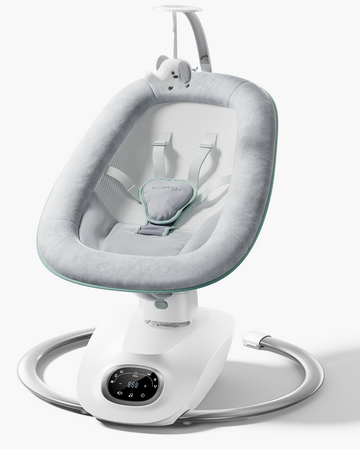
For example, the Momcozy baby swing pairs multi-directional swinging with multiple speed settings, built-in sounds, and a reclining seat. As with any swing, those options are for short, supervised awake use rather than sleep.
A good test is simple: imagine using the swing at 2:00 PM on a messy Tuesday with a tired baby and one free hand. The most useful features are the ones you can operate easily in that moment.
Safety Is the Part That Makes or Breaks the Value
A multi-mode swing is only truly useful if it is easy to use safely every time. That means placing it on a flat, hard floor, checking that the frame is locked, securing the harness, and staying close enough to supervise.
The U.S. safety framework for infant swings is specific because these products carry real risks when poorly designed or misused. A U.S. standards body notes that the federal infant swing standard was shaped after a U.S. consumer safety regulator reviewed 351 reported infant swing-related incidents from 2009 to 2012, including 2 fatalities and 24 injuries, and the standard includes requirements such as stability, restraint, warning labels, and load testing through the mandatory U.S. federal safety standard.

Check the Standard, But Also Check Your Own Setup
Safety standards help set a baseline for products sold in the U.S., but your daily setup still matters. A swing should not go on a couch, bed, counter, table, or thick rug. It belongs on the floor, away from cords, curtains, pets, and anything a baby could grab.
The U.S. consumer safety regulator has continued updating infant and cradle swing requirements, including a 2026 rule incorporating a newer industry standard into 16 CFR Part 1223, with the rule scheduled to take effect on July 25, 2026 unless withdrawn after significant adverse comment through the updated mandatory safety standard. For a parent shopping or using a swing at home, the practical takeaway is still the same: choose a product that follows current safety requirements, then use it exactly within the maker’s instructions.
A Swing Is Not a Sleep Space
This is the part I would not soften: even if the motion helps your baby drift off, a swing is not a crib or bassinet. Swings are for supervised soothing and awake rest, not routine sleep.
A baby’s head can slump forward in a semi-upright seat, and that position can make breathing harder, while soft padding and straps do not create the firm, flat, level surface recommended for infant sleep. If your baby falls asleep in the swing, the safer move is to transfer them to a crib, bassinet, or play yard with a firm, flat mattress, because swings offer versatility as short-term soothing tools rather than sleep spaces.
Keep Sessions Short and Purposeful
For everyday use, think in short sessions rather than long stretches. A practical range is about 15 to 30 minutes at a time, with a few supervised sessions in a day if your baby tolerates it well.
Shorter use also protects time for the things a swing cannot provide: floor play, tummy time, stretching, being held, and interacting face-to-face with you. A multi-mode swing can be part of the rhythm of the day, but it should not become the main place your baby spends awake time.
How Long Will Rocking and Swinging Modes Stay Useful?
This is where expectations matter. Many infant swings are designed for early babyhood, often until a baby reaches around 20 lb or begins sitting up unassisted, though exact limits vary by model.
Some caregiver guidance suggests stopping swing mode at 20 lb or 9 months, whichever comes first, while also following the manufacturer’s own limits and milestone warnings. A safe setup also includes checking the frame, connectors, straps, fabric, and motion before use, especially as your baby gets stronger and more active.
Watch Milestones, Not Just Weight
Weight limits are only one part of the picture. If your baby is trying to roll, pull forward, sit up, or push against the seat, the swing may no longer be appropriate even if they are technically under the weight limit.
This is one reason a convertible design can be useful for some families. A 2-in-1 swing and seat may extend the product’s usefulness as a stationary seat after the swing stage, but only if that mode has its own clear age, weight, harness, and supervision instructions.
How to Decide If a Multi-Mode Swing Is Worth It
A swing with rocking and swinging modes is most likely to feel worth it if you want one soothing spot that can handle different moods. It may be especially helpful if your baby is sensitive to motion changes, if you live in a smaller home and want one product instead of several, or if you need short hands-free moments during feeding, pumping, or sibling care.
It may be less necessary if your baby already settles easily in a basic seat, if you have very limited floor space, or if you know you will not use extra settings. In that case, a simpler swing with a stable base, comfortable recline, washable cover, and secure harness may serve you better than a feature-heavy model.
A Simple Buying Checklist
Before choosing a swing, ask yourself:
- Does it fit safely in the room where I will actually use it?
- Can I switch modes and speeds without a complicated setup?
- Does the recline work for a young baby who still needs good head and neck support?
- Is the harness easy to tighten correctly every time?
- Are the fabric pieces removable and washable?
- Is the motor quiet enough for my home?
- Do the age, weight, and milestone limits match how long I expect to use it?
- Would I still like this swing if my baby only used one or two of the modes?
That last question is a good reality check. A swing is more versatile when its everyday design is strong, not just when the feature list is long.
Practical Next Steps
If you are deciding whether rocking and swinging modes are worth it, focus on your routine first. For a newborn who fusses during short awake windows, multiple gentle motion options can be helpful. For a baby who only wants one consistent rhythm, the extra modes may be nice but not essential.
The safest and most practical choice is a swing that is stable, easy to clean, simple to adjust, and clear about its limits. Use the motion modes for short, supervised soothing; start with the lowest speed; keep your baby harnessed; and move them to a firm, flat sleep space if they doze off.
So yes, rocking and swinging modes can offer real versatility. The best version is not the swing with the most settings, but the one that makes your day a little easier while still fitting your baby, your home, and safe-use habits you can repeat every time.








