


MEDICALLY REVIEWED BY

Talia, OBGYN, master’s degree holder, IBCLC
A board-certified OBGYN, master’s degree holder, and IBCLC. As a mom who exclusively breastfed for 2 years, I bring both clinical expertise and real parenting empathy to my work.
I’ve supported 20,000+ postpartum parents with evidence-based breastfeeding guidance—from latching & positioning to lactation medication safety. 90% of my clients build sustainable feeding routines, and I’ve partnered with 2,000+ families to boost breastfeeding rates and satisfaction.
Yes, a baby swing can move too fast for some babies, but “dizzy” is usually hard to confirm because babies cannot describe the feeling. What you can watch for is overstimulation, discomfort, sudden fussiness, head slumping, gagging, or a baby who simply looks unsettled instead of soothed.
Have you ever put your baby in the swing hoping for a few calm minutes, only to see wide eyes, stiff legs, or crying that gets worse? The most helpful rule of thumb is simple: start low, keep sessions short, and treat 15 to 30 minutes as a practical upper limit for one swing session. Here’s how to tell when the motion is too much and how to use a baby swing in a safer, calmer way.
Why Swing Speed Can Be Too Much for a Baby
Babies process motion differently
A baby swing is meant to soothe, not give a baby a big-motion ride. Some babies love a steady back-and-forth rhythm, while others get upset quickly if the motion is too fast, too jerky, or paired with music, lights, and vibration all at once.

Babies also have immature head and neck control, especially in the newborn stage. For young infants, speed is not the only thing that matters; recline, head position, harness fit, and how long they stay in the seat all work together.
“Dizzy” may look like distress
You may not be able to know whether your baby is truly dizzy, but you can tell when the swing is not helping. Fast or vigorous motion can overstimulate some babies, and a gentle speed setting is usually the better starting point for soothing.
A practical example: if your baby calms at the lowest setting but cries when you move to level three or four, that is useful information. Your baby is not being “picky”; their body may simply prefer a smaller, slower rhythm.
Signs the Swing Is Moving Too Fast
Watch the face, body, and breathing
When a swing is too fast, babies often show it with their whole body. You might notice a startled look, repeated grimacing, hiccup-like fussing, stiff arms or legs, clenched fists, or crying that ramps up instead of settling down.
Other signs can include turning the head away, squirming hard against the harness, gagging, spitting up more than usual, or looking unusually pale or sleepy. If your baby’s head slumps forward, their chin drops toward their chest, or their breathing looks off, stop the swing right away and pick them up.

Fussing after a few minutes counts
Sometimes the motion seems fine at first, then your baby gets overwhelmed after 5 or 10 minutes. That is common, especially with newborns and babies who are already tired, hungry, gassy, or overstimulated from the day.
One simple test I like: reduce the speed to the lowest setting and turn off extra features like music, vibration, or lights. If your baby relaxes within a minute or two, the issue may have been too much stimulation rather than the swing itself.
The Safest Swing Settings for Newborns and Young Babies
Start low and reclined
For newborns, slower is usually better. The seat should be reclined enough to support the head and neck, and infants under 4 months should use the most reclined position available on the swing.
Before turning the swing on, check that your baby’s head is centered, their airway looks open, and the harness sits snugly without pressing into their belly or neck. If you have to keep repositioning your baby, the seat angle or insert may not be a good fit for this stage.
Use the lowest effective speed
You do not need to work up to higher speeds just because the swing has them. The best speed is the lowest one that helps your baby settle.
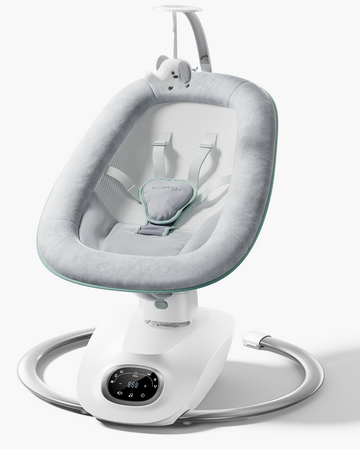
For many babies, that means a slow, steady motion for 10 to 20 minutes while you stay nearby folding laundry, pumping, having a snack, or answering a quick message. If you are using an adjustable model like the Momcozy 2-in-1 Electric Baby Swing, begin at the lowest speed, keep the seat reclined as appropriate, and reduce extra stimulation such as melodies if your baby seems unsettled. A baby swing can be a useful baby care tool during those everyday moments, but it should not become the place your baby spends long stretches of the day.

How Long a Baby Should Stay in a Swing
Keep sessions short
A good practical limit is about 15 to 30 minutes at a time. Several baby care safety guides recommend short periods only, with supervision the entire time.
That time limit is not just about dizziness. Long stretches in a swing can mean less tummy time, less floor play, and more pressure on the same part of your baby’s soft head.
Balance swing time with floor time
If the swing is your go-to tool during fussy windows, try rotating through a few simple soothing options. You might do 10 minutes in the swing, then a feeding, burp break, cuddle, babywearing, or a few minutes of supervised floor play.
Overuse can reduce the time babies spend practicing rolling, reaching, pushing up, and building coordination, and shortening sessions is one practical way to keep the swing helpful without letting it take over the day. If your baby loves motion, even lowering the speed by one setting every few days can make the transition easier.
Sleep, Safety, and Why Supervision Matters
A swing is not a crib
If your baby falls asleep in the swing, it is best to move them to a firm, flat crib or bassinet. The semi-upright position can let a baby’s head slump forward, and swings do not provide the same firm, level sleep surface recommended for infant sleep.
This matters most for newborns and young infants who do not yet have strong head control. A sleeping baby may look peaceful in a swing, but the semi-upright swing position can create airway concerns if their chin drops or their body shifts.

Stay close enough to respond
Supervision means more than being in the same house. Stay close enough to see your baby’s face, check their breathing, and notice if their head position changes.
Place the swing on the floor, never on a table, couch, bed, or countertop. Buckle the harness every time, even for “just a minute,” because babies can wiggle, arch, or slide faster than you expect.
When to Stop Using a Baby Swing
Age, weight, and milestones matter
Most baby swings are designed for babies up to around 6 to 9 months, often with weight limits around 25 to 30 lb, but your own swing’s label is the rule to follow. Stop earlier if your baby can roll, sit up unassisted, pull forward, or try to climb out.
A safety agency notes that infant swings and cradle swings are covered by federal safety rules, including requirements for restraint systems, stability, seat angles, labeling, and other product safety details. That is helpful background, but it does not replace checking your specific swing’s manual and limits.
Use milestones over the calendar
Some babies outgrow the swing at 3 or 4 months because they are rolling early or pushing their bodies forward. Others may use it longer, but only if they still fit within the size limits and cannot sit up, climb, or shift into unsafe positions.
If the swing starts looking less like a cozy soothing spot and more like something your baby is trying to escape, it is time to phase it out. Lower the speed, shorten sessions, and swap in stationary options like a play mat, supervised tummy time, or a safe floor space with a few simple toys.
Practical Next Steps
If you are worried the swing is too fast, start with the easiest fix: use the lowest speed, fully recline the seat for a young baby, buckle the harness, and keep the session to 15 to 30 minutes while you stay nearby. If your baby cries harder, stiffens, gags, spits up repeatedly, looks pale, or cannot keep their head in a safe position, stop using the swing for that moment.
For everyday use, think of the swing as a short soothing helper, not a sleep space or long-term baby holder. A slow setting, a secure fit, and your watchful eye are what make it useful.
The clearest rule is this: if the swing motion makes your baby look unsettled instead of calm, it is too fast, too long, or not the right tool for that moment. Pick them up, reset, and try a slower, simpler approach.








