


MEDICALLY REVIEWED BY

Zola Zhang, MD, IBCLC, Breast Surgeon, Mother
Breast Surgeon | International Board Certified Lactation Consultant | Mother
As a dedicated Breast Surgeon and International Board Certified Lactation Consultant (IBCLC) with 21 years of clinical experience, my work is rooted in both medical expertise and the lived reality of motherhood—because I’m not just a clinician, but also a mother who exclusively breastfed my own child for two years. This dual perspective shapes every interaction, allowing me to blend scientific rigor with deep empathy for the joys and challenges of breastfeeding.
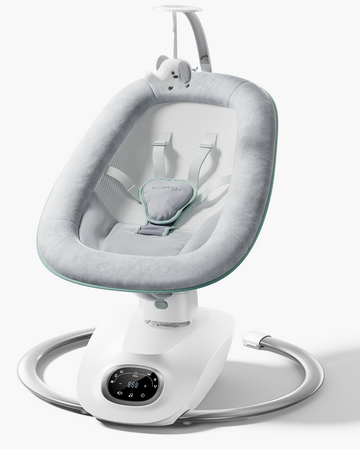
Do not use the swing if the shrunken cover cannot be installed exactly as your model’s instructions require. Set the swing aside if the cover pulls harness slots, buckle openings, tabs, snaps, elastic edges, padding, or frame attachment points out of position. Do not force it to fit or alter it to make it fit.
A seat cover may look like a soft accessory, but its placement can affect how the child sits and how the restraint system is accessed and routed. Federal swing-safety requirements address risks including restraint entanglement and entrapment in leg openings, which is a good reason to treat a fit problem cautiously. Learn about infant and cradle swing safety requirements.

First, Inspect the Fit With the Swing Empty
Before attempting another wash or reinstall, place the swing on a stable surface and perform a broader baby-gear safety check.
Keep the swing out of use if any of the following is true:
- Harness straps do not pass through the intended slots cleanly.
- The buckle is partly covered, difficult to reach, or held at an unusual angle.
- Tabs, snaps, loops, or elastic edges cannot reach their designated attachment points without pulling hard.
- The cover bunches beneath the child’s bottom, behind the back, or around the leg openings.
- Padding has shifted, folded, or no longer sits where the manual shows it.
- The cover pulls the seat into a different recline, seating position, or shape.
- You would need to stretch, tug, pin, tape, sew, cut, or otherwise modify the cover to install it.
A properly installed cover may fit closely; one setup guide based on a specific swing manual describes a “snug fit.” That does not establish how much stretching is acceptable for another model, nor does it make misaligned harness openings acceptable. Your own manual is the standard to follow.
Do Not Try a Generic “Unshrink” Method
It is tempting to soak, stretch, or reinstall the cover while damp in hopes that it will relax back into shape. Do not assume any of those approaches are safe for your swing.
The cover’s care label and the manual for the exact swing model should determine:
- whether the cover can be washed again;
- permitted water temperature and wash cycle;
- whether it may be air-dried or machine-dried;
- whether reshaping is allowed;
- whether the cover must be completely dry before installation or use; and
- the correct reinstallation sequence.
If the instructions permit a limited care step, follow them exactly and then reassess the cover only after it has reached the condition specified by the manufacturer. Do not rely on a temporarily improved fit while fabric is damp.
If you cannot find care instructions, or if they do not address the problem, stop experimenting. A cover that remains too small after permitted care should be treated as unsuitable until the manufacturer advises otherwise.
Find Your Exact Swing Model Before Seeking Help
Replacement covers, pads, and accessories are not interchangeable simply because they look similar. The safest next step is to identify the precise swing model and ask the original manufacturer whether it offers an approved replacement cover or another remedy.

Look for permanent product markings on the swing itself and check any registration materials, original packaging, receipt, or manual you still have. Durable infant products are required to carry permanent distinguishing marks and include a product-registration form, although the location and wording vary by product.
On some swings, identification is located under the seat. For example, a recalled swing model had its model information printed on a label beneath the seat—but that location is only an example, not a universal rule. See an example of product identification under a swing seat.

When you contact the manufacturer, provide:
- The model number and any production, date, or batch information on the product.
- Photos of the cover laid flat.
- Photos showing where the cover no longer reaches, aligns, or attaches.
- A photo of the harness slots, buckle opening, and affected attachment points.
- A brief description of how the cover was cleaned, limited to what you know.
Ask whether the cover is still available for that exact model, whether a replacement has specific installation requirements, and whether there are model-specific care, repair, recall, or disposal instructions.
Do not buy a third-party, used, or cross-model cover based on measurements, color, or appearance alone. A visually similar cover may have different harness-slot placement, padding thickness, attachment hardware, or seat geometry.
Reinstall Only After a Complete Pass/Fail Check
Use the manufacturer’s instructions as the final authority. If the manual requires the cover for use, do not operate the swing without it.
Reinstall only if |
Keep the swing out of use if |
The cover is installed in the exact sequence shown in the manual. |
You must pull, force, or stretch the cover to reach an attachment point. |
Harness straps pass through the correct openings without twisting or obstruction. |
Harness slots, buckle access, or leg openings are covered, shifted, or distorted. |
Every snap, tab, loop, elastic edge, and frame anchor reaches its intended location naturally. |
Any attachment point cannot be secured as directed. |
Padding lies flat and the seat holds the intended position. |
Padding bunches, shifts, or changes how the child would sit. |
The cover is in the condition—such as fully dry—required by the manufacturer. |
The fit is uncertain, temporarily improved only while damp, or different from the manual’s installation images. |
If every safety-critical point aligns and the cover fits as directed, reinstall it only according to the exact model instructions. If it does not, keep the swing out of use and contact the manufacturer for model-specific replacement, repair, recall, or disposal guidance.








