


MEDICALLY REVIEWED BY

Una Qian, Registered Nurse, IBCLC
I am a Registered Nurse and International Board Certified Lactation Consultant (IBCLC) based in Beijing, China. With 16 years of experience in obstetrics and gynecology, I currently provide clinical breastfeeding support. Over the past few years, I have obtained the Level II Certification in the French WAFF Perinatal Rehabilitation Method and the BFE Level I Certification in Pelvic Floor Rehabilitation (European Level I), which qualifies me to guide both prenatal and postpartum mothers in appropriate exercise programs and provide evidence-based postpartum rehabilitation.
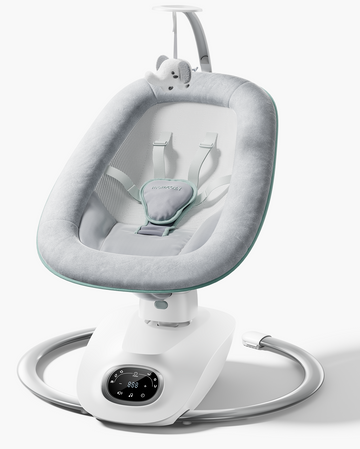
A baby swing may briefly soothe some newborns during a fussy, feed-heavy period, but it cannot fix hunger, illness, discomfort, or feeding problems. Meet your baby’s basic needs first. If you choose to use a swing, use only one approved for your newborn and only for awake, harnessed, continuously supervised soothing—not sleep, and never as a substitute for a safe sleep surface.
A swing is one possible calming tool, not a solution to every hard stretch. Some babies enjoy steady motion; others become more upset in it. If the motion does not help, stop rather than increasing the speed, extending the session, or assuming your baby needs more swinging.
Respond to Your Baby’s Needs Before Trying Motion

Growth-spurt timing and behavior vary. If your newborn seems especially unsettled or wants to feed more often, responsive care comes before any soothing gear.
Start with a simple check:
- Offer a feed if your baby shows hunger cues or it seems likely they are ready to eat.
- Check comfort needs, such as a wet or soiled diaper, clothing that seems too warm or cool, or a need to burp.
- Try close comfort first, such as holding, gentle rocking, walking, quiet shushing, singing, or a pacifier if your baby uses one.
- Consider the swing only after those needs have been addressed and only if the product is appropriate for your newborn.
Research on mechanical soothing has found that a combination of swaddling, sound, and movement reduced fussiness during a controlled calming exercise in infants aged 0 to 6 months. But that study did not test a baby swing by itself or show that motion resolves the reason a baby is crying. The study of combined soothing methods is a useful reminder that calming often involves several forms of comfort, not motion alone.
Confirm That Your Swing is Suitable for Your Newborn
Do not rely on a general “newborn” label, another parent’s advice, or a universal age or weight guideline. Whether a particular swing is appropriate depends on its own instructions.
Before placing your baby in it, check the product manual and labels for:
- Whether the swing permits use from birth or at your baby’s current age and developmental stage
- The stated weight limits and any stop-use criteria
- The required recline position or setup for the youngest permitted baby
- How to use the restraint system correctly
- Any warnings about inserts, accessories, or added items
A swing’s limits are model-specific. Follow the manufacturer’s instructions exactly, and stop using the product when your baby reaches any listed limit or discontinuation milestone.
Use the Swing Only for Brief, Awake, Supervised Soothing

There is no single evidence-supported number of minutes that applies to every swing and every newborn. Instead, keep use brief and purposeful: use it while you are trying to calm an awake baby, then move on once the moment has passed.
For a safer awake session:
- Place the swing on a stable floor, never on a table, bed, sofa, counter, or other elevated surface.
- Secure your baby with the harness exactly as the manufacturer directs.
- Stay nearby and watch your baby continuously.
- Use the swing only while your baby is awake.
- Stop if your baby seems uncomfortable, slumps, cries harder, or falls asleep.
- Do not add blankets, pillows, positioners, or swaddles to the swing.
A swing should not be used for unattended soothing, routine naps, or overnight sleep. It also is not a treatment for reflux, colic, illness, or feeding difficulties. If your baby is still upset after basic needs have been met, choose another comfort measure rather than escalating motion.
If Your Baby Falls Asleep, Transfer Them Right Away
It is understandable to hesitate when motion has finally helped an overtired newborn drift off. Still, sleep safety is non-negotiable: remove your baby from the swing and place them on their back on a firm, flat sleep surface, such as an appropriate crib, bassinet, play yard, or bedside sleeper.
Do not try to make swing sleep safer by adjusting the recline, adding padding, using a positioning item, or staying nearby to watch. In a seated or semi-reclined position, a baby’s head can tip forward and block the airway. Young infants also may not be able to lift their heads away from soft objects. CPSC safe-sleep guidance advises using products intended for sleep and keeping the sleep space bare except for a fitted sheet.
The practical response is simple: if sleep begins, the swing session is over.
Try Other Comfort Measures When the Swing Does Not Help
A fussy newborn may need a different kind of support rather than more movement. Depending on the situation, you might try:
- Feeding or nursing
- Holding close or babywearing
- Gentle rocking or walking
- Quiet shushing, singing, or other calming sound
- A pacifier, if your baby uses one
- Gentle touch or a warm bath
- Swaddling outside the swing, if appropriate for your baby and setting
- Checking whether your baby is too hot or too cold
These are comfort strategies, not cures for unexplained crying or medical concerns. A baby may also need time, a calmer environment, or a change of caregiver if you are feeling overwhelmed. If you need a moment, place your baby in an appropriate safe sleep space before stepping away briefly to regroup.
Know When Crying Needs Medical Advice
Do not assume every difficult period is a growth spurt. Contact your baby’s healthcare provider when crying seems different from usual or your baby appears inconsolable.
Seek clinician guidance rather than trying more motion if your newborn has fever, breathing difficulty, poor feeding, signs of dehydration, unusual lethargy, or concerning vomiting. These symptoms should not be dismissed as ordinary fussiness.
A swing can be one small part of responsive soothing when your newborn is awake, supervised, and eligible to use that specific product. Feed and comfort your baby first, transfer them immediately if they fall asleep, and call a clinician instead of escalating motion when something about their crying or symptoms feels concerning.









