


Medically Reviewed By:Krupa Playforth & Brittian Robinson


Quick Answer
When your newborn breathes with snorting, or pig-like noises, it's almost always normal. Babies have narrow nasal passages and breathe primarily through their noses, so any airflow easily gets amplified into noise --- your baby isn't uncomfortable, even though it sounds like they are.
That said, 3 common conditions deserve closer attention: respiratory infections (common cold, RSV, pneumonia), gastroesophageal reflux disease (GERD), and laryngomalacia. Seek immediate medical care if you are ever concerned about your baby's breathing. Some red flags include if your baby has fever, visibly fast breathing, retractions, is pale, has blue lips or fingernails, or is unusually drowsy and hard to wake.
Every new parent knows the feeling: your baby is sound asleep, but keeps making strange noises --- snorting like a tiny pig. It's even louder during feeds, and the breathing sounds are concerning enough to make your heart race.
You lean in close. Baby looks fine, isn't crying, but the noise just won't stop. Is this normal? Should you call the doctor?
Here's how to tell, step by step: which sounds are normal, which deserve attention, and some warning signs which may mean you need to seek care right away.

Why Do Babies Snort Like Pigs When They Breathe?
A newborn's respiratory system isn't fully developed yet, so their breathing sometimes sounds louder than you'd expect. Once you understand why, this becomes a lot less scary --- your baby isn't bothered by it at all, even if the noise unnerves you.
Reason 1: Newborns have tiny, narrow nasal passages
The narrower the airway, the more easily airflow gets amplified into sound. What would be a faint nasal whisper in an adult becomes a full pig-snort soundtrack in a baby. This is normal anatomy --- not congestion, not discomfort. As your baby grows and their nasal passages widen, the noise naturally fades.
Reason 2: Newborns are obligate nose breathers
Adults can switch to mouth breathing whenever we want. Babies can't --- for the first few months, they breathe almost exclusively through their noses. Every bit of air has to pass through those narrow passages, so even a tiny bit of dried mucus or secretion can make breathing sound much louder because they narrow those passages even more. This is especially noticeable during feeds, when their mouths are occupied --- any "debris" in the nose becomes a full pig-snort symphony.
Beyond these normal anatomical reasons, certain health conditions can also make a baby's breathing sound louder than usual.
3 Conditions That Deserve Closer Attention
Most of the time, that snorting is just background noise of newborn life. But if any of the following situations apply, it may be more than just anatomy --- you'll want to figure out what's going on and act on it.
Condition 1: Respiratory Infection (Common Cold, RSV, Pneumonia)
Respiratory infections can happen in the nasal passages / upper airways, or lower down in the lungs. In both cases, infection can lead to inflammation and mucus production, which can cause already-narrow airways to become even more constricted. Narrower airways mean your baby has to work harder to breathe, leading to more noticeable noisy breathing in addition to other signs of increased work of breathing.
How to tell if this might be the cause
- Runny nose and cough --- the most common upper respiratory infection symptoms
- Fever --- respiratory infections in infants can come with a temperature
- Decreased feeding or peeing
- Lethargy or fatigue, decreased responsiveness
- Increased fussiness
- Increased work of breathing - if a baby is struggling to breathe, you may notice them breathing faster, or using extra muscles to help them breathe. You may hear additional noises, such as wheezing, stridor, or see the skin pulling in at their throat or between their ribs. In some cases, grunting and nasal flaring can also be a sign of increased work of breathing, especially if they are new or getting worse.
- Always seek care from a healthcare provider if you are concerned your child may be sick.

Image source: Thomas C. Thomas, MD / PhyMed HealthCare Group
What to do next
If your baby is under 3 months old: Any of the above signs --- even just a runny nose --- warrant a doctor visit, especially with a fever ≥100.4°F (38°C). Even without fever, if your baby seems sick, seek medical care immediately. Babies this young don't yet have mature immune systems, and sometimes even subtle symptoms can be a sign of a serious problem.
If your baby is over 3 months old with mild symptoms (just a runny nose, mild cough, no fever or just a low-grade fever): usually this is not a cause for alarm --- you can watch at home. Make sure your baby gets plenty of rest and feeds, and try the two methods below to help them feel more comfortable.
At-home care
Method 1: Soften mucus with saline drops
When nasal secretions get dried out and sticky, soften them with saline to make them easier to mobilize.
- Lay your baby down with their head slightly tilted back
- Place 2-3 drops of saline solution in each nostril
- Wait about 1 minute for the saline to loosen the mucus
- If needed, follow up with a nasal aspirator (see Method 2)
Don't do this: Don't use adult nasal sprays, medicated decongestant drops, homeopathic medications, or any oily substances (like petroleum jelly or essential oils) inside or under your baby's nose, unless specifically directed by your pediatrician.
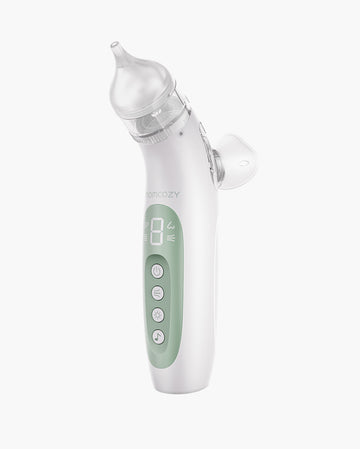
Method 2: Clear secretions with a nasal aspirator
Use a nasal aspirator only when congestion is clearly interfering with feeding, comfort or sleep. If your baby has congestion in their nose but they seem comfortable, it is okay to monitor without intervening. Three main types of aspirators are available: bulb syringes, oral suction aspirators (manual), and electric aspirators. Each has its pros and cons; pick what works for your family.
- Squeeze the air out of the aspirator first --- this is only relevant for a bulb
- Gently place the tip at the nostril opening (don't insert deep into the nostril)
- Release slowly to suction out the mucus
- After each use, wash the aspirator with warm soapy water
How often is too often: No more than 3-4 times a day. Suctioning too frequently or too deeply can irritate your baby's delicate nasal lining.
When to seek immediate medical care
Call your doctor or go to the ER if any of the following occurs:
- Persistent fever
- Breathing faster than normal
- Unusual sounds when baby is breathing (such as wheezing or stridor)
- Any signs that your baby is using extra muscles to help them breathe. This could include nasal flaring with each breath, retractions (skin pulling in between the ribs or at the throat), head bobbing, grunting
- Blue lips or fingernails (cyanosis)
- Paler than usual
- Unusual fussiness, or difficulty consoling
- Not feeding as well as usual
- Not making as many wet diapers as usual
- Unusual drowsiness or difficulty waking
- You have any concerns about your baby. Trust your gut!

Condition 2: Gastroesophageal Reflux Disease (GERD)
Many babies have some degree of gastroesophageal reflux (GER) --- spitting up after feeds. This happens because the "valve" between the esophagus and stomach (the lower esophageal sphincter) isn't fully developed yet, so milk easily flows back up. This is very common, and in most cases, does not mean there is anything medically wrong.
But when reflux becomes frequent or severe enough to affect your baby's breathing, feeding, weight gain, baby sleep, doctors call it gastroesophageal reflux disease (GERD) --- and that's a different story than ordinary spit-up.
What comes back up isn't just milk --- it's stomach acid, too. That acid can irritate the throat and upper airway, causing inflammation and pain.
Normal spit-up vs. GERD: a quick check
- Just GER: baby stays happy, gains weight normally, and does not appear uncomfortable with feeding or when spitting up. We call these babies happy spitters!
- Likely GERD: spit-up comes with feeding refusal, significant discomfort, poor weight gain, significant or forceful vomiting, excessive fussiness, poor weight gain, back arching, breathing trouble, or sleep difficulties
What to do next
If your baby shows these signs and you suspect GERD, the first step is to see your pediatrician. GERD requires medical evaluation to confirm --- your doctor will assess severity, rule out other causes, and decide on next steps.
During evaluation and follow-up, your pediatrician will likely also recommend the following lifestyle changes:
- Smaller, more frequent feedings: reduce the volume per feed and feed more often, so your baby doesn't get overly full at one sitting
- Keep your baby upright for 20-30 minutes after feeding: gravity helps milk stay down. Avoid putting your baby flat right after a feed, and skip vigorous play or infant swings.
- Don't overfeed: watch for fullness cues (pushing the bottle away, turning the head, closing the mouth), and stick to the recommended feeding volume
Don't do this
Whether you're waiting for an appointment or already under treatment, never try the following on your own:
- Don't elevate the head of the crib. Research shows this doesn't reduce GERD --- and it can constrict your baby's airway and compromise breathing. The AAP, NASPGHAN, and ESPGHAN all advise against it.
- Don't put your baby on their side or stomach to sleep. Even with reflux, babies must sleep on their backs to reduce the risk of Sudden Infant Death Syndrome (SIDS).
- Don't thicken formula on your own. Thickened feeds should only be used with explicit pediatrician guidance --- never add cereal or solids to a bottle on your own.
When to seek immediate medical care
Beyond the routine evaluation path described above, seek care right away if any of the following occurs:
- Weight loss or failure to gain weight
- Refusing feeds or eating significantly less than usual
- Vomit containing blood, or appearing yellow or green; or a sudden increase in intensity of vomiting, any forceful (projectile) vomiting
- Repeated choking, difficulty breathing, or pauses in breathing
- Blue tint to lips or skin
- Crying, back arching or significant pain during feeds
- If your baby's belly is swollen or hard
- You have additional concerns about your baby. Trust your gut!
Condition 3: Laryngomalacia (Floppy Larynx)
This one sounds different from the other two --- it's a high-pitched, squeaky stridor, more like a whistle on the inhale than a steady snort.
Your baby's larynx (the tissue above the vocal cords) hasn't fully firmed up yet --- it's soft and floppy. When your baby inhales, airflow pulls those soft tissues down into the airway, partially blocking it and creating that telltale whistling sound. This is the most common cause of noisy breathing in newborns.
Most cases are mild and resolve on their own
For most babies, laryngomalacia is mild --- apart from occasional noisy breathing, feeding, weight gain, and energy levels are all normal. About 90% of cases resolve without treatment as the laryngeal tissue stiffens, typically by 18-20 months of age and often sooner. But around 10% of babies have more severe symptoms that affect breathing and feeding. These cases need to be identified early --- sometimes treatment by a pediatric ENT specialist or surgical intervention is necessary. So the sound itself isn't necessarily alarming, but your pediatrician will help guide you on next steps.
What to do: Whether the symptoms are mild or severe, let your pediatrician know if your baby has any stridor. Laryngomalacia needs to be diagnosed through clinical examination --- if needed, an ENT specialist will use a laryngoscope to confirm. Parents can't reliably gauge severity on their own.
How to tell if this might be the cause
- Noisier when on the back; quieter when held upright or on the tummy
- Louder during crying, feeding, or excitement
- Usually shows up within the first few weeks of life; may get louder over the first few months before gradually improving
- Association with color change (more pale, or blue)
When to seek immediate medical care
The red-flag signs to watch for are the same ones already listed earlier in this guide --- trouble breathing, choking, blue or pale skin, or poor feeding/weight gain. If you notice any of these, seek care right away.

Image source: The Lactation College (thelactationcollege.substack.com)
Baby Grunting Self-Check: Normal or Warning Sign?

Self-Check Guide (For General Reference --- Not a Diagnosis)
This is meant to help you think through what you're noticing --- it isn't a diagnosis, and it doesn't replace an evaluation by your pediatrician.
Step 0: Rule out red flags first
Regardless of where you land in the steps below, seek medical care immediately if your baby has any of the following:
Breathing / systemic red flags:
- Breathing pauses longer than 10 seconds
- Blue tint to lips or skin (cyanosis)
- Breathing that's noticeably faster or more labored than usual
- Visible chest or rib retractions
- Fever ≥100.4°F (38°C) in babies under 3 months old
- Unusual drowsiness or difficulty waking
Feeding / growth red flags:
- Weight loss or failure to gain weight
- Refusing feeds or eating significantly less
- Vomit containing blood, or appearing yellow/greenor black
- Large, forceful (projectile) vomiting
- Repeated choking or difficulty during feeds
If there are no red flags, here are three questions that may help you think about what you're noticing --- this isn't a diagnosis, only your pediatrician can tell you for sure:
Step 1: Is the sound a high-pitched, squeaky stridor?
Characteristics: like a whistle on the inhale (medically called stridor), louder when lying on their back, quieter when held upright or on the tummy.
- Yes → This pattern is sometimes associated with laryngomalacia, though only a clinical exam can confirm it. It's worth mentioning to your pediatrician, who may refer you to a pediatric ENT specialist if needed.
- No → Continue to the next question.
Step 2: Is the sound strongly tied to feeding?
Characteristics: most noticeable during or right after feeds; may come with gagging, coughing, or fussiness.
- Yes → This pattern can sometimes be seen with reflux-related noisy breathing (GERD), but many things can cause feeding-related symptoms. It's worth discussing with your pediatrician, who can evaluate and recommend next steps.
- No → Continue to the next question.
Step 3: Is the noisy breathing accompanied by fever, runny nose, or cough?
Characteristics: recently new or worsening cold/infection symptoms.
- Yes → This combination is often seen with respiratory infections. If your baby is under 3 months old, call your pediatrician right away, even if it's just a runny nose. If your baby is over 3 months old with mild symptoms,home care with saline drops and a nasal aspirator can often help, but if the symptoms persist you should consider checking in with your pediatrician.
- No → Noisy breathing without any of these patterns is often just the normal sound of a newborn's narrow nasal passages amplifying airflow, which tends to fade as your baby grows. Still, if anything feels off to you, it's always fine to check in with your pediatrician.
Important reminder: This is meant as a general starting point, not a diagnosis or a substitute for medical evaluation. Any persistent breathing abnormality or stridor --- even short of meeting "red flag" criteria --- is worth mentioning to your pediatrician.
A new parent's ears are wired to catch every little change in their baby's breathing --- and to feel it in their chest. We hope this guide helps you tell what's normal from what deserves a closer look. And anytime you still feel uneasy, calling your pediatrician is never an overreaction. A parent's intuition is the earliest health monitor a baby has.
Frequently Asked Questions
Q: My baby grunts and strains like they're constipated, but their poop is fine. Is this normal?
A: Yes, this is very common and has a name: infant dyschezia (sometimes called "grunting baby syndrome"). Newborns are still learning to coordinate their abdominal muscles and relax their pelvic floor at the same time, so passing gas or stool takes visible effort. As long as your baby's stool is soft and feedings, weight gain, developmental milestones and overall mood are normal, this usually resolves on its own by 3-4 months and doesn't require treatment.
Q: How do I tell the difference between normal snorting and stridor?
A: Snorting is a low, rhythmic noise --- often loudest during feeds or sleep --- caused by airflow through narrow nasal passages. Stridor is high-pitched and squeaky, almost like a whistle on the inhale; it's often louder when your baby is on their back. Stridor warrants a call to your pediatrician, because it can signal laryngomalacia or other airway issues. Snorting alone, in a happy, well-feeding baby, is usually just newborn anatomy.
Q: My baby only sounds noisy when sleeping but is fine when awake. Should I be worried?
A: Probably not. During sleep, babies breathe more slowly and shallowly, and their muscles relax --- which makes any airflow through a narrow nose more audible. As long as your baby's lips and skin look pink (not blue), there's no labored breathing or chest retractions, and they're feeding and gaining weight normally, sleep-only snorting is almost always benign. If your baby is making concerning sounds at night and you can't tell if they are stridor or snorting — or if you just want added peace of mind — take a video of them sleeping and show it to your pediatrician.
Medical Disclaimer: This article is intended as a general starting point for informational purposes and is not a diagnosis or a substitute for professional medical evaluation. You should always seek care from a healthcare provider if you are ever concerned that your baby may be sick. Seek immediate medical attention if your baby displays any red flags, such as breathing pauses lasting longer than 10 seconds, a blue tint to their lips or skin, visible chest or rib retractions, or unusual drowsiness. Additionally, if your baby is under three months old and appears unwell, you must seek medical care immediately, even in the absence of a fever.
References
- National Center for Biotechnology Information. (n.d.). Upper respiratory tract infections in children.PubMed Central. https://pmc.ncbi.nlm.nih.gov/articles/PMC2806659/
- American Academy of Pediatrics. (n.d.). My baby has a stuffy nose. How can I help them sleep safely?https://www.healthychildren.org/English/tips-tools/ask-the-pediatrician/Pages/my-baby-has-a-stuffy-nose-how-can-i-help-them-sleep-safely.aspx
- Cleveland Clinic. (n.d.). Nasal aspirator and phlegm in your baby's throat.Cleveland Clinic Health Essentials. https://health.clevelandclinic.org/nasal-aspirator-and-phlegm-in-your-babys-throat
- Mayo Clinic. (n.d.). Healthy baby: Sick-day care.https://www.mayoclinic.org/healthy-lifestyle/infant-and-toddler-health/in-depth/healthy-baby/art-20047793
- Merck & Co. (n.d.). Gastroesophageal reflux in infants.MSD Manuals Consumer Version. https://www.msdmanuals.com/home/children-s-health-issues/gastrointestinal-disorders-in-children/gastroesophageal-reflux-in-infants
- American Academy of Pediatrics. (n.d.). Gastroesophageal reflux (GER) & gastroesophageal reflux disease (GERD).https://www.healthychildren.org/English/health-issues/conditions/abdominal/Pages/GERD-Reflux.aspx
- Mayo Clinic. (n.d.). Spitting up in babies: What's OK, what's not.https://www.mayoclinic.org/healthy-lifestyle/infant-and-toddler-health/in-depth/healthy-baby/art-20044329
- Nationwide Children's Hospital. (n.d.). Gastroesophageal reflux disease (GERD) in infants.https://www.nationwidechildrens.org/conditions/gastroesophageal-reflux-disease-gerd-in-infants
- National Library of Medicine. (n.d.). Reflux in infants.MedlinePlus. https://medlineplus.gov/refluxininfants.html
- Children's National Hospital. (n.d.). The ultimate baby reflux survival guide.Rise and Shine. https://riseandshine.childrensnational.org/the-ultimate-baby-reflux-survival-guide/
- Rosen, R., Vandenplas, Y., Singendonk, M., Cabana, M., DiLorenzo, C., Gottrand, F., Gupta, S., Langendam, M., Staiano, A., Thapar, N., Tipnis, N., & Tabbers, M. (2018). Pediatric gastroesophageal reflux clinical practice guidelines: Joint recommendations of the North American Society for Pediatric Gastroenterology, Hepatology, and Nutrition and the European Society for Pediatric Gastroenterology, Hepatology, and Nutrition. Journal of Pediatric Gastroenterology and Nutrition, 66(3), 516–554. https://www.naspghan.org/files/Pediatric_Gastroesophageal_Reflux_Clinical.33.pdf
- Boston Children's Hospital. (n.d.). https://www.childrenshospital.org/conditions/laryngomalacia
- Cincinnati Children's Hospital. (n.d.). Laryngomalacia, infantile.https://www.cincinnatichildrens.org/health/l/laryngomalacia-infantile
- StatPearls Publishing. (n.d.). National Center for Biotechnology Information Bookshelf. https://www.ncbi.nlm.nih.gov/books/NBK544266/
- Children's Hospital of Philadelphia. (n.d.). https://www.chop.edu/conditions-diseases/laryngomalacia
- Nationwide Children's Hospital. (n.d.). https://www.nationwidechildrens.org/conditions/laryngomalacia
- Medical University of South Carolina. (2023, February 28). MUSC News. https://www.musc.edu/content-hub/News/2023/02/28/Laryngomalacia
- National Center for Biotechnology Information. (n.d.). PubMed Central. https://pmc.ncbi.nlm.nih.gov/articles/PMC4196673/
- Cleveland Clinic. (n.d.). Dyschezia: Types, causes & treatment.https://my.clevelandclinic.org/health/diseases/24109-dyschezia
- Children's Minnesota. (n.d.). Infant dyschezia.https://www.childrensmn.org/educationmaterials/childrensmn/article/21819/infant-dyschezia/








