


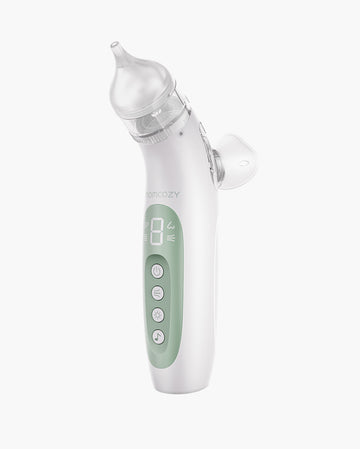
Many nasal aspirator mistakes come from how, when, or why suction is being used, not from the device itself. You could be sucking up dry mucus, putting the tip in too far, sucking too frequently, using it past the point of irritation, or not cleaning thoroughly enough. All of these can make the baby nose sucker less effective and more irritating than it should. If you're using or considering one of Momcozy's baby nasal aspirators, or any other snot sucker, a few minor corrections can make all the difference.
This guide will assist you in finding the mistake, understanding its significance, and selecting the next correction. It is not a substitute for your pediatrician's advice or your product manual. If a topic requires a full walkthrough, like complete suction steps or cleaning, you will find a pointer to the correct guide.
Key Takeaways
- If the mucus is dry or sticky, soften it first; do not push the tip further or turn up the suction immediately.
- The tip should remain shallow at the nostrils. A seal is helpful, but not necessary, and it does not have to be deep.
- If you don't get much output, that doesn't necessarily mean that you need more suction. Always check the mucus, technique, and device setup.
- It is important to note that repeated suction may irritate sensitive nasal tissues, so the return of congestion is not always the cue for another suction.
- If irritation or bleeding occurs, discontinue suctioning; if there is repeated bleeding or symptoms continue to be worrisome, consult a pediatrician.
- If your baby is very upset, stop and reassess rather than force or extend a session.
- Before using or sharing with other children, wash and dry reusable items thoroughly as directed by the product manufacturer.
Quick Check: Which Nasal Aspirator Mistake Are You Making?
Still don't know what's wrong with you? Match what you are seeing to the most likely mistake below. This table is a guide for routing, not a diagnosis.
|
What you notice |
Mistake it may point to |
Quick correction |
Jump to |
|
Mucus looks dry or thick, and the aspirator keeps tugging |
Skipped softening |
Soften first, then reassess |
Mistake 1 |
|
You feel tempted to push the tip inward |
Over-insertion |
Keep the tip shallow at the nostril entrance |
Mistake 2 |
|
Very little comes out, so you raise the power |
Escalating too quickly |
Check mucus, seal, and setup before adding power |
Mistake 3 |
|
You suction again soon after the last session |
Over-suctioning |
Reassess whether removable mucus is actually there |
Mistake 4 |
|
The nose looks red, or you see blood |
Continuing after irritation |
Stop suctioning |
Mistake 5 |
|
Your baby is screaming and pulling away |
Forcing the session |
Pause, calm, and reassess |
Mistake 6 |
|
The device is damp, dirty, or shared |
Hygiene mistake |
Clean and fully dry before the next use |
Mistake 7 |
|
Your baby sounds congested, but you see no mucus |
Treating suction as the only answer |
Decide whether suction is the right tool right now |
Mistake 8 |
|
Suction is weak, the device clogs, or it will not power on |
Possibly a device issue, not a technique mistake |
Check assembly and setup, then troubleshoot |
Mistake 3 |
Mistake 1: Suctioning Dry or Thick Mucus Without Softening It First
If the mucus is dry, sticky, or crusted, sucking alone may be inadequate to move the mucus effectively. It is not about power; it's about texture, and it takes patience to soften it first.
Why dry mucus does not respond well to force
Dry mucus is sticky and will stick to the inside of the nose. A stronger pull won't change this, and it may be more uncomfortable for your baby. One of the most popular baby nasal aspirator mistakes, both in pediatrics and manufacturer instructions, is missing the step of loosening the mucus so it can be removed.
Soften, then reassess before suction.
Try this short correction when mucus looks thick or crusty:
- Check the nostrils for any signs of dryness, crustiness, or stickiness.
- Follow your pediatrician's guidelines and the directions on the product as to how much and when to apply, to help soften it.
- Reassess. If the breathing is clearer, no suction is likely to be required. If there is any loose mucous matter in the surrounding area of the opening, a little gentle pushing may be useful.
Reconsider the situation if making it softer makes it solve itself. If you need a full plan of action, refer to this guide on hard or dry baby boogers.
The BreezyClear™ 2-in-1 nasal aspirator is one example of this soften-then-clear workflow. It's a 10-micron fine mist, auto-stop, and suction in one machine, and the current product page instructs you to mist first, start at the lowest level, and gently clear loose mucus. This is just an example of a workflow. It is not a substitute for saline or medical advice, and is not intended for use in all cases of a stuffy nose. The product page recommends using the product according to the instructions provided in the manual, but says to seek the advice of a pediatrician before using it for children under the age of 2.
Mistake 2: Pushing the Tip Too Far Into the Nostril
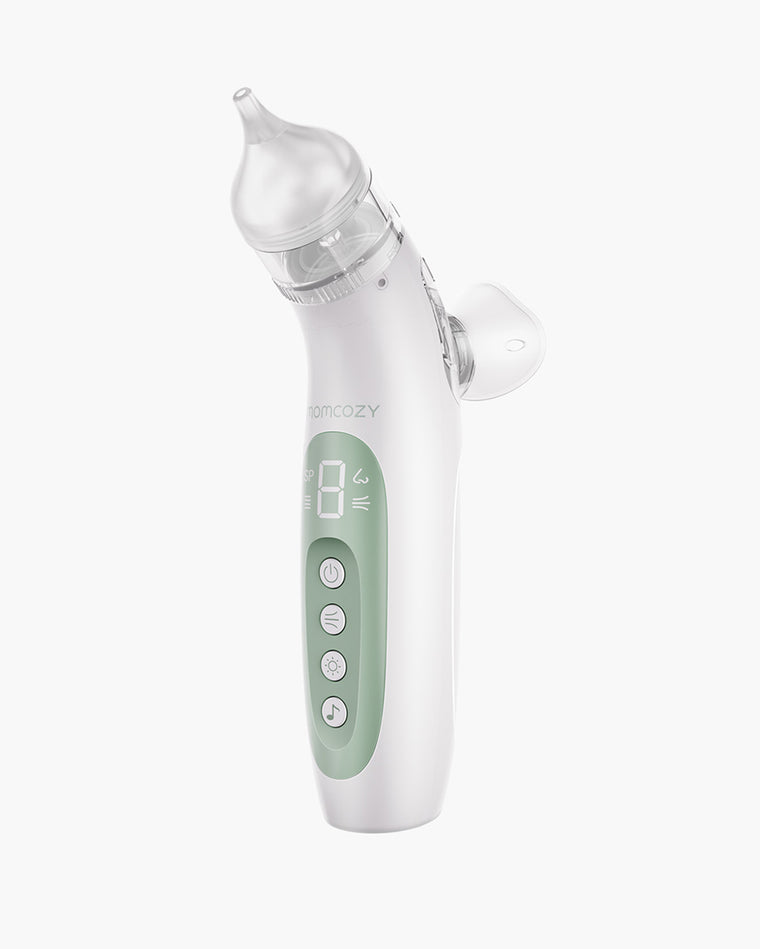
The tip of the aspirator should not penetrate deeply into the nostril opening. Suction may not be more effective the deeper it goes, and it can harm sensitive tissue. If there is not much mucus discharge, it is understandable to want to go further and further into the body, but it is the wrong solution.
A seal at the entrance is different from deep insertion.
A gentle seal is one that allows the tip to sit at the opening, allowing the suction to work on the mucus that is close to the tip. A probing inward is a different action, more mechanical digging than controlled suction. A deeper tip may feel like it gets more mucus, but it really just increases the potential for irritation. The current BreezyClear product page also recommends leaving the soft tip shallow at the nostrils and stopping when your baby appears uncomfortable. There is no design that is entirely safe and no design that calls for deep insertion.
|
Do |
Don’t |
|
Rest the tip gently at the nostril entrance |
Push the tip farther when little comes out |
|
Stop if your baby seems uncomfortable |
Keep going to "finish the job" |
|
Follow the insertion guidance in your product manual |
Guess at depth |
Why forum "go deeper" advice should not be copied
Parent forums are rife with "what am I doing wrong?" threads, and responses sometimes include going further or blocking the other nostril. The comments reflect the extent of the confusion, but do not constitute safe guidance. Do not copy any technique if it is not recommended by your product manual or your pediatrician. For the complete, correct technique, see this walkthrough on how to suction a baby's nose.
Mistake 3: Turning Suction Up Just Because Little or Nothing Comes Out
You may think it's a no-brainer that low output equals low power. Often it does not. It is important not to jump to maximum suction, as it will divert attention from the true reason nothing is moving and will cause the nose to be even more sensitive. When parents think they are using a nasal aspirator incorrectly, they should first review three factors and only then resort to using a power aspirator.
Check the mucus before the motor.
Ask whether there is mucus within reach and whether it is dry or sticky. If it is not ready to move, further sucking will not achieve this. Go back to softening as covered in Mistake 1.
Check the seal and setup before increasing power.
Then, check your technique and setup. Does the tip gently touch the nostril opening? Is the device set up correctly according to the instructions? Low output may be due to the device or setup and not a caregiver mistake. When your aspirator is clogged, doesn't hold a seal, or has a power issue, this is the next step in nasal aspirator troubleshooting.
Stronger is not automatically more effective.
Higher suction is not better for thick mucus, and it can add irritation. The current BreezyClear guidance is to start at the lowest of its four levels and increase one step at a time only when needed. For help with settings, see this guide to choosing nasal aspirator suction levels.
A quick way to decide your next step:
- Mucus looks dry or thick, or you cannot see any: soften and reassess.
- Mucus is present but not moving: check the tip position and seal.
- Technique looks right,t but suction stays weak: suspect a device or setup issue.
Mistake 4: Suctioning Too Often Because Congestion Keeps Coming Back
When congestion comes back, it does not automatically mean another session. The nose must recover, and there are times when some congestion is caused that cannot be removed by suction.
More frequent suction is not the same as better relief.
Parents are seeking constant aid, and therefore it is a natural response for them to reach for the aspirator again. However, those irritations and inflammations may make the nose feel even more congested. This can cause a cycle of increased suction and increased swelling, increased suction and increased swelling. For this reason, over-suctioning is one of the most common nasal suction mistakes.

Reassess before repeating.
Before another session, run through this short checklist:
- Can you actually see or hear mucus near the nostril entrance?
- Does the mucus flow easily?
- Is your baby in need of sucking, or is this normal nasal breathing?
- Is the nose red or sore?
Other comfort measures or a call to your pediatrician might be a better course of action if the answers are not toward suction. Persistent congestion may require medical examination, not additional suction. This article does not provide a schedule of when and how often to use a nasal aspirator; there is a guide to that available.
Mistake 5: Continuing to Suction After Irritation or Blood Appears
Stop suctioning if the nose is becoming irritated or if bleeding starts. Do not keep going only to get to the end of the nose-cleaning.
Blood is a stop signal, not a reason to push through.
You may still hear congestion and want to finish. Tissue recovery and safety come first. Stop if you notice any of the following:
- Blood before, during, or after suction
- Visible redness or soreness at the nostril
- Signs that your baby is in pain
Overuse is commonly linked to irritation and nosebleeds, so reviewing Mistakes 2, 3, and 4 can help you see what led to it. Do not restart suction right away to "check."
When the question becomes a blood or irritation question
This article addresses the stop decision. If you are wondering why, please read this information about blood in baby snot. Speak with your pediatrician if the blood doesn't stop, or if it continues to return.
Mistake 6: Forcing the Session When Your Baby Is Highly Distressed
Don't hold your baby tighter or try to make the session longer if he cries or resists. It can seem like a big deal to finish fast, but rushing can make future sessions more difficult and stressful.
Distress can make suction less effective.
A frightened, thrashing baby makes it hard to place the tip gently and keep a good seal. This usually leads to a longer, more complicated session with reduced gains. Parent forums talk of pinning or restraining babies as a means of workaround. That is a very stressful time and is not something that is recommended.
Pause instead of escalating restraint.
When your baby becomes highly upset, use this pause-and-reassess checklist:
- When your baby is crying, stop and comfort them until they have calmed down.
- Consider if suction is needed at this time.
- Think about how things can be done better or more quickly.
- Try again later only if there is still removable mucus and your baby is calm.
Comfort is not a technique or necessity, but a secondary factor, and there is no one right way for everyone. If you need a detailed plan for making it easier for baby to calm and cooperate, check out this guide on what to do when baby fights nasal suction.
Mistake 7: Reusing a Dirty, Damp, or Shared Aspirator
After use, the parts used for the aspirator must be cleaned and dried, as per the instructions on the product. A dirty or wet device, or sharing a device among children without cleaning, can pose hygiene and cross-contamination issues.
Why moisture and retained mucus matter
Leftover moisture makes it more difficult to keep a device hygienic, and mucus can become lodged in small crevices. An aspirator can appear clean on the surface, but contain residue within. That residue can be transmitted from one child to another with a shared device.
Why "quick rinse and reuse" is not the full cleaning routine
It's easy to get tempted to give a quick rinse when you're tired, and your baby is fussy. However, hygiene is a part of proper use; it's not optional. Basically, the correction is to disassemble the device as instructed, clean the reusable components, and allow them to dry completely before reusing the device. Exact steps depend on your device, so refer to your manual. See this guide for a detailed walkthrough on cleaning a baby nose sucker.
quick hygiene check:
- Has the device been wiped clean since the previous use?
- Are all reusable components completely dry?
- Does it get used by one child, or are there proper measures taken to ensure it is clean between users?
Mistake 8: Treating Suction as the Only Answer to Every Stuffy-Nose Moment
A nasal aspirator is a device that sucks up mucus from the nose. Does not treat all causes of nasal congestion or noisy breathing. When there's no removable mucus or when symptoms extend beyond the nose, moisture, observation, another care measure, or medical evaluation might be a better next step.

A nasal aspirator removes mucus; it is not a cure-all.
Aspirators deal with the nasal cavity's mucus. They don't help with chest or throat congestion or the sickness causing a stuffy nose. When mucus is present, suction is helpful, but it can be overused and thus may postpone a better next action.
In a small 2018 pilot study by the National Institutes of Health (NIH), researchers examined automatic nasal aspiration in children with recurrent wheezing between the ages of 3 and 72 months. It recommended aspiration when necessary if nasal symptoms are present. It did not demonstrate that it is safe for all babies and all sounds, and that the outcomes can be extended to other babies and sounds.
|
Suction may fit |
Suction may not fit |
|
Removable mucus is visible near the nostril entrance |
There is no removable mucus |
|
Congestion is interfering with feeding or sleep and mucus can be reached |
The nose looks irritated or is bleeding |
|
Mucus has been softened and is ready to move |
The concern is breathing difficulty or symptoms beyond the nose |
When the next step is not another suction session
Before reaching for the aspirator again, ask, "Is there mucus I can actually remove?" If not, try a comfort measure your pediatrician approves, or call them if you are unsure. If breathing or feeding seems affected, move to the next section.
When a Nasal Aspirator Mistake Becomes a Reason to Stop and Call the Pediatrician
Correcting your technique solves many problems, but some situations need medical guidance, not more home care.
Stop suctioning when the nose is being injured.
Stop home suction if you see active bleeding, significant redness, or signs of pain in the nose. If blood in nasal secretions is frequent, or suction does not provide relief, let your provider know.
Seek help when breathing or feeding is affected
Contact your pediatrician or seek urgent care as appropriate if your baby has:
- Significant difficulty breathing
- Trouble feeding
- Symptoms that are getting worse
- Symptoms that do not improve with appropriate care
If something seems off, a call is always reasonable, and product use should never delay it.
Persistent symptoms need a different decision
If you have corrected your technique and your baby still seems unwell, the next question is no longer about the aspirator. Your pediatrician can assess what is going on and advise on next steps for your baby's age and situation.
Frequently Asked Questions
Why is nothing coming out of my nasal aspirator?
There may be no mucus within reach, the mucus may be dry or sticky, the tip may not be resting gently at the nostril entrance, or the device may be assembled or working incorrectly. Start with the mucus and your technique, then check the device. For deeper device checks, see this guide on fixing electric nasal aspirator issues.
Should I use saline before every suction session?
There is no universal rule. Saline or mist is most relevant when mucus is dry or sticky. Follow your pediatrician's and your product's guidance for how to use it.
Can I use a stronger suction setting if mucus is thick?
Not automatically. Soften thick mucus first, start low, and use the lowest effective setting. For more on settings, see this guide to nasal aspirator suction level selection.
How deep should a nasal aspirator tip go?
Keep it shallow at the nostril entrance, as your product instructions describe. Do not probe deeper in search of mucus.
Can I use the same nasal aspirator for siblings?
Only with cleaning and hygiene steps appropriate to your device between users. Follow the manual, and see the guide to cleaning and mold prevention for a baby nose sucker for details.
What should I do if I see a little blood after suctioning?
Stop suctioning and do not try to finish the session. If blood is persistent or keeps coming back, talk to your pediatrician.
Is it normal for a baby to cry during nasal suction?
Some babies dislike the sensation, but distress is not a reason to force or prolong suction. Pause, calm your baby, and reassess whether suction is needed.
How do I know if the problem is the device rather than my technique?
If the mucus is prepared, and your technique is appropriate but suction remains weak, the issue may be the seal, a clog, assembly, power, or another product problem.
Conclusion
Good nasal suction is less about doing more and more about doing the right thing at the right time. Prepare the mucus, keep the tip shallow, use the lowest effective approach, stop when irritation appears, avoid unnecessary repeat sessions, and keep the device clean. Correct the behavior before blaming the device, and use suction only when there is removable mucus.
Medical red flags always override the suction routine. And if you are still choosing a device, you can browse Momcozy's nasal aspirator collection at your own pace.









