


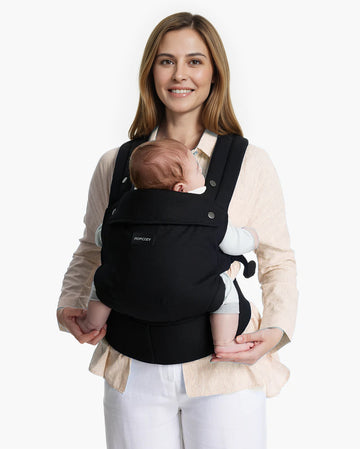
If you added up every lift, hold, and transfer in a single day, most parents would be shocked by the number. A crib pickup, a soothing bounce, a car seat transfer, a feeding session, another pickup ten minutes later. It's rarely one long carry that wears you down. It's dozens of short ones, often on the same side, stacked across a fragmented day, and that pattern shows up again and again in what parents describe when searching for back pain from carrying baby relief.
There is no one right answer as to why your back or shoulders hurt. This article is not designed to diagnose the cause of discomfort, which may be due to repeated load, one-sided holding, awkward bending during transfers, fatigue, postpartum recovery, an existing condition or fit of the carrier. What it can do is guide you through where the load is piling up, how to alter a lift or transfer, and where a baby carrier can be beneficial to redistribute weight during hands-free moments of the day.
The following tips go beyond just a new stretching routine; if the pain is intense, continuing, radiating, or accompanied by numbness, weakness, fever, trauma or difficulty in caring for your baby, it is time for professional assessment.

Key Takeaways
- Repeated lifting, one-sided holding, awkward transfers, fatigue, and postpartum changes can all contribute to back or shoulder discomfort, often with more than one factor at play.
- A baby carrier may redistribute load when it's properly fitted, but it can't diagnose, treat, or guarantee prevention of pain.
- Keeping your baby close before you lift reduces leverage on your spine, while twisting, reaching, or holding your baby away from your center of gravity increases the muscular demand.
- Frequent short pickups can add up into real strain even when no single lift feels heavy in the moment.
- Alternating tasks, changing sides, using stable surfaces, and building in recovery breaks can reduce repeated exposure, though they won't eliminate the caregiving that has to happen.
- Persistent, worsening, radiating, or neurologic symptoms call for professional evaluation rather than continued babywearing or a self-directed exercise plan.
Why Repeated Pick-Ups Feel Harder Than One Long Carry
A single long carry loads your body once and lets you adapt to it. A day of repetition with pickups puts the same tissues in your back, shoulders and core to bend, brace, lift, turn and lower again and again, occasionally before they'd recovered from the previous round. That is a different kind of demand than holding still.
Static holding and repeated transfers load the body differently and require different remedies. Lots of carrying for a long period also causes tiredness of your baby's posterior muscles that help support your baby upright, and repeated transfers from the crib, car seat, etc. bring bending and twisting in as well. None of them are bad in themselves, but a change of routine that's beneficial for one isn't necessarily beneficial for the other, so it's more helpful to examine your routine in particular than a general rule.
Map the Moments That Trigger Pain
It is helpful to become aware of when discomfort actually presents itself before making changes. Write down where it's located (shoulder, neck, mid-back, lower back), what you're doing (crib lift, floor pickup, car seat transfer, feeding, soothing, daycare pickup), which side and whether it improves after a short rest.
This is not for self-diagnosis. Fatigue in the shoulders and neck, tension between the shoulder blades, and lower-back pain can be related to various combinations of activities, and breaking up the activities will provide you with something more productive to work with, both when identifying a pattern and when you consult your doctor or physical therapist.
The Load Changes When Baby Is Farther From Your Body
In simple terms, the further away your baby is from you when you lift or hold them, the more rotation your spine and shoulders need to do. This is why leaning back to counterbalance a baby on one hip, rounding the shoulders while feeding, lifting from a crib at an angle, or reaching into a car seat at an angle is more difficult than lifting at an angle with baby centered.
None of this means you have to have perfect posture all the time. The more realistic goal is to keep your base stable and move your position before becoming tired, not while you are tired.
A Safer Pick-Up and Put-Down Sequence
Even if repeated lifts are necessary, a small mechanical adjustment can decrease the amount of stress that the lift imposes on the body. First, clear the way. Eliminate clutter and make frequently used items such as a burp cloth or pacifier easily accessible – don't lift and reach at the same time.
On picking up your baby, move in close first, get your feet into a stable position, get a solid grip and stand by pushing through your legs, not your back. After pivoting, turn with your feet rather than twisting around while carrying weight. When lowering your baby down, do it in reverse: approach slowly, bend at the knees and hips, and keep the movement controlled and not rushed out with a lunging arm.
Each of the crib transfers, car seat transfers, and floor pickups requires different geometry, and what works for one may not translate cleanly to another. If a specific transfer always causes pain, this is something to discuss with a physical therapist; they can examine your set-up.

Break the All-Day Carrying Cycle Into Shorter Load Blocks
Fragmented days make it easy to lose track of how much lifting and holding has actually happened. Grouping supplies in one spot, staging a soothing station instead of pacing the house, alternating between standing and seated tasks, and handing off to another caregiver when one is available can all reduce how much repeated load falls on you in a given stretch. Supportive seating can also help during longer feeding or soothing sessions, as long as your baby is always attended.
This won't resolve symptoms that are already persistent, but it reduces how much repeated exposure adds up over a day, which is a reasonable first step alongside a professional evaluation when one is needed.
When Babywearing May Help, and When It May Not
A carrier's potential value is fairly specific: when it fits both baby and caregiver correctly, it can offer hands-free support and spread your baby's weight across a broader area of your body instead of concentrating it on one arm or hip. That's genuinely useful during long stretches of soothing, chores, or errands.
It has real limits too. A carrier that's poorly fitted, sized wrong, or worn with your baby sitting low or away from your body can feel worse than carrying in arms, not better, and wearing time beyond your own tolerance isn't something a carrier will fix. The baby carrier dos and don'ts guide covers correct set-up worth reviewing before longer wear, and it's also worth checking how long a baby can safely stay in a carrier each day rather than guessing.
Use This Task-to-Change Table
| Care task | Common load pattern | Routine change | Escalate when |
|---|---|---|---|
| Repeated soothing lifts | Same arm/hip, frequent turns | Alternate sides; set up a stable soothing station | Pain persists or function declines |
| Crib transfer | Deep reach plus rotation | Move close; clear the path; turn with your feet | Sharp or radiating pain, or an unsafe reach |
| Floor pickup | Long lever from a low position | Bring baby close before rising; use stable support | Balance or strength feels unreliable |
| Car seat transfer | Reach into a confined space | Reposition your body/feet; avoid twisting under load | Pain, numbness, or weakness |
| Long arm carry | Baby drifts away or to one hip | Change side or task; use appropriate support | Symptoms worsen despite changes |
| Babywearing | Low, loose, or asymmetric fit | Reset the fit or stop; follow the carrier's instructions | Breathing concern, slumping, or pain |

Choosing Supportive Gear Without Turning It Into a Medical Claim
When you're considering a carrier as part of your daily load, here are some practical points that you might want to consider: secure fit, loads close to the child's body, waistband and shoulder structure that will support the load, easy adjustment, right sizing, and an on/off routine that you can do with a wiggly baby.
A helpful example is the PureHug ergonomic baby carrier, but this does not imply that it is a pain treatment or prevention. The 3D EVA lumbar support at the bottom of the back will relieve some pressure on your shoulders, while the wide padded straps will distribute pressure over a much larger surface area than a thin strap will. Your baby will be supported across the back with the X-strap back design, and the fit can be adjusted using 3 seat widths as your baby grows.

The X-back style also slides on solo, with side buckles that make getting your baby in and out easier without help. Fit still comes down to your own body and your baby's size, so it's worth checking body-specific guidance, like fit tips for petite frames or for plus-size parents, before assuming any carrier will fit the way it looks in photos.
Shoulder Pain Needs Its Own Check
While shoulder pain sometimes accompanies lower-back pain, it isn't always caused by the same factors. This could include repeated one-arm holding, shoulders moving towards the ears during a lift, an un-elegant car seat transfer, a feeding position and any mismatching of the straps of the carrier, but it doesn't necessarily mean it's a diagnosis. The time frame for comfortable carrying may be different if you've had a C-section or other delivery-related procedure, and it may be helpful to read guidance on carrying after a C-section before assuming your usual routine still applies.
Reasonable first steps are changing tasks and checking the fit of the carrier. Stretching or strengthening exercises are not to be undertaken without instruction – doing the wrong exercise for the wrong reason may worsen the situation. If you experience numbness, tingling, weakness, reduced grip strength, trauma, pain that is severe at night, or if it doesn't get better, you should stop self-managing and get it checked.

When to Stop and Seek Professional Care
Most pain that occurs during the transition to a new routine is normal, but pain is not something that can be tolerated indefinitely; no carrier, stretch or posture cue will solve all underlying causes. If the pain is severe or getting worse, spreading down an arm or leg, associated with numbness or weakness, after an injury, fever, bowel or bladder changes or if the pain prevents you from providing the care your baby needs, seek professional care. If you have a task log and you carry one (if you do), this visit can be more useful and specific.
Frequently Asked Questions
Is it normal to feel sore after carrying a baby all day?
It is not uncommon to experience some fatigue at the end of a long day of lifting and holding. If the soreness is sharp, it has gotten worse, or it is making it hard for you to do what you want, that's not something to shrug off, and it's important to tell a provider if it does not improve with rest.
Should I always carry my baby on the opposite side?
Switching sides can help to decrease repetitive strain on one side, but it does not always apply. This will vary depending on the activity you are doing, your baby's size, your body and if you have a pre-existing condition.
Can a baby carrier make shoulder or back pain worse? -
Yes, if it's the wrong fit, poorly adjusted, or worn longer than feels tolerable. If a carrier begins to cause pain, stop and reassess the fit of the carrier instead of tightening straps and forcing through the pain.
Is a hip seat better for frequent up-and-down carrying?
It could be appropriate for babies who are within the age and weight range of the product, but it also depends on how you plan to use the specific model and the ease of wear.
How soon after birth can I use a carrier if my back hurts?
There's no single timeline that fits everyone. It depends on your recovery, any symptoms you're having, whether your baby meets the carrier's requirements, and the manufacturer's instructions, so individualized guidance is worth seeking.
Conclusion
Repeated pickups, transfers, and one-sided holding can add up over a fragmented day, even when no single moment feels especially hard. The goal isn't to blame yourself for the discomfort, but to change how much load repeats and how you move through each lift, while watching for the signs that mean it's time for professional input. A well-fitted carrier can be one part of that routine, and the baby carrier collection is a reasonable place to compare newborn, hip seat, and wrap-style carriers side by side.








