
MEDICALLY REVIEWED BY

Dr Carly Dulabon, MD, IBCLC, NABBLM-C
Dr Carly Dulabon MD, IBCLC, NABBLM-C is medical director of the department of breastfeeding medicine with Akron Children's Hospital. She completed her medical degree at University of Toledo College of medicine, and her pediatrics residency at Children's Hospital of Pittsburgh. Her special interests are in maternal mental health and infant growth.
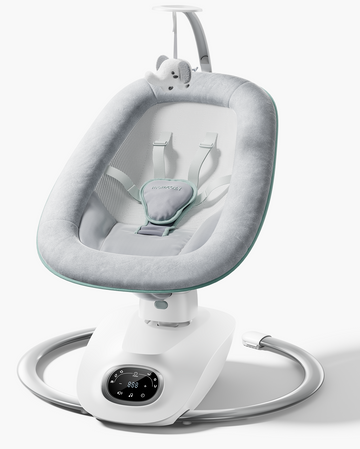
Use only the storage position your specific swing’s manual approves, then choose an in-apartment spot that leaves doorways, exit routes, and safety equipment clear. For a swing that is put away between daytime uses, the best plan is usually the one you can repeat without forcing the frame into an unapproved position: power it down as instructed, keep cords away from baby, store it as the manual instructs, and return it to its approved setup before the next use.
If no approved storage position fits safely in your home, do not improvise by balancing the swing upright, wedging it behind furniture, or placing it in an exit path.
Pick the Storage Zone Before Moving the Swing
In a small apartment, the most convenient empty patch of floor is not always an appropriate storage area. Choose one designated zone inside your unit first, then determine whether the swing can be placed there in a manufacturer-approved configuration.
A closet floor, an unused room edge, or a portion of the living area may work if the swing fits without being balanced, squeezed, or positioned where people must step around it. The goal is a predictable parking place—not the smallest possible footprint at any cost.
Rule out these locations first:
- Shared hallways, building corridors, stairways, and stair enclosures
- In front of an apartment door or along the route to an exit
- Near or in front of fire extinguishers, alarm controls, exit signs, or evacuation markings
- Any place where the swing could be easily knocked over or dislodged
- A location that prevents a door from opening normally
Exit-path safety guidance treats corridors, entrances, passageways, and stairways as emergency routes rather than storage areas. Your lease, building management, and local requirements may set additional rules, so follow those if they are stricter.
A simple test helps: stand at the apartment entry and walk the path you would use in a hurry. If the swing narrows, blocks, or complicates that route, choose another zone.
Let the Manual Decide the Storage Position
Do not assume a baby swing can fold because it has hinges, fit under a bed because it is low enough, or stand vertically because it balances that way. Those are model-specific questions.

Check the manual for instructions on:
- Folding and locking the frame
- Approved carrying or moving methods
- Whether the swing may be stored upright, on its side, or flat
- Detaching the seat, toy bar, adapter, or other accessories
- Power, battery, and cleaning procedures
- Any required inspection or setup steps before use
Use the manual to make the storage decision:
- If it provides a fold-and-lock procedure, use that exact procedure for daily storage.
- If it identifies an approved stored orientation, use only that orientation in your chosen zone.
- If it does not authorize folding, vertical storage, side storage, or disassembly, keep the swing in its normal approved configuration and find a space that accommodates it.
- If an under-bed or behind-furniture location requires bending, tipping, or forcing the frame, do not use it unless the manufacturer specifically permits that arrangement.
A closet is not automatically safer than an open room corner. It works only when the swing can enter, rest, and come back out without changing its approved configuration or causing clutter to fall onto it.
Build a Fast Daily Put-Away Routine
The best daytime routine is short enough to use after every session. It should reduce clutter without creating a complicated reassembly job later.

- Remove baby and switch the swing off. Follow the manual for unplugging, disconnecting, or other power steps.
- Deal with the cord according to the product instructions. Whether the adapter stays attached or is removed depends on the model, but the cord should never remain reachable by a baby. The CPSC’s cord-safety guidance emphasizes keeping cords away from babies because strangulation can happen quickly and may be silent.
- Leave or remove accessories only as directed. Do not automatically take off toys, seat pads, or the power adapter for a few hours of storage. Removing parts unnecessarily can make daily setup harder and can increase the chance that something is reattached incorrectly.
- Move the swing by the manufacturer-designated method. Do not drag it by the seat, toy bar, cord, or a part not intended as a handle.
- Place it in its approved stored position. Keep it clear of the apartment’s doors and paths of travel.
- Check for moisture or spills. If the swing or its textiles need cleaning, follow the care instructions before storing them.
For a swing used several times a day, keep the storage zone simple. The fewer items you must move before parking or retrieving it, the more likely the routine will remain safe and workable.
Treat Daily Storage and Long-Term Storage Differently
Putting a swing away for a few daytime hours is not the same as storing it for months. Avoid turning a quick daily reset into unnecessary disassembly unless the manual requires it.
|
Factor |
Between Daytime Uses |
Several Months of Nonuse |
|
Frame position |
Use the manual-approved storage or folded position. |
Follow the manual’s longer-term storage directions. |
|
Batteries |
Follow the swing manual; do not assume daily removal is required. |
Remove batteries when equipment will not be used for several months, as batteries may leak over time. |
|
AC power |
Follow the product instructions. |
Follow the manual before packing the unit away. |
|
Temperature |
Avoid very warm storage areas for battery-powered equipment. |
Continue to avoid very warm areas, which can reduce battery performance and contribute to leakage. |
|
Cleaning |
Address spills and keep components in the condition the manual requires. |
Clean and dry components as instructed before storage. |
If you remove spare batteries from the swing, keep them in their original packaging in a dry location at normal room temperature.
Cleaning directions can vary substantially. For example, MamaRoo care instructions call for thoroughly drying the frame rather than storing it wet; its seat fabric and infant insert have their own washing and flat-drying directions. That is an example of why your swing’s own care guide—not another model’s instructions—should determine whether a pad, insert, or frame is ready to store.
Reset the Swing Before Every Use
Storage should not become a shortcut around safe setup. Each time you bring the swing back out, return it fully to the manufacturer-approved use condition.

Before placing baby in the swing, check:
- The swing is on a flat, stable floor.
- Any frame sections are fully opened and locked, if applicable.
- The seat, fabric, insert, and accessories are correctly attached as the manual directs.
- Parts that should be dry are dry.
- The harness is present and ready to use as instructed.
- The cord and adapter are positioned safely and are not accessible to baby.
- Nothing nearby could interfere with the swing, its moving parts, or safe access to it.
Know When the Plan is Not Working
A storage method has failed if it depends on an unapproved position, blocks a needed path, leaves a cord accessible, or makes proper setup so cumbersome that steps are likely to be skipped.
Use this decision path:
- If your swing has an approved storage position and you have a clear, accessible in-unit zone: establish the daily put-away and pre-use checklist.
- If the only possible location is a hallway, doorway, exit route, stair area, or an improvised upright or side position: do not store it there.
- If the swing cannot be stored and reset safely within your apartment routine: reassess the layout or compare other compact soothing options that better fit the available space.
The right solution is not necessarily the smallest storage footprint. It is the one that lets you put the swing away, bring it back out, and use it as instructed every time.









