
MEDICALLY REVIEWED BY

Dr Carly Dulabon, MD, IBCLC, NABBLM-C
Dr Carly Dulabon MD, IBCLC, NABBLM-C is medical director of the department of breastfeeding medicine with Akron Children's Hospital. She completed her medical degree at University of Toledo College of medicine, and her pediatrics residency at Children's Hospital of Pittsburgh. Her special interests are in maternal mental health and infant growth.
A stable, relatively flat, non-sagging high-chair seat may help a baby maintain a more active upright posture during meals. But seat firmness alone has not been directly shown to improve core stability or build core strength.
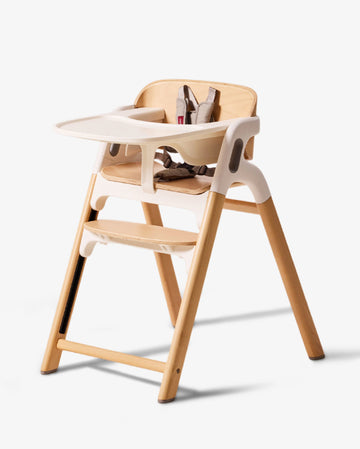
The bigger priority is the whole seating setup: a chair that fits your baby, an upright backrest, correctly used restraints, a tray close enough for easy reaching, and stable foot support. Think of seat firmness as one part of a supportive base—not a stand-alone solution for slumping, leaning, or feeding difficulty.
What Seat Firmness Can—and Cannot—Do
Clinical positioning guidance favors a flat, firm seat because it can allow a child to sit more directly on their “sit bones,” supporting an active upright posture. By comparison, deeply contoured or bucket-style seats may encourage the pelvis to tip backward, which can contribute to a rounded spine.

That does not mean the hardest possible seat is best, or that a firm chair will strengthen a baby’s trunk. There is limited direct research comparing soft and firm high-chair seats as independent causes of infant postural stability. Available guidance is mainly about posture, seat shape, and overall support.
A useful distinction:
- Stable, flat, non-sagging: May provide a more predictable base for the pelvis and trunk.
- Deeply contoured: May make it easier for a baby to slide backward or round forward.
- Very hard but poorly fitted: Will not solve poor posture if the chair is too large, reclined, deep, or missing foot support.
A supportive seat can reduce how much effort a baby spends trying to stay in position, leaving more attention for reaching, grasping, bringing food to the mouth, and participating in the meal. For more on the full seating picture, see this guide to 90-90-90 posture and foot support in a high chair.
Set up the Whole Chair for an Upright Meal
Before deciding that a seat is too soft or too hard, assess the rest of the chair. A stable meal position depends on several features working together.

Start with Readiness and Upright Control
When beginning solids—commonly around 6 months—readiness, upright positioning, close supervision, secure harness use, and following the chair manufacturer’s instructions are key safety priorities.
A baby should be alert and able to maintain upright head and trunk control for the meal. A high chair should support that position, not hold a baby in a reclined posture for eating solids.
Use 90-90-90 as a Flexible Guide
The 90-90-90 framework is a useful shorthand, not a requirement to measure your baby’s joints at every meal. It generally means:
- Hips are positioned at approximately 90 degrees.
- Knees are positioned at approximately 90 degrees.
- Feet have support so ankles can rest at approximately 90 degrees.
Babies vary in size, proportions, and developmental abilities, so the goal is functional support rather than perfect geometry. Look for a position in which your baby appears comfortably upright, with their bottom supported in the seat and their feet resting on a stable footrest when the chair provides one.
Foot support matters because it gives the baby a stable base. Unsupported, dangling feet can make it harder to maintain position and may contribute to restlessness or fatigue.
Bring Food Within Easy Reach
A tray should be close enough that your baby can reach food without repeatedly leaning far forward. There is no universal tray distance, but excessive reaching can pull the trunk out of position and make balance more difficult.
A well-set chair usually lets a baby:
- Sit upright rather than recline or collapse forward.
- Rest securely against the back of the chair.
- Use the harness as instructed by the manufacturer.
- Reach the tray without a large forward lean.
- Place both feet on the chair’s footrest when available.
Troubleshoot Fit Before Blaming the Cushioning
Slumping, sliding, leaning, or fussing can point to a chair-fit issue. They do not diagnose a developmental, motor, or feeding condition—but they are worth noticing.

What You Notice |
Possible Setup Issue |
Safe Next Step |
Baby slides forward or sinks into the seat |
Seat may be sagging, overly contoured, too deep, or poorly matched to the child’s size |
Check the manufacturer-approved seat settings and restraint fit. If the chair cannot provide a stable fit, consider a better-fitting chair rather than adding padding. |
Baby rounds forward or slumps |
Backrest may be too reclined, the seat shape may encourage a backward pelvic tilt, or the child may be working hard to stay upright |
Set the chair to its approved upright feeding position, confirm the harness is used correctly, and reassess the seat’s fit and shape. |
Baby leans to one side repeatedly |
The chair may be too large or not providing enough support for the child’s current size |
Check approved adjustments and observe whether the child can stay centered. Persistent leaning deserves professional guidance rather than a furniture-only fix. |
Feet dangle well above the footrest |
Footrest height may not match the child |
Adjust the built-in footrest if the chair allows it. An adjustable footrest can help maintain support as a child grows. |
Baby must reach far forward for food |
Tray may be too far away |
Use the tray’s manufacturer-approved setting to bring food closer, if available. |
Do Not Add Improvised Padding
Do not use loose cushions, rolled towels, wedges, aftermarket inserts, or other improvised padding to make a seat firmer, shallower, or more comfortable unless the high-chair manufacturer explicitly permits that exact accessory and setup.
An addition can change how the harness fits, alter the child’s position, affect stability, or create cleaning and entrapment concerns. The safe route is to use only manufacturer-approved adjustments and accessories.
If the chair remains too deep, too reclined, too wide, or otherwise poorly fitted after approved adjustments, a different chair may be a safer practical choice than trying to modify the one you have.
When a Chair Adjustment is Not Enough
A stable, well-fitted chair can support comfortable meal participation, but it is not treatment for swallowing, motor, or developmental concerns.
If your baby is upright, securely positioned, and comfortable after safe setup adjustments, continue using the manufacturer-approved configuration and monitor how they do during meals.
Pause the furniture troubleshooting and contact your child’s pediatrician or a qualified pediatric feeding or physical therapist if your child continues to slump, slide, lean, cough, choke, or struggle during meals despite a stable setup. Uncertainty about feeding posture or support needs is a good reason to seek individualized guidance.









