
MEDICALLY REVIEWED BY

Zola Zhang, MD, IBCLC, Breast Surgeon, Mother
Breast Surgeon | International Board Certified Lactation Consultant | Mother
As a dedicated Breast Surgeon and International Board Certified Lactation Consultant (IBCLC) with 21 years of clinical experience, my work is rooted in both medical expertise and the lived reality of motherhood—because I’m not just a clinician, but also a mother who exclusively breastfed my own child for two years. This dual perspective shapes every interaction, allowing me to blend scientific rigor with deep empathy for the joys and challenges of breastfeeding.
The most reliable way to reduce diaper-pail odor is not to add a stronger scent. Start by removing the waste, keeping the pail sealed, cleaning residue from the lid and chute, and letting every washed part dry completely. Neutralizers are best treated as backup for lingering odor—not a substitute for cleaning or a pail that closes properly.
Among the options commonly discussed, baking soda has the clearest pail-specific support here: it can be used as a cleaning solution for stubborn lingering smells on a compatible pail. The available evidence does not establish that loose baking soda, activated charcoal, essential oils, scented bags, or fragrance pods work better than regular emptying, cleaning, and good sealing.
Fix the Odor Source Before Adding Anything
A diaper pail can smell for several reasons: a full bag, residue around the chute or lid, a liner that is not fitted correctly, moisture left behind after cleaning, or a seal that is worn or not closing fully. A deodorizer may make the smell less noticeable for a while, but it cannot correct those problems.

Before choosing an odor-control product, work through this short list:
- Empty the bag if odor is building. Do not wait for a universal number of days; diaper volume, stool-heavy loads, room conditions, and your pail’s seal all affect when a bag needs changing.
- Check the liner and closure. Make sure the bag is seated properly and that the lid, gasket, clamp, or other sealing parts close as intended.
- Clean visible residue. Pay special attention to the chute, underside of the lid, seams, and other areas that may not be reached during a quick bag change.
- Dry the pail fully. Closing a damp pail can leave lingering odor behind.
- Inspect worn parts. A cracked lid, damaged sealing ring, or loose lock can matter more than whichever neutralizer you choose.
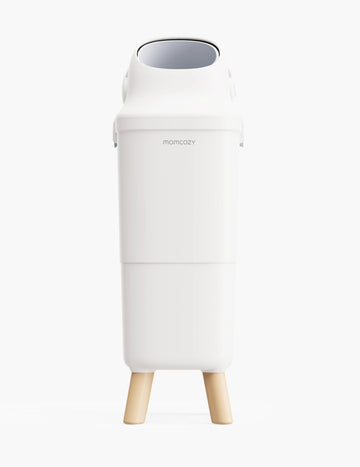
For example, the Momcozy Triple-Seal Diaper Pail is designed to control odor through physical sealing during disposal, storage, and bag removal, with a separate deodorizer pack intended for residual odor. Its manufacturer also notes that plastic can retain smells over time and benefits from regular cleaning and airing out.
That hierarchy is useful for any pail: contain the waste first, remove residue second, and consider an accessory only after the basics are working.
What Each Odor-Control Option Can Realistically Do
The important distinction is between cleaning, containment, an odor absorber, and fragrance. These are not interchangeable.
Option |
Realistic Role |
What the Available Evidence Supports |
When to Skip or Reconsider It |
Baking soda |
Cleaning aid for stubborn lingering odor |
A baking-soda solution may be used to wipe the inside of the Momcozy Triple-Seal Diaper Pail, followed by thorough air-drying |
Do not assume loose dry powder in the pail is tested, approved, or more effective |
Activated charcoal |
Conditional accessory |
The available material does not establish charcoal performance in diaper pails or show that it outperforms cleaning and sealing |
Skip it if your manual does not allow it, if it could interfere with the mechanism, or if it cannot be securely contained |
Essential oils |
Fragrance choice, not a proven odor-control fix |
The available material does not establish that oils remove diaper-pail odors or are compatible with pail materials and filters |
Avoid adding oils when fragrance is unwanted, compatibility is uncertain, or the oil could contact plastic, seals, or filters |
Scented liners, pods, and refills |
May change the smell around the pail |
The available material does not show that scented products control diaper-pail odor better than maintenance |
Reconsider if the scent merely covers an underlying dirty, damp, or poorly sealed pail |
Approved pail deodorizer or filter |
Residual-odor accessory |
Its usefulness depends on the specific pail and manufacturer instructions |
Replace it on the stated schedule and do not treat it as a replacement for cleaning |
Baking Soda: Best Used as Part of Cleaning
Baking soda is often discussed as a dry deodorizer, but the pail-specific guidance available supports a narrower use: a baking-soda solution for wiping stubborn lingering smells, followed by thorough air-drying in a well-ventilated place.
That matters. A cleaning solution addresses odor that has settled on the interior surface. It does not prove that sprinkling loose powder into the bottom of a pail, bag path, lid, or filter compartment will work better—or that it will be compatible with every design.
If your pail manual does not mention baking soda, follow the manual rather than experimenting inside the mechanism.
Charcoal: A Conditional Add-on, Not a Proven Winner
Activated-charcoal sachets and filters are often marketed for odor control, but the approved material does not directly test charcoal in diaper pails or compare it with baking soda, essential oils, scented liners, or routine cleaning
A charcoal product may be worth considering only when it is designed for your pail or can be kept securely contained without obstructing the lid, bag path, seal, or moving parts. It should be treated as an accessory for residual odor, not as a fix for a full bag, dirty chute, or failing gasket.
Essential Oils and Scented Products: Do Not Mistake Fragrance for a Fix
Essential oils, scented bags, and fragrance pods may change the smell you notice when you open the pail, but they are not established in the available evidence as superior odor-control tools. If a strong fragrance is covering up a persistent odor, you may miss the fact that residue is collecting around the lid or that the pail is no longer sealing well. For fragrance-sensitive households, skipping fragrance is the simpler choice.
Keep Additives Contained and Compatible
Do not put loose powder, beads, sachets, or other small odor-control materials where a child could access them or where they could fall into a moving lid or bag mechanism.

Before using any deodorizing product:
- Read your pail’s manual and cleaning instructions.
- Use only accessories the manufacturer approves for that model when possible.
- Do not drip oils onto filters, seals, liners, or plastic components.
- Do not place a sachet where it can block a closing mechanism or move into the bag path.
- Stop using an additive if it leaves residue, affects closure, or makes cleaning more difficult.
The available manufacturer guidance specifically cautions that unknown disinfectants can corrode plastic and shorten a pail’s life. It does not verify compatibility for essential oils, charcoal sachets, fragranced products, or commercial deodorizers. When compatibility is unclear, do not assume that a household product is safe for the pail’s plastic, seals, or installed filter.
Build a Low-Effort Odor Routine
A simple routine prevents the cycle of repeatedly adding deodorizer to a pail that needs cleaning.

After Messy Use
Wipe any soiled chute or lid area promptly. For the Momcozy Triple-Seal Diaper Pail, the manufacturer advises wiping soiled chute areas daily with a baby wipe or damp cloth, then allowing them to dry completely before closing the lid. That is model-specific guidance, but the basic principle applies broadly: residue and trapped moisture deserve attention.
At Each Bag Change
Use the bag change as an inspection point:
- Check that the liner fits correctly.
- Look for residue under the lid and around the opening.
- Confirm that the lid, locks, and seal close normally.
- Empty earlier when odor is rising rather than relying on capacity alone.
For its 22-liter pail, Momcozy gives an average emptying range of every 3–5 days, depending on the child’s age and daily diaper use. That is not a universal odor or hygiene schedule for every pail.
During a Deep Clean
Deep-clean according to your pail’s instructions. The Momcozy Triple-Seal Diaper Pail guidance recommends at least monthly deep cleaning and checking sealing rings and locks for wear or damage. If stubborn odor remains after cleaning, a baking-soda solution may be used as directed for that model, followed by complete air-drying.
Its included deodorizer pack is intended for residual odor and is recommended for monthly replacement. That replacement schedule applies to that specific product; other pails may use different filters, accessories, or no filter at all.
When the Smell Keeps Coming Back
If odor returns immediately after cleaning, do not keep layering on fragrance. Work through the likely failure points:
- Empty the bag and remove any hidden residue.
- Wash the interior and accessible lid or chute components according to the manual.
- Dry every part completely before reassembling.
- Inspect the liner fit, lid, gasket, locks, and closing action.
- Replace a worn, manufacturer-approved seal or filter if your pail uses one.
- If the pail still cannot close or seal effectively, inspect for damaged components and replace them as needed.
Remove the waste and clean the odor source first. Then confirm that the pail seals properly and that the liner or approved filter is in good condition. Only after that should you add a compatible, contained odor-control option if you still need one. For more practical diapering and nursery-care routines, explore Momcozy’s diapering guidance alongside your pail’s own care instructions.









