


MEDICALLY REVIEWED BY

Zola Zhang, MD, IBCLC, Breast Surgeon, Mother
Breast Surgeon | International Board Certified Lactation Consultant | Mother
As a dedicated Breast Surgeon and International Board Certified Lactation Consultant (IBCLC) with 21 years of clinical experience, my work is rooted in both medical expertise and the lived reality of motherhood—because I’m not just a clinician, but also a mother who exclusively breastfed my own child for two years. This dual perspective shapes every interaction, allowing me to blend scientific rigor with deep empathy for the joys and challenges of breastfeeding.
No—not based on weight alone. Your baby can use a swing only if your exact model’s manual and warning label still allow it under every applicable limit: age, weight, height or size (if listed), product mode, harness fit, and developmental stop-use warnings. If any one limit has been reached—or you cannot confirm it—stop using the swing.
Weight limits and age or milestone limits are not interchangeable. A baby may remain below the listed maximum weight but become too mobile for the seat to be used safely. This swing-safety guide identifies rolling, sitting independently, and trying to climb out as reasons to transition away from swing use.
Start With Your Exact Model’s Manual
The manual and warning label for the specific swing in your home are the decision-makers. Do not substitute:
- An online product listing
- Advice for another brand or model
- A limit from a different product mode
- A weight limit from a bouncer, rocker, or portable seat
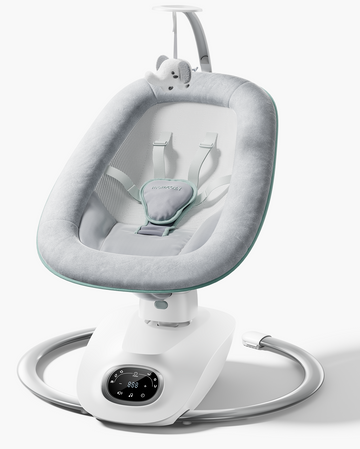
Some multi-use products have different limits depending on whether they are being used as a swing, bouncer, or rocker. A full-size swing, portable swing, bouncer, and infant rocker are not interchangeable categories, even when they look similar or serve a similar soothing purpose.
Before using the product, find the model number and check for all of these items in the manual or on the label:
- Minimum and maximum age, if listed
- Minimum and maximum weight
- Height or size restrictions, if listed
- The approved mode of use
- Harness instructions and fit requirements
- Developmental stop-use warnings
- Warnings about rolling, sitting, pushing up, climbing, or other mobility
- Placement and accessory instructions
A practical rule: if the manual says stop at a particular age, size, ability, or mode-specific limit, remaining under the weight limit does not override that instruction.

If the manual is missing, the product label is unreadable, or the harness no longer fits as directed, stop using the swing until you can get clear instructions from the manufacturer.
Mobility Can End Swing Use Before Weight Does
Babies often change more quickly in mobility than in weight. That is why a remaining weight allowance is not a reliable green light by itself.
Common stop-use conditions to look for
Stop using the swing if your manual says to stop when your baby:
- Rolls over
- Sits independently
- Attempts to climb out
- No longer fits securely in the harness as instructed
- Reaches another age, height, weight, or developmental limit
Rolling, sitting independently, and trying to climb out are common reasons to discontinue swing use, even when the baby has not reached the maximum weight. Your product may set earlier limits or list additional stop-use conditions, so its instructions may be stricter than this general guidance.

Always secure the harness exactly as the manual directs. However, a properly fastened harness does not cancel a stop-use warning or make an outgrown swing appropriate again.
If Use Is Still Allowed, Keep It Awake and Supervised
If your baby still meets every stated requirement for the specific product, use the swing only in its approved configuration and for awake, supervised time.
A simple awake-use check:
- Place the swing on a flat, stable floor—not on a table, counter, bed, sofa, or other elevated surface.
- Use the correct mode for the product.
- Fasten the harness as directed.
- Do not add blankets, swaddles, extra padding, or non-manufacturer inserts.
- Use only accessories supplied with the product or specifically approved in its instructions.
- Rotate swing time with other positions and activities rather than making the swing your baby’s main location.
There is no universal session-length rule that applies to every swing and every child. Instead of relying on a single number, follow your manual and vary your baby’s positions and activities throughout the day.
A Swing Is Not a Sleep Space—Even for an Older Baby
Being older, still fitting in the seat, staying under the weight limit, or being closely watched does not make sleep in a swing appropriate.
Swings and other semi-reclined seating devices are for awake, supervised use. In a semi-reclined bouncer or swing, an infant can slump forward in a way that may obstruct the airway. Supervision does not turn a sitting device into a routine sleep surface.
If your baby becomes drowsy or falls asleep in the swing, move them to a safe sleep space. The American Academy of Pediatrics identifies a crib, bassinet, or portable play yard with a firm, flat mattress and fitted sheet as appropriate sleep options, and advises avoiding seating devices for sleep. See the AAP’s Safe Sleep: The Back to Sleep Campaign.

This applies to short naps as well as longer sleep. Do not make an exception because your baby is older or because the harness still fits.
What to Use Instead When the Swing Is No Longer Appropriate
Outgrowing a swing does not mean your baby has to lose every calming routine. Match the alternative to the immediate need.
For awake time, options may include:
- Supervised floor play
- Caregiver holding
- Changing positions and activities through the day
- An age-appropriate seating or play option only if your child meets that product’s own instructions
For sleep, use a crib, bassinet, or portable play yard with a firm, flat mattress and fitted sheet—not a swing, rocker, bouncer, or other seating device.
Five Steps Before You Use the Swing Again
- Find the exact model manual and warning label.
- Check every limit—not just weight—including age, size, mode, harness fit, and developmental stop-use warnings.
- Search the model in the CPSC recall database and stop using it if a relevant recall applies.
- Stop immediately if your baby has reached any limit, rolls, sits independently, attempts to climb out, or cannot be secured as directed.
- Use a firm, flat sleep surface for sleep and reserve any still-approved swing use for awake, supervised time.
For additional help choosing what fits your baby’s next developmental stage, explore Momcozy’s safe-sleep and developmental-stage resources.









