


MEDICALLY REVIEWED BY

Zola Zhang, MD, IBCLC, Breast Surgeon, Mother
Breast Surgeon | International Board Certified Lactation Consultant | Mother
As a dedicated Breast Surgeon and International Board Certified Lactation Consultant (IBCLC) with 21 years of clinical experience, my work is rooted in both medical expertise and the lived reality of motherhood—because I’m not just a clinician, but also a mother who exclusively breastfed my own child for two years. This dual perspective shapes every interaction, allowing me to blend scientific rigor with deep empathy for the joys and challenges of breastfeeding.
Wash every bottle and feeding part thoroughly after each use. For many older, healthy babies, careful washing may make a separate daily sanitizing step unnecessary. But daily sanitizing is particularly important for babies younger than 2 months, babies born prematurely, and babies with weakened immune systems. In those situations, follow your baby’s clinician, local public-health guidance, and the feeding-equipment manufacturer’s instructions.
Washing is not a lesser version of care—it is the foundation. Sanitizing is an added layer when your baby’s age, health, or local guidance calls for extra germ reduction.
Use a Risk-Based Routine
A practical way to decide is to start with what never changes: clean feeding items after every feed. That includes every surface that contacts milk or your baby’s mouth—not just the bottle itself.
Then consider whether your family should add a routine sanitizing step.
Situation |
Practical Approach |
Healthy, older baby and items are carefully cleaned after every use |
Thorough washing may be sufficient without separate daily sanitizing. |
Baby is younger than 2 months |
Add daily sanitizing. |
Baby was born prematurely |
Add daily sanitizing and follow clinician guidance. |
Baby has a weakened immune system because of illness or medical treatment |
Add daily sanitizing and ask the baby’s clinician for individualized advice. |
Local health guidance recommends sterilizing for longer |
Follow the applicable local recommendation. |
For help turning age, health, and local guidance into a repeatable routine, see this guide to how often to sanitize baby bottles.
The CDC’s infant feeding-item guidance uses this age- and risk-based approach: careful cleaning after every use may be enough for older, healthy babies, while daily sanitizing is particularly important for babies under 2 months, premature babies, and babies with weakened immune systems.
In everyday conversation, families often say “sterilizing” when they mean using a home sanitizing method. It is helpful to keep the sequence clear: clean first, then sanitize if needed. Sanitizing does not replace washing away milk residue.
Check First-Use Instructions and Local Guidance
New bottles, nipples or teats, rings, caps, valves, membranes, and compatible pump parts should be cleaned before first use. Always follow the manufacturer's instructions, because materials and safe cleaning methods differ.
Guidance can also differ by country.
Rather than treating either schedule as a one-size-fits-all rule, use this order of priority:
- Your clinician’s advice for a premature, medically vulnerable, or immunocompromised baby.
- Local public-health guidance for your country or region.
- Manufacturer instructions for each bottle, nipple, pump part, dishwasher basket, or sanitizing device.
What Thorough Washing Actually Means
A quick rinse is not the same as cleaning. Used bottles need to be washed before they are used again; simply rinsing can leave conditions that allow germs to grow when milk or formula is added. For detailed disassembly, brushing, rinsing, and drying instructions, follow this step-by-step guide to washing baby bottles.
After Every Feed, Clean All Removable Parts
- Wash your hands with soap and water for 20 seconds before handling used or cleaned feeding items.
- Take the feeding equipment apart. Separate bottles, nipples or teats, rings, caps, and any valves or membranes.
- Use a clean basin or container reserved for infant feeding items rather than washing directly in the sink.
- Wash with hot water and soap. Scrub with a clean brush used only for infant feeding items.
- Clean nipples carefully. Squeeze water through nipple holes to help clean them.
- Check the manufacturer’s instructions for parts that should not be brushed or that need a specific cleaning method.

The same principle applies to breast-pump parts that contact breast or breast milk: take them apart and clean them as soon as possible after each pumping session. Follow the pump manufacturer’s directions, since some parts can be damaged by particular cleaning methods. See this guide to cleaning and storing breast-pump parts.
Choose a Sanitizing Method Your Equipment Can Handle
Sanitize only after feeding items have been cleaned. The right method depends on whether the equipment is dishwasher-safe, heat-safe, and approved for a particular steam system.
Method |
When It Can Work |
Key Check |
Dishwasher |
Dishwasher-safe items are washed using hot water plus a heated drying cycle or a sanitizing setting |
Not every dishwasher cycle qualifies; confirm the item is dishwasher-safe. |
Boiling |
Disassembled items are safe to boil |
Cover items with water and boil for 5 minutes; follow manufacturer guidance. |
Microwave or plug-in steam system |
The feeding items and system are designed for that use |
Follow the system and feeding-item instructions for loading, heating, cooling, and drying. |
Chemical or cold-water solution |
Heat-based options cannot be used or local guidance recommends it |
Use only as directed by the solution manufacturer, including contact time and replacement instructions. |
A dishwasher can reduce the need for a separate sanitizing step only under the specified conditions: dishwasher-safe feeding items, hot water, and a heated drying cycle or sanitizing setting. An ordinary cycle should not automatically be assumed to provide the same result. Compare bottle-cleaning and sanitizing options based on your equipment and routine.
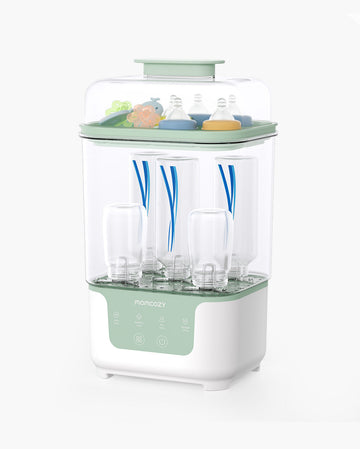
Boiling is another option for items the manufacturer says are safe to boil. Because high heat can affect some materials, do not boil parts simply because they look sturdy. Likewise, use microwave steam bags, microwave sterilizers, and plug-in steam systems only with compatible equipment and according to the instructions provided.
Protect Clean Items From Recontamination
Cleaning and sanitizing do their job only if the equipment stays clean afterward.
- Wash your hands before touching cleaned or sanitized parts.
- Let items air-dry completely in an area protected from dirt and dust.
- Do not rub or pat them dry with a dish towel, which can transfer germs.
- Once everything is dry, reassemble the feeding items.
- Store them in a clean, protected area until needed.
If you use a drying rack for feeding equipment, keep it for infant feeding items rather than using it for general dishes. Bottle brushes and wash basins also need care: rinse and air-dry them after use, and wash them regularly. For babies under 2 months, premature babies, or babies with weakened immune systems, wash the basin and brush after every use.
Thorough washing after every feed is the essential routine for every family. Sanitizing is an extra layer—not a reason to panic—when you are preparing new equipment, caring for a higher-risk baby, or following local guidance that calls for it. Choose a routine you can perform consistently, confirm what your equipment can safely handle, and ask your clinician for advice when your baby has special health needs.








