


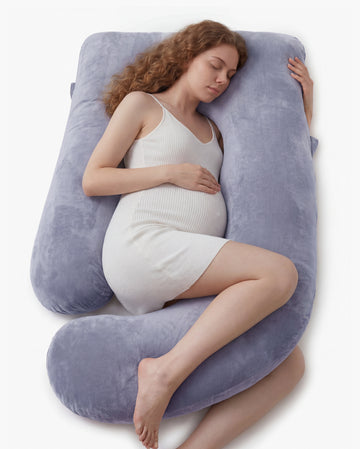
Finding a comfortable side sleeping position during pregnancy will take a bit of trial and error. A pillow may be perfectly supportive in one position, and then you move, and there's a gap right up by the belly or the legs. The point is not to get it absolutely right in one position; it's to work out where you need support and then position your pillows to provide that.
If you're looking at various options, then you might want to check out the Momcozy pregnancy pillow collection to see what's available.
This guide will walk you through how to use a pregnancy pillow for side sleeping. You will also learn how to adapt it to your own needs, and how to make changes when your standard setup is no longer working for you.

Key Takeaways
- Start by working out which area you need support in (your tummy, your back, your knees, or your legs).
- Position the pillow so that it's making good contact with the areas you want to support without forcing your body into any one position.
- A pillow between your knees during pregnancy may well help to achieve a more comfortable position for your legs.
- U-shaped, C-shaped, and J-shaped pillows all give you different layouts, but there is no one shape that is best for everybody.
- Recheck your pillow position every time you change sides or notice a fresh gap.
- Adjust the head section, the surrounding fabric, and the overall footprint if the setup feels too high, too warm, or too crowded.
- A pregnancy pillow is optional. Regular pillows will probably be quite sufficient if they give you the support you're after.
- A pillow can provide comfort; it won't necessarily keep you in one position all night, and it won't treat a medical condition.
Start with the Area That Needs Support
Before you go and get a pregnancy pillow, work out which bit of you needs the support. That way, you don't end up with an extra cushion or a rather large pillow when you might only need a small one.
Belly Support
If you're after some support under your belly when lying on your side, then position a soft part of the pillow so that it's resting gently against that area. It should be comfortable rather than pushing your belly up or in any way restricting you. If you find there's a gap between your body and the pillow, then adjust the position accordingly.
You may want more support as your pregnancy progresses. It's worth checking how the pillow feels when you're in your normal position rather than just going on the basis that the same setup will be comfortable every night.
Knee and Leg Support
Your knees and legs may require a different sort of support for your belly. A longer pillow can be used as a surface to rest your upper leg on; a smaller cushion can go between your knees. The idea is to get a comfortable position without having to hold your legs in place.
When it comes to pregnancy pillow positions for side sleeping, think about the relationship between your knees, your hips, and the amount of pillow space you have. If the pillow is too thick between your knees and your legs are feeling all odd, then just move it or try a thinner pillow.
Light Back Contact and Comfortable Head Support
Some people like their pillow just resting lightly behind them. Others prefer a lot more open space. If you're using a pillow behind you, then position it for comfortable contact rather than having it there to stop you from moving.
Your head pillow is also important. It should be comfortable for your head and neck, and you shouldn't have to tilt your head up or down very much at all. You may well be able to just stick with your normal head pillow and not need to use the head section of a pregnancy pillow at all.
Build a Simple Side Sleeping Setup
A comfortable arrangement needn't, in fact, go all the way around your body. Start with the minimum number of pillows you need to support the areas you've established.
- First, get into your preferred side-lying position. Put a pillow where you'd like it to be and check that it's properly in contact with your body. Suppose you need support under your belly and between your knees, then get that in place separately before adding in another pillow.
- Next, check that you can move your arms and legs freely. The pillow should not be in a position that's going to squeeze you or make it difficult to change position. If you're sharing a bed, then think about how much space the arrangement leaves for the other person.
- Give the setup a moment before making any further changes. If one area still feels unsupported, then just move the relevant pillow rather than adding several cushions at once. It's far easier to work out what feels better if you only change one thing at a time.
The same is true when you're learning how to sleep with your pregnancy pillow for the first time. Start off with a very simple setup, see how it feels, and then modify it to suit your own comfort. You don't need to exactly replicate the picture as your body shape, the space you have in the bed, and your own individual preference will all be different.
Position a U-Shaped Pregnancy Pillow

A U-shaped pregnancy pillow (with two long sides joined by a curve) can provide support on either side of the body depending on how you position it. The downside is that it's going to take up quite a bit of bed space due to its size and shape.
- Start by putting the pillow in a position that allows you to lie in it comfortably in its shape. Get onto one side and check where the pillow is touching your tummy, your back, and your legs. You may well end up with one section in front of you and one behind you, but you don't necessarily have to use all the sections in the same way.
- Pay attention to the head section. You may not need to add your normal head pillow on top if it’s already comfortable. Suppose there’s already an extra pillow, and the total height feels a bit awkward. Remove the extra pillow or reposition it until your head and neck are comfortable.
A U-shaped design can be useful if you want support available on both sides. That is especially true if you often change sides during the night. It doesn't necessarily mean that it will stay in position, and you'll still probably need to readjust it at some point.
As a further example of this format, take the Momcozy Huggable U-Shaped Maternity Body Pillow. Check out the product specification and instructions for the exact model you're considering prior to making up your mind about its features and configuration.


Arrange a C-Shaped or J-Shaped Pillow

C-shaped and J-shaped pillows have a more open layout than the U-shaped. With the particular model in question, the curved or extended section will provide support to certain areas and leave more space around the rest of your body.
C-Shaped Pillow
For a C-shaped pillow, you'll want to work out which part of the curve is going to get to the bit you're trying to support. You could have one section positioned near your tummy and another near your back or your legs, depending on the shape of the pillow and your own preference as to where you're going to use it. Don't assume that every C-shaped pillow is going to get to all those areas in the same way.
J-Shaped Pillow
A J-shaped pillow has a more open configuration, so you may need to position the longer part quite carefully to get to the area that you need support for. If it's providing good support for your upper body but leaving your knees unsupported, then you may want to consider whether a small additional cushion would be of any benefit.
With either shape, ensure the pillow doesn't force you to twist or stretch to get to the support you require. Move the pillow rather than trying to maintain an uncomfortable position. The ideal arrangement is the one that works for your body and your sleeping space rather than one that conforms to some universal diagram.
Use Compact Cushions or Regular Pillows
A dedicated pregnancy pillow isn't essential to having a comfortable side sleeping arrangement. If the pillows you're used to are providing the support you want, then by all means continue to use them.
Standard Pillow
A standard pillow will do as a base, either under your belly or between your knees. You could also use one between your knees. A longer body pillow might be used as a surface for your upper leg or as something to lean against. Check if the pillows you have are already enough.
For a pillow between knees during pregnancy when you're pregnant, go for a thickness that feels comfortable rather than one that's going to force your knees way out. If it's too thick, then go for a thinner one or move it around. Your legs should be supported; the pillow shouldn't be in the way.
Compact Cushions
Compact cushions can also be of use in the scenario where you only require support in one area. So if your tummy is well supported but your legs are not, then you may well find you need a separate cushion for your knees rather than a full body pillow.
Keep it simple, really. Too many pillows on the bed will just end up crowding it, sliding about, and making it very difficult to change sides. If you're happy with the way your bed is set up at the moment, then there's probably no point in changing it.
Recheck the Setup When You Change Sides
A pillow that's excellent on one side may be quite another proposition on the other. It may have shifted, the cushion may have moved away from your belly, the bit that's meant to be under your knees may not be in the right place etc.
After you've switched sides, take a moment to check your pillow is actually getting to the area you're trying to support. If it's not, then move it into a more comfortable position and get back down.
A U-shaped pillow will leave a section of the pillow exposed on either side, while a single-sided pillow will probably need repositioning when you turn. In either scenario, you still have to check that you're comfortable after you've moved.
You don't need to rebuild the entire thing each time. Just go in and modify the section that's moved or that's no longer working. If the head section, the belly support, and the knee cushion are all still comfortable, then just leave them as they are.
Remember that no pillow is going to lock you into a particular sleeping position for the length of the night. The whole purpose of checking your setup is to make sure you're comfortable as you move throughout the night, not to stop you from moving.
Adjust a Setup That Feels Too High, Hot, or Crowded
A pregnancy pillow should be something that fits into your routine rather than something that actually makes it harder to get into a comfortable position. If your setup is uncomfortable, then you need to work out why before you go and change everything.
Pillow Is Too High
If the pillow feels too high, then check the head section and any additional pillow you've placed underneath it. You may not actually need both. Remove or reposition the extra pillow and see if your head and neck feel any more comfortable. Don't assume that one particular height or angle is right for everyone.
Pillow Is Too Warm
If the setup feels too warm, then consider how much of your body is actually in the pillow, the feel of the cover, and the number of layers you have. Opening it up a bit or using fewer cushions may well make it feel less snug. The fabric descriptions and the product specs will vary from model to model, so it's worth checking the exact product details rather than assuming that all the versions will be equally cool.
Setup Is Too Crowded
If the pillow feels a bit crowded, then move the long sections away from the areas where you actually need the space. If it's taking up too much of the bed, then a smaller cushion or a standard pillow may be the way to go. A smaller option may also make it easier to reposition your support when you turn.
If there's a support gap, then focus on that area. A tiny shift in the pillow position may be all that's required. You don't necessarily need a bigger pillow or a more complex arrangement.
Make one change at a time and re-assess how the setup feels. If it's still feeling awkward, then perhaps a different pillow arrangement would be better for you and your space.
Know When Pillow Adjustment Is Not Enough
Pregnancy pillows are comfort devices rather than medical treatments. They may help you get into a more comfortable position to rest in, but they won't tell you what the cause of your ongoing discomfort or your breathing problems.
If you have ongoing pain, difficulty breathing, persistent snoring, or any concerns at all about your sleeping position, then you should talk to your antenatal healthcare professional. Don't just rely on a pillow to treat a medical issue, and don't assume that any particular sleeping position is appropriate for all pregnancies.
If you wake up in a different position than the one you started in, then that doesn't necessarily mean your pillow has failed. Adjust your position as you see fit and just go with the individual advice of your clinician. If you've been given specific positioning advice, then of course that should be followed rather than any general pillow advice.
If your main problem is choosing a different type of pillow, then a more general buying or comparison guide might help you work through the options. That decision should be kept distinct from the simple matter of getting a pillow you already have.
Frequently Asked Questions
Do I have to use the head section of a pregnancy pillow?
If the head section is comfortable and properly supports the head and neck, then you can go ahead and use it. If it feels too high or rather awkward, then by all means you can just use your normal head pillow instead (as long as the overall setup is comfortable). Don't just go in and start stacking pillows without checking what the height is going to be.
Can I just keep using my normal pillows?
A pregnancy pillow is optional, and regular pillows may be quite sufficient if they're going to provide the support you need. You could use one pillow close to your tummy and another one between your knees, for instance. The key thing is to check how it feels and to adjust it if it becomes uncomfortable.
Can I use the same pregnancy pillow on either side?
That's down to the shape of the pillow and how you've positioned it. A U-shaped pillow has sections on either side, so support may be available when you turn. With a more open or single- sided pillow, you may find you need to move it after you've turned. Check the new position rather than assume that the support is still in place.
Does waking up on my back mean my pillow failed?
Not in the least. No pillow will ensure that you stay in one position through the night. If you find yourself awake on your back, then go back to a comfortable side position if that's what you've been advised. Of course, you follow your antenatal care professional's advice on sleep position, particularly if you have any specific medical issues.
Conclusion
Learning how to use a pregnancy pillow for side sleeping begins with working out where you need support and then positioning your pillows accordingly. Check the feel of the pillow in the area of your tummy, your knees, your legs, your back, and your head. Make small tweaks as you move from side to side or as you find that your current arrangement is not providing the required comfort. U-shaped, C-shaped, and J-shaped pillows all have different ways of being arranged, but a standard pillow can be sufficient. Pick the arrangement that is comfortable, allows for some movement, and works in the space you have. If a pillow adjustment is not going to get rid of a symptom or medical issue, then you should, of course, seek advice from your antenatal care provider rather than just go on the pillow.









