


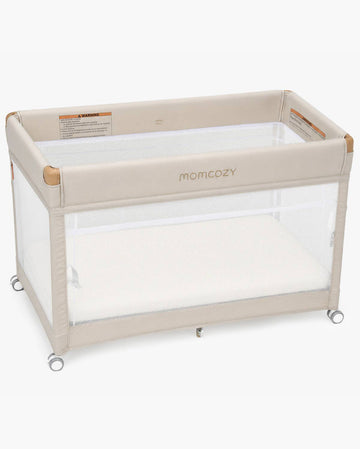
A playard may work instead of a traditional crib for some families when the exact product and mode are approved for the intended use. The better fit depends on your space, expected longevity, portability, caregiver access, and daily routine. The real question is: Do you need a permanent crib, or can one foldable space cover more of your home and travel routine? A playard is a flexible, enclosed space for sleep and play, while a crib is typically fixed nursery furniture. Explore Portable Playards collection as you compare your options.

Key Takeaways
A playard can replace a traditional crib for some families, but only when the exact product and mode are approved for the intended use and fit the child's current stage. The better choice depends less on which product is "better" and more on how your family uses space, moves baby around the home, and expects the sleep setup to work over time.
- Choose a crib when you have dedicated nursery space and want a fixed sleep setup designed around long-term use.
- Consider a playard when folding, storage, room-to-room movement, or multi-location use matters more than having permanent nursery furniture.
- Think about caregiver access, because a raised infant mode may make early transfers easier while a lower playard floor can require more bending later.
- Consider both if you need one permanent nursery sleep space plus a second setup for another floor, grandparents' home, daytime use, or travel.
- Do not assume sleep surfaces are interchangeable. Use only the mattress, pad, and accessories approved for the specific product.
- Compare total value, including useful years, setup frequency, portability, available space, and the child's stage—not just the purchase price.
Can You Use a Pack and Play as a Crib?
Sometimes, yes. A playard may serve as a sleep space when the specific product is intended and approved for that use and the applicable mode, age, weight, height, and other instructions are followed. The term "Pack and Play" is commonly used when people search for a portable playard, although the terminology can be confusing. If you want a fuller explanation of what the term means and how it differs from related products, see What Is a Pack and Play?
The more useful question is not simply whether a playard can be a crib. It is whether one foldable sleep-and-play space can realistically replace the role a fixed crib would play in your family's routine.
That depends on where the baby sleeps, how long you expect the setup to remain in one room, whether you need to move or store it regularly, and how comfortable caregivers are with the changing access height.
Pack and Play vs. Crib: The Differences That Actually Change Your Decision
The biggest difference is not simply that one folds and the other does not. A crib is generally a piece of fixed nursery furniture, while a playard is designed around flexibility, movement, and use in different locations. CPSC describes play yards as framed enclosures with a floor and mesh or fabric sides that can provide sleeping and playing accommodation, while distinguishing them from non-full-size cribs.
|
Decision factor |
Pack and Play / Playard |
Traditional crib |
Who should care most |
|
Footprint & storage |
Often folds for storage and has a smaller flexible footprint |
Larger fixed footprint |
Apartment and shared-bedroom families |
|
Portability |
Designed to fold or move; weight varies by model |
Usually stays assembled |
Families using multiple rooms or homes |
|
Setup pattern |
May require repeated folding and unfolding |
More setup initially, then stays put |
Families who move baby gear often |
|
Use lifespan |
Depends on the product and individual modes |
Often designed around longer-term nursery use |
Longevity-focused buyers |
|
Caregiver access |
Some models offer a raised infant mode before transitioning lower |
Mattress height depends on crib design and setup |
Families making frequent transfers |
|
Functions |
May combine sleep, play, movement, and other functions depending on model |
Primarily fixed sleep furniture |
Minimalist and multi-use shoppers |
|
Cost |
Varies by configuration and features |
Varies by crib, mattress, and furniture setup |
Budget and value shoppers |
There is no universal winner. Each row represents a trade-off: what you gain in flexibility may be exchanged for something else, such as repeated setup or a lower sleep surface later on.
Choose a Crib When Long-Term, Fixed Nursery Use Matters Most
A crib can make more sense when the nursery already has a dedicated place for it and the sleep setup is unlikely to move. If you expect the same room to remain the baby's primary sleep location for years, the value of a permanent piece of furniture can outweigh the flexibility of a foldable product.
A crib may fit your routine particularly well if you:
- Have a dedicated nursery or enough space for a permanent setup
- Rarely travel or move baby gear between rooms
- Prefer conventional nursery furniture
- Expect to use the same sleep space for an extended period
- Value a setup that does not need to be folded and stored
The trade-off is flexibility. A fixed crib generally occupies its footprint all the time, and moving it between rooms or homes is less convenient than moving a foldable playard.
That does not make a crib inherently safer or more comfortable. It simply means its fixed, long-term role may be better aligned with some families.

Choose a Playard When Space and Flexibility Matter More
A playard becomes more compelling when your home needs to perform several jobs with limited floor space. For a family living in a one-bedroom apartment, sharing a bedroom, working from a home office, or regularly moving between floors, a foldable setup can make better use of the space you already have.
A playard may fit especially well if you:
- Need to reclaim floor space when baby gear is not in use
- Want to move a setup between rooms
- Regularly visit grandparents or another caregiver's home
- Prefer one familiar setup across multiple locations
- Want sleep and supervised play functions in one product
The trade-off is that flexibility does not automatically mean greater longevity. A playard's usable stages and modes are product-specific, so check the exact limits rather than assuming every playard will remain suitable for the same role throughout early childhood.
For detailed measurements, footprint comparisons, and room-fit considerations, see Pack and Play Size Guide.
Think About Nighttime Transfers, Not Just Floor Space
Floor space is easy to measure. Caregiver access is harder to account for until you are making repeated transfers every day.
Some playards provide a raised Bassinet Mode during the early months. That can change the physical routine of placing or lifting a baby compared with reaching all the way down to a lower playard floor. However, raised modes have specific limits and stop-use conditions, so they should never be treated as a permanent height adjustment.
Once a baby moves to the lower playard level, think honestly about your routine. How often will you place a sleeping baby down? Will you be moving between rooms at night? Is the lower access height practical for the caregivers who will use it most?
This is a routine and reach consideration, not a medical benefit. The right choice depends on what feels manageable for your household and how long each mode is intended to be used.
For a closer look at raised modes, caregiver access, and when to transition between modes, see Playard with Bassinet Guide.
Compare the Mattress and Sleep Surface Without "Fixing" It Yourself
The sleep surface is one of the biggest reasons parents hesitate to use a playard as a primary sleep space. A crib mattress can look and feel very different from the pad included with a playard, which can make parents wonder whether the playard needs a thicker mattress or topper.
Do not make softness the deciding factor. Instead, compare the approved sleep system: the surface supplied or approved for that product, its fit, the support structure underneath it, and the manufacturer's instructions.
CPSC states that safe infant sleep products include qualifying cribs, bassinets, and play yards, and recommends a firm, flat sleep surface with only a fitted sheet.
Most importantly, do not assume that a crib mattress will fit inside a playard. CPSC notes that mattresses intended for play yards and non-full-size cribs must meet applicable requirements, and compatibility with the specific product matters.
So if a playard pad looks thinner or firmer than a crib mattress, resist the temptation to modify it. Follow the exact product instructions instead.
For product-specific safe-sleep and mattress guidance, see Can a Newborn Sleep in a Pack and Play? Use the approved sleep surface for the specific product rather than adding an aftermarket mattress or topper. CPSC recommends a firm, flat sleep surface and warns against adding soft bedding or unsuitable sleep-surface modifications.

A Crib Can Win on Longevity; a Playard Can Win on Multi-Use Value
The better value depends on how many useful jobs you expect the product to perform.
A crib can offer strong long-term value when it remains assembled in a dedicated nursery and serves primarily as the family's main sleep space. Some crib models may also offer conversion options, although that depends entirely on the model.
A playard can offer a different kind of value. Its usefulness may come from performing different jobs in different places: a sleep space when an approved mode allows it, a play area, a second-room setup, or a portable option for visits.
But feature count is not the same as value. A changing station, storage feature, or attachment only adds value if your family will actually use it.
Before comparing prices, ask:
- How many years will we realistically use it?
- How often will we move or fold it?
- Do we need a second setup?
- Will we use its additional functions repeatedly?
- Are any accessories optional or sold separately?
If you're comparing individual playard features and trying to determine which ones are actually worth paying for, see Which Playard Features Do Parents Actually Use? (B02 / Feature-value content)
What Changes If You Travel or Use Grandparents' House?
A second location can change the crib-versus-playard calculation significantly.
If grandparents provide regular childcare, a foldable playard may be easier to store when it is not needed and easier to set up when the family visits. The same logic can apply to a downstairs living area, a second bedroom, or another regular caregiving location.
Travel adds another consideration: packed size, weight, setup, and carrying method. A product being foldable does not automatically make it airline-friendly or suitable as a carry-on.
For occasional road trips or family visits, a playard may provide useful flexibility without requiring a second full-size crib. But if travel is the primary reason you are shopping, compare products specifically designed around travel rather than assuming every playard is equivalent.
If travel becomes the main consideration, see Home Playard vs. Travel Crib for a more detailed comparison.
Who May Still Want Both a Crib and a Playard?
Choosing both is not necessarily a sign that you bought too much baby gear. Sometimes the products solve two different recurring problems.
For example, a family might keep a crib in the nursery while using a playard:
- Downstairs during the day
- In a home office while a parent works nearby
- At grandparents' house
- During overnight road trips
- In another part of a two-story home
- As a flexible second sleep-and-play space when the approved use allows it
The key is whether both locations or functions occur often enough to justify having separate equipment.
If you only need one permanent sleep space, buying both may add unnecessary cost and storage. If you repeatedly need a fixed nursery setup and a movable second space, forcing one product to do both jobs may be less convenient.

A Simple Decision Tree: Crib, Playard, or Both?
Use your daily routine rather than a generic "which is better?" answer.
Lean toward a crib if:
- You have dedicated nursery space.
- The sleep setup will stay assembled.
- You expect long-term fixed use.
- You rarely need to move or store the sleep space.
Consider a playard if:
- Floor space is limited.
- You regularly move baby between rooms.
- Storage matters.
- Grandparents or other second locations are part of your routine.
- You value a foldable setup that can serve more than one role.
Consider both if:
- You have a permanent nursery but also need a recurring second location.
- You regularly travel or visit grandparents.
- You need a movable daytime setup downstairs or in another room.
- Neither product alone solves your two most important recurring jobs.
And if your main question has become whether a particular product or mode is approved for newborn sleep, whether a mattress can be added, or when a Bassinet Mode must be stopped, pause the comparison and check the product-specific safety and mode guidance first.
Where the Momcozy One-Click Foldable Baby Playard Fits in This Comparison
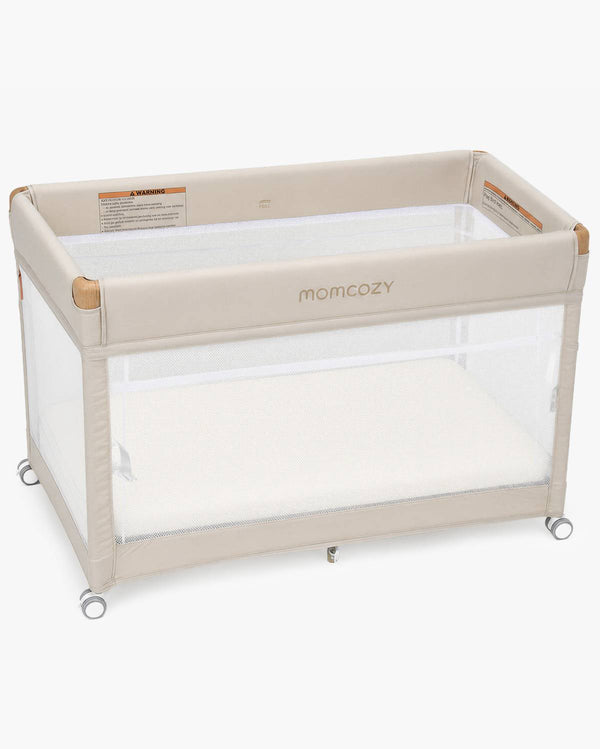
The Momcozy One-Click Foldable Baby Playard is designed around the playard side of this decision: a foldable setup for families that prioritize space efficiency, repeated folding, stage switching, and room-to-room movement.
The product is designed with an open footprint of 112 × 62 × 78 cm and a folded footprint of 63.5 × 16 × 78 cm, with a product weight of 10.3 kg. It also has four swivel wheels with individual brakes for easy repositioning around the home.
For Bassinet Mode, current product information lists a 0–5 month age range and a maximum weight of 9 kg (20 lb). Playard Mode is listed for children from 0–24 months and up to 15 kg (33 lb). Final age and weight limits should be confirmed in the user manual and on the product page.
The included sleep surface is a 2.5 cm mattress with full-board support. As with any playard, do not add an unapproved mattress, topper, or padding simply to make the surface resemble a traditional crib mattress.
This product may be a strong fit for families who want a foldable, movable setup rather than permanent nursery furniture. However, families whose priority is a fixed nursery sleep space that stays assembled long term may still prefer a traditional crib.
See the Momcozy One-Click Foldable Baby Playard for the complete configuration and current specifications.
FAQ
Q1: Do I need a crib if I already have a playard with a bassinet mode?
Not necessarily. If the exact playard and mode are approved for the intended sleep use and fit your child's current stage, it may serve the sleep-space role. Whether it is the best long-term replacement depends on your space, routine, and how you plan to use it after the raised mode ends.
Q2: Can a playard stay set up permanently?
That depends on the product instructions and how you use it. A playard's ability to fold does not mean it must be folded after every use, but you should follow the manufacturer's setup, use, and storage instructions.
Q3: Does a crib mattress fit inside a Pack and Play?
Do not assume so. Crib and playard sleep surfaces have different dimensions and requirements, and compatibility must be established for the specific product. CPSC specifically distinguishes OEM and aftermarket play-yard mattresses and requires applicable compatibility testing.
Q4: Is a mini crib closer to a playard or a full-size crib?
A mini crib is generally closer to a crib because it is fixed sleep furniture, although its smaller footprint can make it an alternative for families with limited space. A playard prioritizes a different combination of portability, folding, and multi-location use.
Q5: Which is easier for grandparents to use: a crib or a playard?
For a home that needs a sleep-and-play setup only occasionally, a foldable playard may be easier to store and deploy. The better option still depends on available space, caregiver routine, and the specific product's setup requirements.
Q6: Can one playard be used for both daytime play and nighttime sleep?
Some play yards are designed for both sleeping and playing, but the exact product and mode determine what uses are permitted. Check the manufacturer's instructions rather than assuming that every playard is approved for overnight sleep. CPSC recognizes qualifying play yards as products that can provide sleeping and playing accommodation.
Find the Better Fit for Your Family
A crib and a playard solve different problems. A crib is often the stronger choice when you want a fixed, longer-term nursery setup, while a playard can make more sense when foldability, storage, small-space living, and multi-location use materially improve your daily routine.
And you do not always have to choose one. If your family has a permanent nursery need plus a recurring need for a movable second space, owning both can be more practical than forcing either product to cover every situation.
If you are considering a playard for sleep, remember that the name "Pack and Play" does not determine what is appropriate. The exact product, mode, applicable limits, and manufacturer instructions do. Explore Momcozy portable playards for the best fit!








