


MEDICALLY REVIEWED BY

Pada Yang is a registered nurse with more than 12 years of experience in obstetrics‑gynecology and an International Board‑Certified Lactation Consultant (IBCLC). Based in Beijing, she works as a maternal‑health content reviewer and freelance health writer. She is dedicated to making reliable, easy‑to‑understand guidance accessible to families navigating postpartum recovery and breastfeeding, empowering parents to build gentle, confident care for their little ones. Outside of work, she enjoys quiet time with her family. Supporting new parents with evidence‑based, compassionate information has always been deeply rewarding for her, both as a clinical professional and a parent.
In clinical positioning guidance for children with significant postural needs, pelvic stability is the foundation of seated support. When the pelvis is supported rather than tucked under in a slump or pushed into a strong arch, the trunk and head can stay more comfortably aligned. That can leave the hands freer for reaching, picking up food, using utensils, and bringing food to the mouth.
Neutral pelvis is a useful high-chair fit target—not a treatment for choking, swallowing disorders, sensory feeding challenges, or developmental conditions.
What a Neutral Pelvis Looks Like at Mealtime
Side view of an upright baby with neutral pelvis, secured harness, and supported feet
“Neutral” does not mean perfectly still or rigid. Children naturally shift, wiggle, and tire during meals. Instead, look for a setup that lets your child sit with their body generally centered and supported, without having to brace, slide, or strain to stay upright.
A practical picture of a well-supported seated position includes:
- Bottom positioned back in the seat rather than perched at the edge
- Pelvis that is neither noticeably tucked under nor strongly arched forward
- Trunk generally upright and centered, without persistent leaning to one side
- Head comfortably near midline rather than consistently falling forward, back, or sideways
- Hips and knees bent, with thighs supported by the seat
- Feet resting on a stable surface
- A tray close enough for comfortable reaching and forearm use
In clinical positioning guidance for children with significant postural needs, pelvic stability is the foundation of seated support. When the pelvis falls out of alignment, the trunk and head may follow. In postural management contexts, a child who has to use their arms, head, or body tension to stay stable has less freedom to use their hands for feeding tasks.
This does not mean a brief slouch signals a problem. Restlessness and fatigue can happen when children remain in one position for too long, including children who are otherwise developing typically. The goal is not a posture test; it is a chair setup that supports comfortable, functional eating.
Start with the Chair Fit, Not the Child’s Behavior

Before assuming a child is “not sitting properly,” check whether the high chair fits their current size and stage. A chair that fit a younger baby may not provide the same support for a growing toddler.
Check the Seat and Hips First
Seat your child fully back in the chair using the manufacturer-provided seat, harness, and inserts exactly as instructed. Then observe whether their pelvis stays reasonably stable or whether they repeatedly slide forward and round into the seat.
A seat that feels too deep for the child’s current proportions can contribute to a tucked-under pelvic position and sliding. If the child cannot comfortably reach the back of the seat while maintaining supported thighs and feet, the chair may no longer be a good fit.
Do not use loose cushions, rolled towels, DIY inserts, or unapproved aftermarket products to fill extra space. Use only adjustments and accessories approved for that specific chair.
Use 90-90-90 as a Flexible Starting Point
Parents may hear “90-90-90” used in feeding discussions. It is shorthand for a seated starting point in which hips, knees, and ankles are comfortably bent at roughly right angles.
It is not a universal measurement rule, and it is not a requirement that every child maintain exact angles. Body proportions, development, comfort, and individual needs vary. Still, it can be a helpful visual cue:
- Hips are bent rather than stretched out in front.
- Knees are bent rather than locked or dangling.
- Feet have a stable place to rest.
Clinical guidance describes neutral or slight anterior pelvic tilt with hips flexed at about 90 degrees for children with significant postural needs. It also notes that stable foot support influences hip and pelvic stability. These principles can help parents evaluate ordinary high-chair fit without turning a general setup check into individualized therapy.
Make Foot Support a Priority
Dangling feet do not automatically mean a child cannot eat safely, but unsupported feet can make it harder for some children to settle into a stable seated position.
Use the chair’s built-in, adjustable footrest if it has one. The aim is for the child to rest both feet on a stable surface without having to point their toes, push awkwardly, or brace against the tray.
Avoid attaching unapproved footrests or modifying the chair. If the chair has no manufacturer-approved way to provide stable foot support, that is useful information when deciding whether its design still suits your child.
Check Tray Reach and Arm Space
The tray should allow your child to reach food without repeatedly lunging forward, leaning far to one side, or pushing away from the chair. It should also leave enough space for their forearms and elbows to rest naturally while they explore food or practice self-feeding.
For children with significant postural needs, clinical guidance notes that a tray can initially add stability and later provide a surface for forearms and elbows during emerging self-feeding. In a typical high-chair setup, think of the tray as a practical work surface—not a restraint and not a substitute for proper harness use.
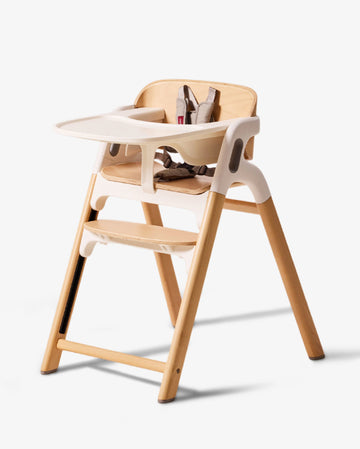
For more detail on choosing furniture around these principles, see this guide to high-chair 90-90-90 posture and foot support.
What Slouching and Arching May be Telling You
Caregiver checking high-chair recline, harness, tray reach, foot support, and stable setup
A repeated posture pattern can be a useful clue to reassess the chair, but it cannot diagnose why a child is moving that way.
What You May See |
Safe Furniture Checks |
Child slides forward, rounds the lower back, or tucks the pelvis under |
Check whether the seat seems too deep, whether the child can sit fully back, and whether their feet are supported on an approved footrest. |
Child’s feet dangle or barely touch the footrest |
Check whether the built-in footrest can be adjusted to provide a stable surface. A footrest that is positioned too high or too low may not provide useful support. |
Child leans forward to reach food |
Check whether the tray can be adjusted closer using the manufacturer’s approved settings. |
Child persistently arches or pushes away from the chair |
Confirm the chair is assembled correctly, the harness is used as directed, and the child has not outgrown the seat configuration. Do not force the child into position or add improvised supports. |
Child consistently leans to one side |
Recheck fit and restraint placement, but seek professional advice if the pattern persists rather than trying to add side supports at home. |
Posterior pelvic tilt, or a tucked-under slouch, can be associated with seating factors such as excessive seat depth, sliding, and poorly matched foot support. It can also have child-related contributors. Similarly, a strong forward arch may have more than one possible explanation.
The important distinction is this: a high chair can contribute to a poor fit, but it is not always the cause of a child’s posture. Persistent patterns deserve observation and, when appropriate, professional assessment.
Better Positioning Does Not Replace High-Chair Safety

A stable seated posture can support comfort and function, but it does not prevent choking, aspiration, or every feeding difficulty. Children should eat upright and supervised, and caregivers should follow the chair’s age, weight, assembly, restraint, and accessory instructions every time.
Use these basics at every meal:
- Secure the manufacturer-provided harness, including the crotch restraint.
- Never allow a child to stand in the chair.
- Keep the chair away from counters and tables that a child could push against.
- Never leave a child unattended.
- If the chair folds, confirm the locking mechanism is fully engaged before use.
The American Academy of Pediatrics’ high-chair safety guidance emphasizes secure straps, supervision, and keeping high chairs away from surfaces that could contribute to tipping. A child who appears stable still needs those protections.
When a High-Chair Adjustment is Not Enough
Stop experimenting with furniture changes and contact a pediatrician and a qualified pediatric feeding professional if your child has persistent concerns such as:
- Inability to keep the trunk generally centered despite an appropriate, approved chair setup
- Consistent leaning, sliding, or arching that interferes with eating
- Difficulty holding the head in a comfortable position for meals
- Persistent coughing, choking, or apparent difficulty swallowing during meals
- Marked fatigue, distress, or refusal to eat
- Concerns related to motor, orthopedic, neurological, or known swallowing needs
Poor head control can affect swallowing, but a high-chair observation alone cannot identify the cause. Children who need lateral trunk, head, jaw, or other specialized supports require individualized assessment; these are not additions to improvise on a standard high chair. Clinical guidance recommends occupational therapy and/or physiotherapy evaluation for children with moderate to severe postural needs to help determine suitable, safe equipment.
At the next meal, do a simple fit check: seat your child back in the chair, confirm supported hips and feet, check tray reach, secure the harness, and watch whether they look comfortable and stable. Make only manufacturer-approved adjustments. If the chair no longer fits, explore a better-suited high-chair setup; if concerning feeding or positioning signs continue, contact your pediatrician and a qualified pediatric feeding professional.









