


MEDICALLY REVIEWED BY

Shelly Umstot, BSN, RN
Shelly Umstot is a BSN and has been a registered nurse for over 35 years. She lives in North East Ohio and is a freelance health content writer. Her passion is bringing understanding to those with questions and concerns regarding health issues and helping them obtain and maintain their optimal health. She loves being with her family and has two lovely granddaughters who have stolen her heart. Assisting new parents in finding the information they need to face the joys and challenges of caring for their children is a gratifying experience for her as a professional, parent, and grandparent herself.
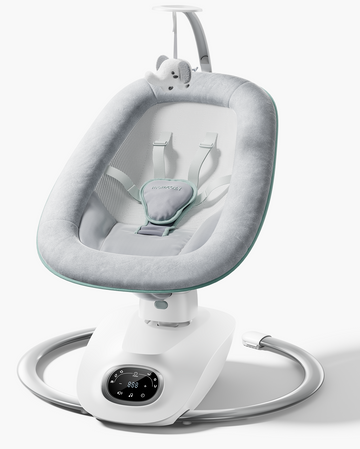
A modular soothing system can be useful for awake, supervised soothing, but it is not a replacement for a crib, bassinet, or play yard. Its value depends on whether each configuration’s instructions, child limits, setup, restraints, cleaning needs, and footprint genuinely fit your routine.
Set one rule before comparing features: if your baby falls asleep in a swing, bouncer, rocker, or similar upright or inclined seat, move them to a firm, flat sleep space as soon as practical.
Start With the Sleep Boundary
A product that swings, bounces, rocks, vibrates, or converts may sound like it can cover every soothing moment. It cannot replace a separate sleep setup.
Guidance for infant sleep is clear: rockers, gliders, car seats, soothers, and swings should not be used for infant sleep. An infant who falls asleep in an inclined or upright product should be moved to a crib, bassinet, or play yard with a firm, flat surface. For that sleep space, use only a fitted sheet—without blankets, pillows, padded bumpers, or other items. Safe-sleep guidance for inclined and upright products
That distinction matters when you are judging an all-in-one product’s real usefulness.
For awake, supervised soothing |
For sleep |
|---|---|
Follow the exact product’s instructions for assembly, positioning, restraint use, supervision, and limits. |
Use a crib, bassinet, or play yard with a firm, flat surface and a fitted sheet only. |
Stay close enough to supervise the baby rather than leaving them in the seat. |
Place the baby on their back to start every sleep. |
Treat a baby falling asleep as a cue to transfer them. |
Do not add sleep accessories from an upright seat to the sleep space. |
A harness does not turn a seat into a sleep surface. Nor do motion, vibration, a deeper-looking recline, or a premium price. Seated positioning can allow a young infant’s head to fall forward when neck strength is limited, potentially interfering with breathing. That is one reason these products are not intended for naps or overnight sleep.
What “Modular” Actually Means in Daily Use
“Swing,” “bouncer,” and “rocker” are useful shopping labels, but they do not tell you everything you need to know about a particular product. In a modular system, the seat, base, motion source, recline positions, or lock settings may change between configurations. What looks like three functions may be three genuinely different setups—or one seat with slightly different ways to use it.

Rather than assuming what a label means, make a mode map from the exact model’s manual.
Check for each configuration |
Why it matters |
|---|---|
How the product creates motion, if any |
Confirms what the mode is actually designed to do. |
Whether the base must be locked, unlocked, attached, or repositioned |
Conversion steps can affect stability and intended use. |
Approved seat positions |
A mode may not permit every recline or attachment position. |
Restraint instructions |
Use the restraint exactly as the manual directs for that configuration. |
Child age, weight, height, and developmental limits |
Limits may differ between modes. |
Stop-use instructions |
A product may need to be discontinued when a child reaches a manufacturer-specified limit or developmental stage. |
Supervision and placement warnings |
These instructions can cover floor placement, nearby hazards, and use around other children or pets. |
Use the most restrictive applicable limit when more than one instruction could apply. Do not borrow a weight limit, age range, or milestone rule from another seat—or even another mode of the same system.
For any rocker or similar product, avoid leaving an infant unrestrained, unsupervised, or with bedding material in the seat. The manual is the final word on how to secure the baby, where to place the product, and when to stop using it.
Buy for a Specific Routine, Not for an “All-in-One” Promise
A convertible system may reduce the number of items you own, but it does not automatically save space, money, or effort. It may be the right choice if it replaces functions you would otherwise use during supervised awake time. It may be less useful if conversion is cumbersome, storage is difficult, or one mode is rarely used.
Before comparing prices, define the problem you want the product to solve.
Questions for a small-space household
- What are the product’s dimensions in every configuration?
- Does it need a permanent spot, or can it be stored between uses?
- What is its folded size, if it folds?
- Can you move it through your doorways without disassembly?
- Will the product’s base fit safely in the room where you expect to use it?
Questions for a multi-room routine
- Is the product intended to be moved while assembled?
- How much effort does it take to switch rooms or configurations?
- Can one caregiver complete the conversion steps correctly every time?
- Is there a safe, clear floor location in each room?
Questions about power and care
- Does the exact model use mains power, batteries, or both?
- Which parts are included, and which are optional?
- Which fabric components can be removed and cleaned, and how?
- Are replacement parts available through the manufacturer?
- What will happen when the cover needs washing—do you have another approved place for supervised soothing?
A simple comparison can help. List the current price of the modular system beside the price of only the separate items you realistically expect to use. Then add non-price factors: storage volume, setup time, cleaning, power needs, and whether every caregiver can operate it confidently.
The goal is not to prove that one system is better. It is to avoid paying for modes that do not fit your home or routine.
Read the Manual Before the Box Comes Home
The manual is not a formality. With a modular seat, the document tells you what each configuration is for—and what it is not for.
Before buying, downloading, accepting, or using a system, confirm:
- The exact model name and model number. Product families can include versions with different attachments, limits, and instructions.
- The current official manual. Read the configuration, restraint, supervision, child-limit, cleaning, feeding, and stop-use sections before first use.
- All parts and labels. Check that the base, locks, fasteners, restraints, fabric, and included components match the manual.
- Conversion steps. Practice changing modes without the baby in the seat. If a lock, attachment, or position is unclear, do not improvise.
- The intended floor location. Set it up on the surface and in the room where you expect to use it, following the manual’s placement warnings.
- Registration options. Register a new product so the manufacturer can contact you about safety information.
- Recall status. Check both the manufacturer’s support or recall page and the CPSC recall information for the exact model and manufacturing details, and note the date you checked.

This last step is especially important for secondhand gear. Do not accept a product with missing parts, unreadable labels, an unavailable manual, improvised repairs, or an uncertain model identity. Federal law prohibits the sale of products subject to a Commission-ordered recall or a voluntary recall undertaken in consultation with the CPSC. CPSC guidance on infant-product safety rules and recalled-product sales
A Practical Decision Rule
Choose modularity only when it has a verified fit with your space and your awake, supervised soothing routine—not because it appears to offer an all-in-one answer to infant sleep.
Save this checklist, confirm the exact model’s manual and recall status, and prepare an approved firm, flat sleep space before the seat is ever used. The best setup is the one that makes safe routines easier to follow, even on a tired day.









