


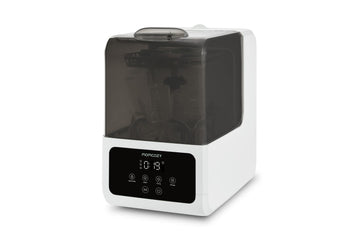
A bottle washer and sterilizer takes a repetitive feeding chore off your hands, but it still needs routine care. Milk residue, droplets, and standing moisture, and standing moisture can build up around the places water travels through, including the tank, spray arms, filter area, racks, and chamber. A short cleaning routine after each use, plus a regular deep clean of the removable parts, helps keep the machine working as intended.
This guide covers how to clean Momcozy Bottle Washer models, including KleanPal Pro, D8 (DeepClean), and the new Momcozy DeepClean Lite Baby Bottle Washer and Sterilizer. Always follow the instructions supplied with your exact model, and never immerse the main unit or use harsh abrasives.

Why Regular Cleaning Matters
Cleaning removes milk residue, droplets, and debris from accessible surfaces and removable parts. Left alone, that residue can block spray holes, reduce water flow, trap moisture, and lead to odors or dark spots inside the chamber.
Regular care also gives you a chance to inspect spray holes, racks, the residue cup or filter, and the water-tank connection. Momcozy support advises draining residual water after each use, cleaning areas that collect debris, and leaving the lid open to air-dry the unit. If you notice black spots, a persistent odor, poor water flow, or a visible residue, pause use and complete a thorough clean before the next feeding cycle.
How Often Should I Clean My Washer?
A simple rhythm is easier to keep than waiting for buildup to appear. A quick routine after each cycle keeps milk residue and moisture from settling in, and a deeper clean of the removable parts can follow whenever you notice residue, an odor, or reduced water flow.
After every cycle:
- Empty any remaining water from the tank or chamber.
- Remove visible residue from the chamber, filter, or residue holder.
- Wipe splashes from the exterior, top cover, water tank, and tank lid with a soft, damp cloth.
- Leave the lid open until the interior is fully dry.
Regularly, or whenever you see residue or reduced flow:
- Remove and rinse the spray arms, racks, and filter, then check the spray holes for debris.
By model:
-
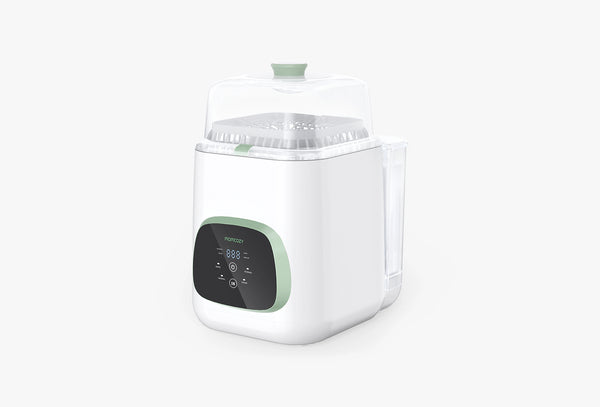
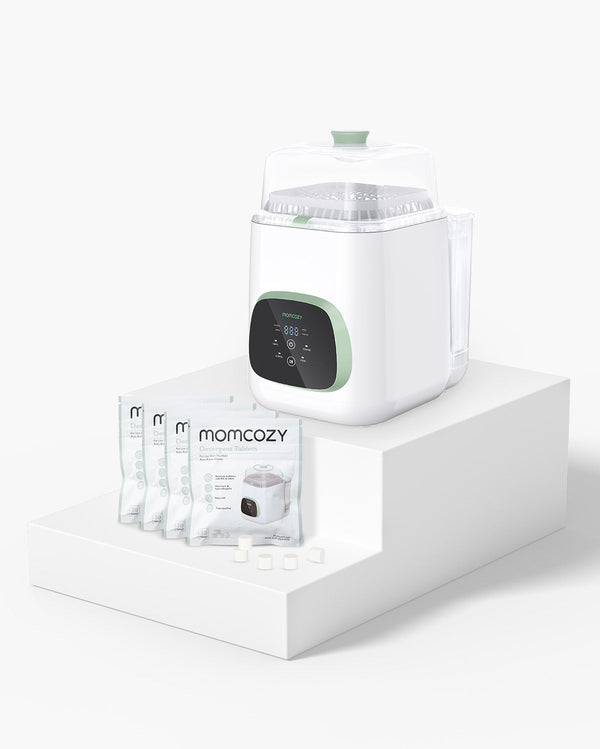
KleanPal Pro: clean the spray arms, shelves, shelf arms, and water storage tank regularly.
 Member price$299.99Code Save 10%
 Member price$304.99
$319.99Code Save 10% -
D8: run the Self-Cleaning program when needed and do a manual deep clean when you see residue or reduced flow. Clean the water-tank inlet at least monthly.
 Member price$359.99Code Save $30
 Member price$364.99
$404.99Code Save 10% -
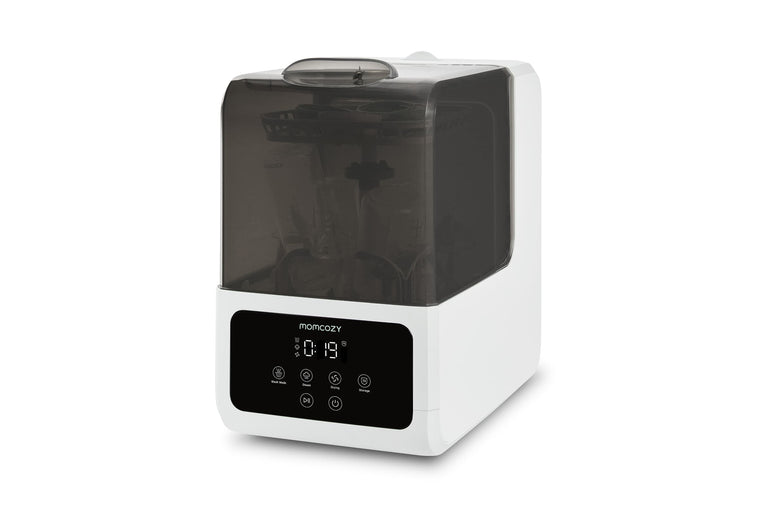
DeepClean Lite: rinse the spray arms, racks, center water column, and filter by hand when you see residue. Because it sends used water to your sink through its drain hose, there is no wastewater tank to empty after a cycle.
 $299.99Code Save $30
How to Clean Momcozy Bottle Sterilizer and Washer
The right routine differs slightly by model because the removable parts are arranged differently. If you are cleaning after a wash cycle, allow hot surfaces to cool first.
Before You Start Cleaning
These basics apply to all three models:
- Switch the appliance off, unplug it, and let it cool completely if you have just run a wash cycle.
- Remove all bottles, nipples, pump parts, and accessories.
- Empty the water tank and discard any residue from the chamber.
- Keep the electrical base dry throughout. Wipe the main unit with a damp cloth only, and never pour water over it or submerge it.
- Use a soft cloth or sponge. Avoid abrasive pads and powders, which can scratch surfaces and leave particles in narrow water paths.
Momcozy KleanPal Pro
The KleanPal Pro has four main washable areas: the top cover, upper and lower spray arms, upper and lower brackets with shelf arms, and the water storage tank. Member price
$299.99Code Save 10%
Member price
$299.99Code Save 10%
 Member price
$304.99
Member price
$304.99
$319.99Code Save 10%
- Wipe the exterior. Clean the outer box, transparent top cover, water tank, and tank cover with a soft, moist cloth. Do not pour water over the main unit.
- Remove the upper spray-arm assembly. Lift it straight up.
- Remove the lower shelf. Open the lower shelf clasp with gentle pressure, then lift the lower shelf assembly out with both hands.
- Remove the lower spray arm and residue holder. Lift out the lower spray arm, then turn the residue holder slightly to the right to remove it.
- Empty the residue holder. Discard any food or milk debris before rinsing.
- Rinse the removable parts. Rinse the racks, upper and lower spray arms, residue holder, and other removable components with clean water.
- Check the spray holes. Look for debris and rinse until water moves through freely.
- Wipe the chamber. Clean the inside with a soft, damp cloth, paying attention to the corners and the area around the residue holder.
- Reassemble. Reinstall the parts in reverse order, making sure each piece is seated correctly and the spray arms rotate freely.
- Air-dry. Leave the lid open until the chamber is dry.
Before an ordinary KleanPal Pro wash cycle, discard visible milk curds or heavy residue, briefly rinse items with obvious grease, and place one Momcozy detergent tablet in its designated area on the lower shelf. Invert bottles over the spray columns and keep small access.
Member price
$299.99Code Save 10%
Member price
$304.99$319.99Code Save 10%
Momcozy DeepClean D8
For everyday exterior care, wipe the D8 main unit, top cover, water tank, and tank lid with a soft, damp cloth. The D8 bottle washer also has a dedicated Self-Cleaning program for the internal waterlines and chamber. For better cleaning results, use a Momcozy descaling tablet with this program. Member price
$359.99Code Save $30
Member price
$359.99Code Save $30
 Member price
$364.99
Member price
$364.99
$404.99Code Save 10%
- Add room-temperature softened, purified, or distilled water to the water tank, keeping the level between the MIN and MAX marks.
- With the washing chamber empty, place one Momcozy descaling tablet directly on the bottom of the chamber.
- Reinstall the water tank securely. Connect the drain hose and route its end to a sink or suitable drainage container. Keep the hose horizontal, with its end no higher than the midpoint of the machine.
- Press and hold Power, then select Self-Cleaning with the Cleaning button. Confirm that the Self-Cleaning indicator is selected.
- Press Start/Pause once to begin. Let the 30-minute high-temperature program finish without opening the lid. The cycle runs through the internal water path and chamber, then drains through the hose.
- When the cycle ends, let the unit cool before use. Self-Cleaning does not replace manual rinsing of the removable parts, so follow its manual deep clean when you see residue or reduced flow.
Momcozy DeepClean Lite
For everyday exterior care, wipe the DeepClean Lite main unit, top cover, water tank, and tank lid with a soft, damp cloth. Unlike the D8, the Lite does not have a Self-Cleaning program, so the chamber is cleaned by hand. $299.99Code Save $30
- Remove the spray arms, racks, center water column, and filter, plus the Pump360 Rotary Jets if installed.
- Rinse the removable parts with clean water. Check the spray holes for debris so water can move freely.
- Reinstall the parts in the reverse order, making sure each piece is seated correctly, and the spray arms can rotate freely before the next cycle.
Before each wash cycle
Fill the water tank to the MAX line with clean, room-temperature water. Purified or distilled water is recommended. Check that the drain hose directs used water into your sink or another suitable drain. Pour out leftover milk, place bottles upside down on the lower rack with the openings aligned to the spray towers, and add one Momcozy Washing Block. For pump parts, install the Pump360 Rotary Jets.
Do not use household dishwasher detergent, powder, liquid dish soap, or standard dishwasher tablets, which can create excess foam or leave residue.
What If My Washer Smells or Has Black Spots?
If you notice a musty odor, dark spots, or slimy residue, stop using the machine for baby items and clean it before the next cycle:
- Unplug the unit and remove all baby items.
- Remove and rinse every removable part, including the filter or residue holder, which are common places for debris to hide.
- Wipe the chamber, door seal area, and lid with a soft, damp cloth.
- Run the model’s cleaning routine (Self-Cleaning on the D8, or a manual deep clean on the KleanPal Pro and DeepClean Lite).
- Leave the lid open until everything is completely dry.
If the odor or spots return after a thorough clean, contact Momcozy support for model-specific guidance.
What Not to Use When Cleaning
Do not use foaming dish soap, bleach, abrasive powders, scouring pads, or an unapproved cleaner. A stronger household product is not necessarily a better choice for a bottle appliance, and it may damage components or leave residue that is difficult to rinse away. Stick to a soft cloth, clean water, the approved Momcozy tablets for your model, and the cleaning steps in your product guide.
FAQs
How to Use Vinegar to Clean a Bottle Sterilizer?
Use vinegar only when it is compatible with your model instructions. Keep bottles and parts out of the appliance; use the recommended dilution or a food-grade vinegar wipe for the designated area, then rinse and run the required empty cycle. Never pour vinegar into a place the manual does not identify.
Can I Use Vinegar to Clean My Baby Bottle Sterilizer?
It can be appropriate for some maintenance tasks, but the answer depends on the model and the area you are cleaning. For D8, Momcozy specifically permits food-grade white vinegar or citric acid solution on a cotton swab for the water-tank inlet. Follow the manual for all other areas.
What Is a Good Descaling Solution for a Baby Bottle Sterilizer?
The best first choice is the descaling tablet or solution approved by the appliance manufacturer. A compatible citric-acid descaler may also be suitable when the guide allows it. Use the amount, program, and rinse sequence specified for your model. For the DeepClean Lite, that means one Momcozy descaling tablet in the water tank per descaling run.
Which Is Better, Vinegar or Descaling Solution?
A manufacturer-approved descaling solution is usually the simpler option because its directions are written for the appliance. Vinegar can be useful for a permitted wipe-down or a manufacturer-approved descale, but it can leave an odor if the unit is not rinsed thoroughly.
How to Clean a Sterilizer With Baking Soda?
Do not use baking soda unless the manufacturer specifically approves it. Its gritty particles may be difficult to rinse from narrow water paths. A soft cloth, clean water, and the approved descaling method are safer choices for routine appliance care.

Can I Use Tap Water in My Bottle Sterilizer?
Check your product guide. In hard-water areas, tap water can create scale more quickly. Momcozy support notes that distilled water is preferred when managing recurring mineral buildup; using it can reduce the frequency of descaling. For the DeepClean Lite, Momcozy recommends purified or distilled water, especially in hard-water areas.
Is Vinegar Safe for Baby Bottles?
Vinegar should not be treated as a substitute for washing baby bottles. If you use it for appliance maintenance, keep baby items out of the unit during descaling and complete the manual-required rinse cycle before washing bottles again.
What Is the Best Way to Clean and Sterilize Baby Bottles?
First, wash away milk residue with the correct detergent and a complete wash method, then use a Sterilizing process that follows the bottle, nipple, and appliance instructions. Separate small parts, position bottles for proper water flow, and inspect them after the cycle.
How Long Do Bottles Stay Sterile After Sterilizing?
That depends on how and where they are stored after the cycle. A closed appliance can help protect clean items, but avoid opening it repeatedly, touching bottle interiors, or assuming an item is sterile indefinitely. Follow your appliance’s storage instructions.
What Is the Easiest Way to Sterilize Bottles?
The easiest method is the one you can use consistently and correctly. An automatic washer-Sterilizer, such as the DeepClean Lite, can combine washing, Sterilizing, drying, and storage, provided you load it properly, use the approved detergent, and keep the machine clean.
Can You Sterilize Bottles Without Washing Them First?
No. Sterilizing does not remove milk residue or grease. Bottles should be washed first, whether by hand or in an appliance cycle that includes washing, so the Sterilizing stage starts with visibly clean items.
Why Does My Sterilizer Smell Like Vinegar After Descaling?
The most likely cause is residual vinegar in the water path or on removable parts. Rinse all removable pieces, run the empty rinse or cleaning cycle required by the manual, and let the unit air-dry with the lid open. Repeat the rinse if the odor remains.
When Should I Replace My Bottle Sterilizer?
Replace it if the manufacturer advises replacement, a safety-related part is damaged, it leaks, it cannot be cleaned or descaled effectively, or it continues to malfunction after approved troubleshooting. Stop using a damaged appliance and contact the manufacturer for model-specific support.
Keep Your Bottle Washer Clean
A clean bottle washer is part of a reliable feeding routine. Drain water after use, let the interior dry, rinse removable parts regularly, and descale when mineral buildup calls for it. For KleanPal Pro, D8, and DeepClean Lite, use the model-specific support instructions for disassembly, Self-Clean or maintenance programs, approved tablets, and replacement parts. That small routine helps keep the appliance ready for the next wash cycle.








