


MEDICALLY REVIEWED BY

Dr Carly Dulabon, MD, IBCLC, NABBLM-C
Dr Carly Dulabon MD, IBCLC, NABBLM-C is medical director of the department of breastfeeding medicine with Akron Children's Hospital. She completed her medical degree at University of Toledo College of medicine, and her pediatrics residency at Children's Hospital of Pittsburgh. Her special interests are in maternal mental health and infant growth.
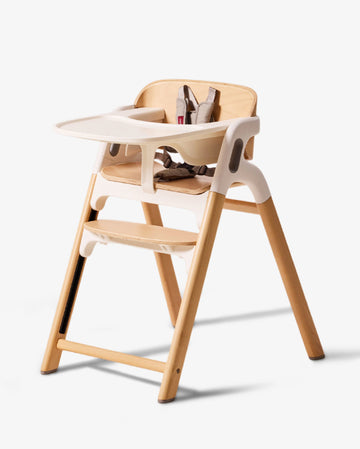
For starting solids, avoid using a reclined high-chair position unless the manufacturer’s manual explicitly supports it for solid feeding. Set the chair in its most supportive, manual-approved upright feeding setting, then look at your baby’s actual posture: stable head and neck, supported trunk, and no sliding or curling forward.
There is no universal seat-back angle that has been established as safe for solid foods, and available guidance does not quantify how much a recline changes choking or aspiration risk. Rather than looking for a degree number, use the chair as intended and make sure your baby can stay well positioned throughout the meal.
Use the Upright Feeding Setting for Solids
A recline feature may be included for a purpose specified by a particular high-chair manufacturer. It should not be assumed to be appropriate for purées, finger foods, or baby-led weaning meals simply because a baby looks comfortable there.
For solids, choose the chair’s most supportive upright feeding position allowed by its manual. Then reassess the fit every time you place your baby in the seat. A setting that appears upright on the chair may not be supportive enough for a particular child if they slide downward, lean heavily to one side, or cannot keep their head steady.
Avoid making these assumptions:
- “Purées are safe in a recline.” Food texture matters, but it does not make a reclined setup an appropriate solid-feeding position.
- “A little recline is fine if my baby is strapped in.” A harness helps keep a child secured in the chair; it does not turn poor posture into stable feeding posture.
- “The chair’s recline setting must be for feeding.” Check the manual for the intended use of every recline position, insert, and harness configuration.
- “Bottle feeding and solids follow the same rules.” Do not treat a chair’s bottle-feeding or infant-positioning instructions as permission to offer solids in that setting.
Check Readiness Before Offering Solids

High-chair adjustment cannot substitute for developmental readiness. Solid foods generally begin around 6 months while breast milk or infant formula continues, but age alone is not the deciding factor. The NHS guidance on starting solids also emphasizes that complementary feeding continues alongside a baby’s usual milk feeds.
Before offering solids, look for these practical readiness signs:
- Your baby has good head control while in the high chair or feeding seat.
- Your baby can remain positioned without their head falling forward or to the side.
- For finger foods, your baby can sit and bring hands or objects to their mouth.
- Your baby is not being started on solids solely because they have reached a particular age.
If your baby cannot maintain head control in the feeding seat, repeatedly folds forward, or cannot stay positioned without substantial support, pause the meal rather than trying a deeper recline. Ask your pediatric clinician or a feeding specialist for individualized guidance if positioning or feeding concerns continue.
Check Posture and Fit Before Every Meal
“Upright” is not a number on a seat-back adjustment. It is what you can observe once your baby is secured in the chair.
Use this quick pre-meal check:
- Seat back: Select the manual-approved upright feeding setting.
- Head and neck: Your baby’s head stays centered and controlled rather than dropping forward or sideways.
- Trunk: The body stays centered in the seat instead of twisting, leaning, or collapsing.
- Hips: The pelvis is back in the seat rather than sliding toward the front edge.
- Harness: Use the harness as instructed for the chair, with the straps correctly fitted for your baby.
- Knees and feet: If the chair provides foot support, adjust it according to the manual so your child has a stable, comfortable setup.
- Tray distance: Position the tray as directed so your baby is not stretched far forward to reach food.
- Inserts and cushions: Use only removable components approved for that chair and for your child’s current stage, weight, and configuration.
Foot support, a fitted harness, and a well-adjusted tray may improve comfort and stability, but they should not be treated as devices that prevent choking or aspiration. The key decision is simpler: if your baby slides, slumps, twists, arches persistently, or loses head position, stop and adjust the setup. If you cannot achieve stable posture, pause solids.
Pair Positioning with Appropriate Food and Supervision
A supportive chair setup is only one part of safer feeding. New eaters need food prepared for their current skills and continuous adult supervision.
For a baby starting solids:
- Offer soft or puréed foods appropriate for a new eater.
- Stay with your baby throughout the meal.
- Watch how your baby manages each bite instead of focusing only on how much they eat.
- Introduce finger foods only when your baby can sit and bring hands or objects to their mouth.
- Follow food-preparation guidance appropriate to your child’s developmental stage.
Gagging is common when babies are learning to chew and swallow. The NHS explanation of choking and gagging describes gagging as a normal reflex during the introduction of solids.
Gagging is Not the Same as Choking
Gagging is usually loud. You may hear coughing, spluttering, or retching as your baby works food forward in the mouth. Stay close and watch carefully, but do not treat ordinary gagging as a choking emergency.
Choking is typically quiet because the child may be unable to breathe properly. Blue discoloration can be a possible sign, including on the gums, inside the lips, or fingernails in babies with brown or black skin. These signs are not a complete diagnostic test, but a quiet child who cannot breathe properly needs immediate action.
Respond to Choking as an Emergency
If your baby is gagging loudly and breathing, observe closely. If your baby is choking and cannot breathe properly, call for help, remove them from the high chair, and use age-appropriate choking first aid. Guidance for a choking child includes supporting the chest and chin and giving five sharp back blows between the shoulder blades.
Take an infant choking and CPR course before you need it. If there is an active choking emergency, contact local emergency services. For ongoing concerns such as persistent coughing during meals, repeated feeding difficulty, or concern that food or liquid may be entering the airway, seek prompt advice from your child’s pediatric clinician or a qualified feeding specialist.
Before the next meal, set the chair to its most supportive manual-approved upright feeding position, secure the harness, and watch your baby’s posture for a few moments before offering food. Adjust the fit—or pause solids—if your baby slumps or lacks readiness. Thoughtful high-chair setup supports safer feeding, but it does not replace appropriate food preparation, active supervision, or choking-response readiness.









