


MEDICALLY REVIEWED BY

Una Qian, Registered Nurse, IBCLC
I am a Registered Nurse and International Board Certified Lactation Consultant (IBCLC) based in Beijing, China. With 16 years of experience in obstetrics and gynecology, I currently provide clinical breastfeeding support. Over the past few years, I have obtained the Level II Certification in the French WAFF Perinatal Rehabilitation Method and the BFE Level I Certification in Pelvic Floor Rehabilitation (European Level I), which qualifies me to guide both prenatal and postpartum mothers in appropriate exercise programs and provide evidence-based postpartum rehabilitation.
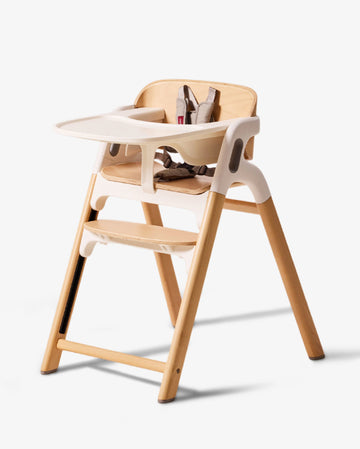
During active cooking, put the high chair in a visible spot outside the 3-foot kid-free zone around the cooking space. If a narrow kitchen cannot accommodate that distance while leaving a clear route to cook, carry food, and leave the room, feed the child outside the kitchen until cooking is finished.
This 3-foot measure is child-safety guidance—not a building-code requirement or a universal appliance-installation clearance. Your range manual still controls for its own installation, operating, and safety warnings. But for daily family use, the practical question is simple: can the child sit well away from active cooking without being in the path of heat, spills, hot cookware, or an adult carrying a meal? Safe Kids Worldwide’s kitchen burn-prevention guidance specifically advises placing a baby in a visible high chair outside this kid-free zone while cooking.
Decide Whether a Spot Works During Active Cooking
Do not judge a location only by whether it is directly in front of the stove. A chair beside the range, behind it, or across a narrow aisle can still be a poor choice if it falls within the cooking zone or forces people to squeeze past it.

Use this quick placement test before the child is seated:
- Start at the cooking space. Identify the area within at least 3 feet of the cooktop and active cooking area. That is the child-free zone during cooking.
- Place the empty high chair beyond it. The child should remain visible to the cook without the chair being part of the cooking workspace.
- Check the full chair footprint. A chair may look clear until it is pulled out, reclined, or positioned as it would be during an actual meal. If any part of its normal setup intrudes into the cooking zone or a main route, reject that spot for active cooking.
There is no single universal high-chair-to-stove measurement that makes every kitchen safe. The 3-foot guidance is a useful starting boundary for children near cooking; it does not mean every location beyond that line is automatically suitable.
Look Beyond the Burners
A chair can be outside the stove zone and still sit near a burn or scald hazard. Before using a proposed spot, look at what happens around it during normal meal preparation.

Reject or rethink the location if it is:
- At the end of a counter where hot plates, soup, coffee, or pans are routinely set down.
- Within a child’s reach of hot food or drinks near counter or table edges.
- In the path where cookware is moved from the stove, oven, microwave, or sink.
- Close to where hot containers are opened and steam may escape.
- Positioned where a child could reach toward pot handles, cookware, or the stove edge.
Use back burners when possible and turn pot handles away from the stove edge. These habits reduce the chance that hot cookware will be bumped or pulled down, but they do not make stove-adjacent high-chair placement safe on their own.
Steam deserves the same attention as a hot pan. Open hot containers slowly and away from people, and do not make the high chair part of that task area. Kitchen burn and scald-prevention advice from Hawaiʻi Pacific Health also cautions that steam can cause burns.
Test the Walking and Exit Route
A narrow kitchen often fails not because the chair is too close to the stove, but because it blocks the route between the refrigerator, sink, cooktop, table, and exit.

With the chair empty and set up as it would be during a meal, walk your usual route through the kitchen. Carry a bulky but harmless object to mimic a serving dish. Ask:
- Can you reach the stove, sink, refrigerator, and table without turning sideways, stepping around the chair, or moving it first?
- Can you carry hot food without passing directly over or brushing against the child?
- Can another adult enter or leave without bumping the chair?
- Can you respond promptly to a spill or cooking problem without the chair blocking your movement or exit?
If the answer to any of these is no, the spot is not a good active-cooking location. Do not try to solve the problem by carrying the child while preparing food or moving hot objects.
Stay with active cooking. If you need to leave the kitchen, turn the burner off first, as advised in U.S. Fire Administration cooking fire-safety guidance.
Treat Cold-Stove Feeding as a Separate Situation
A high-chair location that works when the stove is cold may not work while dinner is cooking. Separating those routines is often the most workable solution in a compact home.

Consider one of these arrangements:
- Cook first, feed afterward. Finish cooking, turn off the appliance, move hot food away from edges and transfer paths, then bring the child to their usual feeding spot.
- Feed in a nearby dining or living area. This is often the simplest option when the kitchen has no safe location beyond the cooking zone.
- Use alternating supervision. If another adult is available, one person can supervise the child away from the kitchen while the other cooks.
- Prepare parts of the meal before seating the child. Set up cold ingredients, dishes, and the feeding area before active cooking begins, then keep the child out of the kitchen during the heat-intensive steps.
Whatever location you use, follow your specific high-chair manual for its restraint, stability, locking, age or weight, and surface-use requirements.
If the chair cannot sit on a level surface outside the stove’s heat, reach, and traffic zones while leaving a clear route to move and respond to a fire, feed the child somewhere else during active cooking. For help building a routine around your home’s layout, consult Momcozy’s verified feeding and child-safety resources.









