


MEDICALLY REVIEWED BY

Una Qian, Registered Nurse, IBCLC
I am a Registered Nurse and International Board Certified Lactation Consultant (IBCLC) based in Beijing, China. With 16 years of experience in obstetrics and gynecology, I currently provide clinical breastfeeding support. Over the past few years, I have obtained the Level II Certification in the French WAFF Perinatal Rehabilitation Method and the BFE Level I Certification in Pelvic Floor Rehabilitation (European Level I), which qualifies me to guide both prenatal and postpartum mothers in appropriate exercise programs and provide evidence-based postpartum rehabilitation.
Baby swings are for supervised soothing, not sleep. If your baby dozes off in a swing, the safest next step is to move them to a firm, flat crib, bassinet, or play yard as soon as you can.
You know that moment when the house finally gets quiet, your baby is gently rocking, and you realize they have fallen asleep in the swing? It feels like a tiny miracle, especially when you are tired, feeding around the clock, and just trying to drink your coffee while it is still warm. The latest safety guidance gives parents a clear, practical rule: swings can help calm a baby, but sleep should happen on a firm, flat surface made for infant sleep.
The Big Message: Swings Are Not Sleep Spaces
Current federal safety guidance is pretty straightforward: products used for infant sleep need to meet strict federal sleep-product rules, and soft, inclined, or nest-like products can create suffocation and fall hazards. In one recent warning, a federal safety agency told consumers to stop using certain baby loungers because they failed federal infant sleep product rules and created an unsafe sleeping environment.
For parents, the practical takeaway is this: do not treat a swing, lounger, rocker, bouncer, stroller, or carrier as a crib substitute. Even if your baby looks peaceful, a swing does not provide the firm, flat, open sleep space recommended for infants.
The safest sleep setup is still simple: baby on their back, alone, on a firm, flat surface, with only a fitted sheet. That means no pillows, loose blankets, padded bumpers, nursing pillows, stuffed animals, or extra inserts in the sleep area.
Why Swing Sleep Can Be Risky
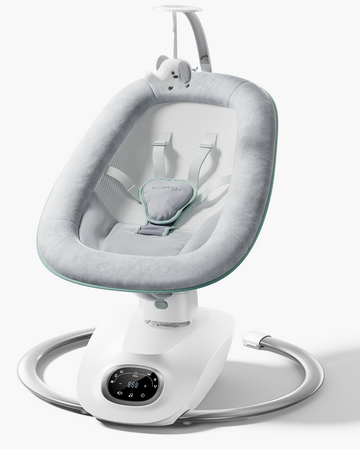
A baby swing usually holds your baby at an angle, and that semi-upright position is the concern. When a young baby’s head tips forward, their chin can move toward their chest, and that can make breathing harder, especially for newborns who do not yet have strong head and neck control.
Baby swings also use padding, straps, and a seated shape that can let a baby slump to one side or settle into a curled position. A safe sleep surface should be firm, flat, and non-inclined, which is why a crib, bassinet, or play yard is different from a swing.
This matters most in the early months. A pediatric health organization notes that about 3,500 babies in the U.S. die each year from sleep-related deaths, and 90% of SIDS cases happen before 6 months, with the highest risk between 1 and 4 months. That is exactly the stage when many babies love motion and many parents are leaning on swings to get through fussy stretches.
What To Do If Your Baby Falls Asleep in a Swing
If your baby falls asleep in a swing, do not panic. Stop the motion, unbuckle them carefully, and move them to a crib, bassinet, or play yard with a firm mattress and fitted sheet.
Try to make the transfer boring and predictable. Keep the room dim, support your baby’s head and neck, and place them on their back. If they wake up, it is frustrating, but the goal is not a perfect transfer every time; the goal is to keep sleep happening in a space designed for sleep.
A rhythm that helps in real life is to use the swing before sleep, not during sleep. For example, after a feeding and burp, you might use the swing for 10 to 20 minutes of supervised calming while you sit nearby with your water bottle, pump parts, or burp cloths. Once your baby gets drowsy, move them before they are fully asleep if you can.
How To Use a Baby Swing More Safely
A baby swing can still be helpful during the day when you need a safe place to soothe your baby while you fold tiny onesies, prep bottles, or sit down for a quick snack. The key is to use it as a short, supervised baby care tool, not as a nap solution.
For newborns and younger infants, the seat should be reclined as much as the product allows, because babies under 4 months need extra head and neck support. Safe swing use also means a snug harness, the swing placed on a flat floor, and no added blankets, pillows, toys, or loose items in the seat.
Most swing sessions should stay short. A practical range is about 15 to 30 minutes at a time, and many swings have weight limits around 20 to 30 lb depending on the model. Stop using the swing once your baby can sit up unassisted, roll strongly, or try to climb out, even if they have not reached the printed weight limit.
How Federal Safety Guidance Affects Baby Gear Shopping
When you are building a registry or sorting through hand-me-downs, the most important question is not “Does this look cozy?” It is “Is this product actually approved and intended for infant sleep?”
Recommended sleep products include a crib, bassinet, portable crib, or play yard that meets federal safety standards. A safe sleep organization’s parent guidance puts it plainly: babies should sleep alone, on their back, and in a crib or play yard.
Be especially careful with online listings that use words like “napper,” “sleeper,” “lounger,” “nest,” or “anti-roll” while showing babies asleep in soft or angled products. A federal health agency warns parents not to buy baby products that claim to prevent or reduce SIDS or SUID, and it says there is no cleared or approved baby product for that purpose among products that claim to prevent those sleep-related risks.
What Belongs in the Sleep Space
A safe sleep space is intentionally plain. I know that can feel a little cold when you are looking at sweet nursery photos, but plain is exactly what makes it safer.
For sleep, use:
- A crib, bassinet, or play yard that meets current safety standards
- A firm, flat mattress made for that product
- A fitted sheet that fits snugly
- A wearable blanket or sleep sack if your baby needs warmth
- A pacifier once breastfeeding is established, if your baby accepts one
If your baby needs warmth, a wearable option such as the Momcozy Baby Sleep Sack 1.5 TOG can be used instead of a loose blanket when dressing baby for sleep.
Keep out pillows, loose blankets, crib bumpers, positioners, stuffed animals, nursing pillows, and extra padding. Pediatric safe sleep guidance recommends that babies sleep on their backs for every sleep period and use a firm surface without soft objects or loose bedding.
This is also where breastfeeding and night care routines matter. If you are nursing, pumping, or combo feeding, set up your nighttime area so the safe sleep space is easy to use when you are tired. A bassinet next to your bed, a burp cloth within reach, and a dim light can make it easier to feed your baby and put them back down safely instead of letting them stay asleep in a swing or on the couch.
A Practical Swing Routine for Tired Parents
Here is a simple way to think about swing use during the baby stage: soothe, supervise, transfer. Use the swing when your baby is awake or getting calm, stay close enough to watch their breathing and position, and move them to a safe sleep space if they get sleepy.
A realistic routine might look like this: feed, burp, diaper check, then 15 minutes in the swing while you sit nearby and finish pumping or rinsing bottles. If your baby starts blinking slowly, looking heavy-eyed, or going limp in the seat, that is your cue to transfer.
One option I’ve found helpful in the newborn season is keeping the bassinet or play yard already cleared and ready before you start the feeding or soothing routine. When the safe spot is prepared, you are less tempted to “just let them sleep there for a few minutes,” especially during those early weeks when every minute of quiet feels precious.
Final Takeaway
The latest federal safety message fits with what pediatric safe sleep guidance has been saying for years: baby swings can be useful for short, supervised soothing, but they are not safe sleep spaces. If your baby falls asleep in a swing, move them to a firm, flat crib, bassinet, or play yard as soon as possible.
For everyday parenting, keep the rule simple. Swings are for awake time, calming, and brief hands-free moments while you supervise. Sleep belongs on the back, on a firm flat surface, with no loose bedding or extra baby gear in the sleep space.








