


MEDICALLY REVIEWED BY

Zola Zhang, MD, IBCLC, Breast Surgeon, Mother
Breast Surgeon | International Board Certified Lactation Consultant | Mother
As a dedicated Breast Surgeon and International Board Certified Lactation Consultant (IBCLC) with 21 years of clinical experience, my work is rooted in both medical expertise and the lived reality of motherhood—because I’m not just a clinician, but also a mother who exclusively breastfed my own child for two years. This dual perspective shapes every interaction, allowing me to blend scientific rigor with deep empathy for the joys and challenges of breastfeeding.
Do not choose a diaper pail by its latch label alone. A push button, twist control, or foot pedal may be easy or difficult for a particular child depending on the complete design—and on every route into the pail. A foot pedal is not automatically a lock. Check the current instructions, assess the pail in your own home, and treat placement and liner handling as additional safeguards.
The practical question is not simply, “Can my toddler open this lid?” It is: What does each control do, what openings remain accessible, and what can my child reach, copy, pull, press, or twist right now?
A lid release is not necessarily a child-access barrier
Diaper-pail descriptions often blend together features that serve different purposes:

- Convenience: hands-free opening, one-handed use, a wide drop opening.
- Odor containment: seals, clamps, rotating chambers, or closing lids.
- Access resistance: a separate lock or multi-step action intended to add a barrier before the pail opens.
Those are not interchangeable claims. A mechanism can help contain odors without making the contents inaccessible to a child. Likewise, hands-free use may make adult diaper changes easier without saying anything about whether a toddler can operate the pail.
Label or feature |
What it may describe |
What to verify |
Push button |
A button that releases or opens a lid |
Does the button merely open the lid? Is there a separate lock? Can the loading opening still be reached? |
Twist control |
A rotating lid, knob, collar, or locking action |
What must be twisted, in which direction, and does it secure the opening or only manage odor containment? |
Foot pedal / hands-free opening |
An adult-operated way to open the pail without using hands |
Does the pedal open the lid, engage a lock, or do something else entirely? |
Child lock / safety lock |
A manufacturer-described safety feature |
Which opening does it secure? What is the release sequence? Are there warnings, limits, or instructions for use? |
There is no reliable, universal ranking that says toddlers can always open push mechanisms but cannot open twist mechanisms, or that a pedal-operated pail is secure. The available information does not provide toddler-opening tests, age thresholds, or a basis for treating one broad latch category as consistently more resistant than another.
A twist-style action may be harder for some children because it can involve grip, coordination, leverage, or more than one motion. But the outcome depends on the child and the specific pail—not on the word twist in a product listing.
Inspect every way into the pail
A locked main lid may not secure a separate diaper-drop door. A pail can also have a refill compartment, bag-change opening, handle, clamp, or liner edge that deserves attention.

Do an adult-only inspection before relying on the pail around a mobile child. Do not turn this into a game or ask a toddler to demonstrate whether they can open it.
Ask:
- Can the child reach the button, pedal, handle, knob, lid edge, or loading door?
- Can they pull the pail toward themselves, climb on nearby furniture, or use the pail as something to hold onto?
- Does pressing, stepping, lifting, or twisting expose the contents?
- Is there a second opening for removing a full bag? If so, does it have its own closure or lock?
- Can a child reach loose liner material, a refill roll, or a bag being changed?
- Does the pail stay where adults leave it, or can it be moved into a more accessible position?
Reassess when your child begins copying adult actions, opening cabinets, using both hands together, pulling objects closer, climbing, or showing a new interest in buttons and pedals. A pail that has not attracted attention before may become more interesting once a child notices how adults use it.
What push, twist, and foot-operated designs mean in practice
Push-button releases
A visible button can be a straightforward adult lid release. It may be useful during a diaper change, but convenience is not evidence of child resistance.
Some product descriptions separately refer to odor-locking clamps and push-button opening. That distinction matters: an odor-control clamp should not be assumed to be a lock that prevents child access unless the current instructions specifically say so.
When evaluating a push-button pail, look beyond the button itself. Check whether the lid can be lifted from another edge, whether the diaper-loading opening is separate, and whether a lock must be engaged after use.
Twist-style controls
“Twist” can refer to several very different designs: a rotating lid barrier, a turning latch, or a knob that must be moved before a lid opens. Without the model’s current manual, the label alone does not reveal the required motion or what it secures.

For a household with an exploratory toddler, examine the actual sequence:
- Is a twist required to open the pail, or does it happen during normal diaper disposal?
- Does the twist secure the loading opening, the bag-removal opening, or neither?
- Can the control be gripped easily from a child’s height?
- Does the child need one motion, two motions, or both hands?
A more complex motion may add friction for some children, but it is still not a substitute for secure placement and supervision.
Foot pedals and “foot-lock” language
A foot pedal commonly signals hands-free opening. It does not automatically mean that stepping on the pedal locks the pail or that the lid is inaccessible once closed.
Before treating a pedal as a safety feature, find the manual’s explanation of exactly what happens when it is pressed. Check whether the pail has a separate lock, whether that lock must be manually engaged, and whether it applies to the same opening the pedal operates.
The clearest decision rule is simple: if the documentation does not say that a control locks a particular opening, treat it as an opening control—not a proven child-access barrier.
When access is plausible, add environmental barriers
A latch is only one layer. If a child can freely approach, move, or operate the pail, placement and bag handling become especially important.
Prioritize these steps:
- Keep the pail out of a child’s easy reach and away from unsupervised play areas. Avoid arrangements where nearby furniture could help a child reach controls or where the pail can be readily pulled into a different position.
- Store refill bags and spare liners separately. Loose plastic bags can rapidly cover a baby’s or toddler’s nose and mouth, creating a suffocation risk. Keep trash liners, refill rolls, packaging, and removed bags in a high cabinet, latched drawer, or closed container.

- Manage bag changes deliberately. Do not leave a liner hanging out, a refill roll on the floor, or a removed bag within reach while handling another task.
- Empty the pail promptly when a full bag needs to be removed. The bag-change stage can temporarily expose both the contents and loose plastic material.
- Follow the manufacturer’s current instructions. Use the intended lock or closure sequence every time it applies; do not assume a lid has re-secured itself.
These steps do not turn an accessible pail into a childproof object. They reduce opportunities for a child to reach the pail’s contents or loose liner material.
How to evaluate a “child lock” claim
A “child lock” label is useful only when you understand its scope. Before buying a pail—or continuing to rely on one already in use—look for current product instructions that answer the following:
- What exact part is locked: the main lid, diaper-drop opening, bag-removal door, or refill compartment?
- How is the lock engaged and released?
- Must an adult reset it after each use?
- Can the pail still be opened through another access point?
- Are there age guidance, warnings, cleaning instructions, or replacement-part instructions?
- Does the manufacturer provide any current safety or recall information for the model?
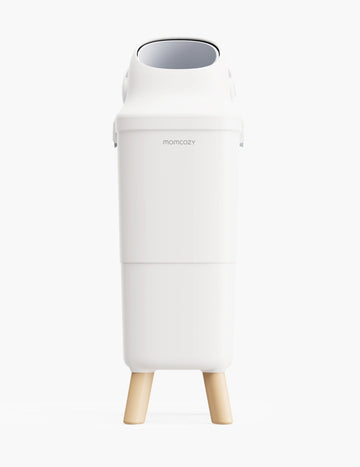
For example, Momcozy’s Triple-Seal Diaper Pail product page advertises a “Child Safety Lock,” a hands-free wide opening, and compatibility with standard 13-gallon trash bags. Those feature labels do not, on that page, identify the lock sequence, provide an age rating, or say that toddlers cannot gain access. The appropriate next step is to review current official instructions and confirm which openings the lock covers.
A feature called a child lock may still be valuable, but it should be understood as one part of the setup rather than a promise that every child will be unable to open the pail.
A calm final check before relying on any diaper pail
- Identify every opening: diaper-drop door, lid, bag-removal compartment, refill area, and exposed liner.
- Confirm what each button, pedal, twist control, and lock actually does.
- Consider your child’s current reach, imitation, grip, coordination, climbing, and persistence.
- Read the latest manufacturer instructions, warnings, and recall information for the exact model.
- Keep refill bags, spare liners, packaging, and removed bags out of sight and reach.
- Place the pail where a child cannot freely access, move, or tip it.
- Reassess the arrangement as your child’s skills change.
The goal is not to find a latch that can outsmart every toddler. It is to build a daily diaper-changing routine in which the pail’s controls, placement, liner handling, and adult supervision work together.








