


MEDICALLY REVIEWED BY

Shelly Umstot, BSN, RN
Shelly Umstot is a BSN and has been a registered nurse for over 35 years. She lives in North East Ohio and is a freelance health content writer. Her passion is bringing understanding to those with questions and concerns regarding health issues and helping them obtain and maintain their optimal health. She loves being with her family and has two lovely granddaughters who have stolen her heart. Assisting new parents in finding the information they need to face the joys and challenges of caring for their children is a gratifying experience for her as a professional, parent, and grandparent herself.
For most families, the most durable practical choice is a convertible chair with a smooth, nonporous, low-crevice feeding surface and robust, inspectable frame and conversion hardware—not simply a chair labeled plastic, wood, or metal.
A simple molded feeding area is often the lower-maintenance option for managing first-food and mealtime mess. Wood can serve for a long time, too, but only if you are comfortable maintaining its finish and checking its joints. In every material category, the tray, harness, attachment points, locks, and adjustment mechanisms matter as much as the visible seat.
Start With the Feeding Zone, Not the Material Label
“Plastic,” “wood,” and “metal” describe only part of a high chair. A convertible model is a system of surfaces and moving parts:
- seat shell or wooden seat structure
- tray and tray attachment
- cushion or seat pad
- harness, buckles, and anchor points
- footrest and adjustment points
- frame connections, fasteners, and conversion locks
For everyday durability, prioritize the places that receive food, moisture, and repeated wiping. Cleaning difficulty depends not only on the seat-pad material but also on whether you can reach the chair’s crevices. Grooves can trap food, so a beautiful material can still become a frustrating daily-cleaning job if its design has inaccessible seams or channels.
Favor |
Treat as a closer inspection point |
Smooth surfaces you can see and wipe fully |
Deep grooves, decorative channels, or hidden ledges |
A tray that fits securely and removes as intended |
A tray that leaves a concerning opening or feels loose |
Separately cleanable or replaceable harness and tray components |
Permanently attached padded components with hard-to-reach seams |
Hardware, fasteners, and locks you can inspect |
Connections obscured by covers or difficult to check after conversion |

This is why a one-piece-looking molded chair is not automatically easier to maintain than every wood chair—and why a wood chair with a removable tray and washable restraint can still be a sensible long-term choice.
How Common Seat Materials Age
There is no credible blanket verdict that one material will last five years in every chair. Thickness, construction, finish, stress points, care instructions, and conversion design can outweigh the material name.
Molded plastic: practical for the messiest years
For the feeding zone, molded plastic is often the practical default when it is smooth and has few seams. It can be a good fit for households that want fast wipe-downs and minimal fabric care.
If a listing specifies the resin, treat that as a clue—not a durability guarantee. Polypropylene (PP) is generally characterized as flexible, fatigue-resistant, and chemically stable. ABS is generally characterized as more rigid, with structural strength and a surface finish valued in molded products. PP is also described as having broader resistance to acids, alkalis, alcohols, detergents, and solvents than ABS, while ABS has more limited resistance to strong acids, bases, and organic solvents.

Those are general material properties, not five-year tests of a particular high-chair seat, tray, color, thickness, or cleaning routine. Do not assume that a PP tray is dishwasher-safe, that an ABS seat will crack, or that either resin is automatically the better choice. Follow the exact model’s cleaning instructions.
What to inspect: scratches that become cracks, stress whitening around clips or attachment points, loose tray guides, and worn areas around the harness anchors.
Finished wood: potentially long-serving, but more care-dependent
A wood-based grow-with-me chair can remain useful well beyond the high-chair stage, especially when its seat and footrest adjust as a child grows. The tradeoff is maintenance: the finish, edges, joints, and fasteners all deserve regular attention after repeated wiping and conversions.
A manufacturer-oriented source identifies moisture-related cracking and joint loosening as possible long-term risks for wooden high chairs. That is not five-year test data, and it does not mean wood chairs are inherently short-lived. It does mean buyers should examine the actual finish and assembly design rather than assuming wood alone equals longevity.
What to inspect: finish wear, cracks or splits, rough edges, movement at joints, and fasteners that no longer stay tight.
Metal frames: look past the frame material
Metal is usually a frame material rather than the primary feeding surface. It may support a long-lived design, but it does not remove the need to inspect the connections between the frame and the seat.
Historical recalls illustrate why attachment points deserve attention. In one recalled adjustable chair line, seats could separate from the frame, slip from their set height, or fall; some restraint anchors could also slip through the seat back. Those failures concerned a specific product line, not all metal-frame or convertible chairs, but they show why a solid-looking frame is not enough. Read the details of the seat-to-frame and height-adjustment recall before assuming any adjustment mechanism is maintenance-free.

Fabric and foam: more components, more upkeep
Fabric-covered inserts, cushions, and foam-padded seating can make a chair feel more comfortable, but they add surfaces that need stain and odor management. Their long-term practicality depends on whether they can be removed, cleaned according to the manual, and replaced if needed.
For a high-use chair, ask whether the cushion is truly necessary for your household. If it is, prioritize a design where the pad, cover, and harness can be cleaned separately without leaving inaccessible food traps beneath them.
Buy for the Conversion Path
A convertible chair is not durable merely because it offers several modes. Repeated adjustments introduce more points to inspect: seat-height settings, footrest positions, fasteners, locks, and the components removed or added during conversion.
Some grow-with-me chairs use wood or metal construction and can continue into childhood, but adjustments may require tools and conversion kits can be awkward. That does not make them a poor choice; it means the best long-term design is one your household will actually maintain and reconfigure correctly.
Before buying, check each component individually:
- Seat and finish: Can you identify the material and approved cleaning method?
- Tray: Does it attach firmly, remove as intended, and leave no problematic gap when installed?
- Harness: Is it attached, intact, adjustable, and available as a replacement part if it wears?
- Cushion: Is it removable, and does the manufacturer state how it should be cleaned?
- Footrest and conversion hardware: Are the required tools, parts, and configuration-specific instructions clear?
- Parts support: Can you obtain a replacement tray, harness, cushion, or hardware rather than replacing the full chair?
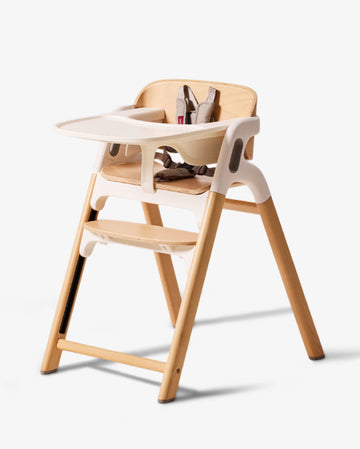
A wood-frame chair can still be highly practical when the daily-mess components are separately maintainable. For example, the manufacturer documentation for the Momcozy DinerPal convertible high chair specifies a beechwood structure, dishwasher-safe tray, machine-washable five-point harness, adjustable seat and footrest positions, and multiple seating modes. Those are model-specific specifications—not proof of five-year durability—so check current instructions, limits, and parts availability before purchase.
A Five-Minute Safety Check Before Reuse or Conversion
Material wear becomes a safety issue when it affects restraint, attachment, fit, or stability. Inspect a chair before reuse after storage, after a conversion, and whenever a component seems loose or damaged.
Stop using the chair and resolve the issue if you find:
- cracked plastic, especially near clips, hinges, tray guides, or harness anchors
- split wood, loose joints, or fasteners that will not remain tight
- a loose seat-to-frame connection or a height setting that slips
- damaged, frayed, missing, or detached harness straps
- damaged buckle or harness-anchor points
- a tray that does not lock securely or creates an unsafe-looking gap at the seat
- locks or conversion mechanisms that do not engage as the manual describes
- missing parts, improvised repairs, or hardware substituted without manufacturer approval

These are not theoretical details. A 2025 recall of a specific 5-in-1 convertible chair involved chairs sold without the required attached restraint system, creating a fall risk; the opening between the seat and tray also created an entrapment hazard. The recalled product does not represent all convertible chairs or any one material type, but it is a clear reminder to inspect restraint and tray fit—not just the chair’s finish. See the CPSC recall notice and affected-model details.
Use only the manufacturer’s approved replacement parts and care methods. If the manual does not address the damage or missing component, contact the manufacturer before putting a child back in the chair.
Verify the Exact Model Before You Price Its Five-Year Cost
In the United States, ASTM F404-21 became the mandatory high-chair safety standard on July 23, 2022. The standard addresses performance requirements, test methods, warning labels, and instructional literature. That is an important regulatory baseline, but it does not predict whether a particular chair will remain easy to clean, structurally sound, or presentable after five years of use. Read the federal rule incorporating ASTM F404-21 as a baseline, not a longevity score.
Price is not a reliable shortcut to safety or functionality. Instead, compare the whole ownership picture:
- Identify the materials for the seat, tray, frame, pad, and harness.
- Read the manual’s approved cleaning instructions before buying.
- Confirm the weight and age limits for every intended configuration.
- Check the warranty terms and recall history for the exact model.
- Verify whether replacement harnesses, trays, cushions, and hardware are available.
- Consider the time cost of wiping seams, laundering pads, tightening hardware, and converting the chair.
Choose the chair whose documented materials and care requirements match your household’s mess level and maintenance tolerance. Then confirm that its conversion limits, restraint condition and replaceability, locking hardware, and long-term parts support are as durable as the surface you plan to wipe every day.








