


MEDICALLY REVIEWED BY

Mary Bicknell, MSN, BSN, RNC, ANLC
Mary Bicknell comes with over 30 years of experience as an RN in the NICU. Educating mothers on the importance of healthy breastfeeding is important to her. It can be challenging to maintain successful breastfeeding through many difficult situations and long hospitalizations. Mary is committed to helping families define what successful breastfeeding means to them; and to assist them to obtain their goal. After leaving the bedside, Mary became a nurse leader and continued to make sure that breastfeeding education and support was always available to the families in her unit.
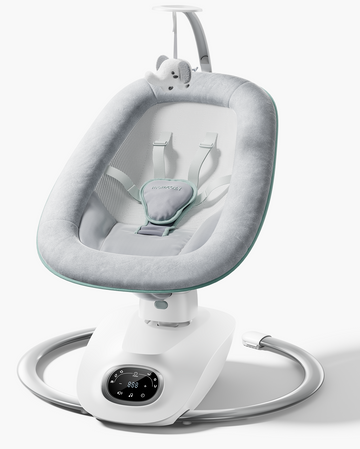
Choose a soothing seat only after planning for two different spaces: its full floor footprint while in use and the space it occupies when folded or stored. In a one-bedroom apartment, the practical options are a powered swing that is brought out for supervised use or non-powered bouncer that can be folded flat for supervised awake time. Neither replaces a separate firm, flat sleep space.
The statement that a swing is compact is not enough. A swing can fold neatly yet still be awkward to carry, too tall for a closet, dependent on an inconvenient outlet, or too wide to use without blocking the path between the bed, kitchen, and bathroom. The best choice is the one you can set up, supervise, clean, and put away consistently in your household.
Measure Before You Shop

Start with the room, not the product listing. Identify one temporary zone with a level floor
where an adult can reach the baby easily and where the frame will not obstruct a walking path.
For every model you consider, collect two sets of dimensions from its current manual or manufacturer documentation:
What to Measure |
What It Tells You |
Assembled length and width |
Whether the swing fits on the floor while operating |
Product height |
Whether it interferes with furniture, shelving, or sightlines |
Required clearance |
Whether the seat can move as intended without contacting walls or furniture |
Folded length, width, and height |
Whether it fits in the planned closet, storage nook, or other approved storage location |
Product weight |
Whether one caregiver can realistically move it daily |
Storage orientation |
Whether the manufacturer permits it to stand, lie flat, or be stored in a particular position |
Use painter’s tape to mark the assembled footprint on the floor. Then add the clearance specified in the manual and leave enough room for an adult to approach, buckle the harness, or lift the baby out.
Next, test the storage route. A swing that fits in a closet but cannot pass through the doorway, around the bed, or past a narrow hallway is not going to be manageable in the space. Also measure the storage opening, not just the storage area behind it.
Choose the Right Space Strategy

A powered swing and a non-powered bouncer solve different problems. Pick based on the motion you want and the daily setup burden you can sustain.
Option |
What It Provides |
Small-Space Trade-Off |
Powered swing |
Motorized swinging or gliding motion |
Needs a stable floor setup, power plan, and daily storage routine |
Non-powered bouncer |
Motion created by the baby’s movement |
May avoid batteries and motor noise, but does not provide automatic motion |
No soothing seat |
No extra equipment to store |
May be the better choice if there is no reliable supervised-use zone |
The federal infant-swing standard covers products with a powered mechanism that swings or glides a seat or cradle relative to its frame, including battery-powered, AC-adapter-powered, and wind-up units. A bouncer driven by a baby’s own movement is a different type of product. The federal infant-swing safety standard also makes it clear that powered swings and bouncers are not sleep products.
A non-powered bouncer may be easier to carry and store because it has no motor or power supply. That can matter in a one-bedroom apartment where sound carries and outlets are limited. But it should not be chosen as a “quiet swing”; it offers a different kind of motion.
Do not treat doorway jumpers, suspended seats, or tabletop placement as interchangeable substitutes for a floor swing. They have their own age, developmental, installation, and location requirements. A floor product should remain on the floor, on a flat surface, and in the location suggested by its manufacturer.
Compare the Exact Model, Not the Marketing Label

Avoid making a decision based on phrases such as “small-space,” “portable,” “newborn-ready,” or “easy fold.” Those descriptions do not tell you whether the exact model works in your apartment or for your baby.
Build a shortlist and verify each point in the product’s current manual:
- Assembled dimensions and folded dimensions
- Product weight and whether one person can carry it safely
- Folding and unfolding steps
- Approved floor surface and placement instructions
- Required clearance around moving parts
- Plug location, cord instructions, battery options, and any power restrictions
- Harness type and required use
- Recline positions and which positions are approved for your baby
- Newborn eligibility, if any
- Weight, height, age, and developmental stop-use limits
- Cleaning instructions for the seat pad, harness, and frame
- Available replacement parts and warranty information
Broad product categories are not enough. The federal standard distinguishes cradle swings, described as intended from birth to about 5 months, from seated infant swings, described as intended from birth to about 9 months. Those ranges do not override a particular model’s label, manual, weight limit, height limit, or instructions for what developmental milestones indicate stopping to use the product.
For example, a model may have an early-life recline setting, but that does not mean every newborn can use it in every configuration. Confirm the manufacturer’s positioning, harness, and eligibility instructions before use.
Create One Safe Temporary Use Zone
In a one-bedroom apartment, a swing works best when it has one deliberate location rather than being improvised beside the sofa, bed, or kitchen counter.
A workable setup should:
- Sit on a stable, floor-level surface specified by the manual.
- Stay out of the route between the sleeping area, bathroom, and kitchen.
- Leave an adult enough room to reach the baby without stepping over the frame.
- Keep any approved power cord arranged exactly as the manufacturer directs.
- Remain away from objects that could interfere with the swing’s movement.
- Be close enough to the caregiver for active supervision.
- Have a clear path to the baby’s separate sleep space.
Avoid placing a swing on a bed, sofa, counter, tabletop, or other elevated surface. Do not create a makeshift “parking spot” by wedging the frame between furniture or reducing the clearance the manual calls for.
Consider the daily routine before buying. A manageable sequence might be: bring the seat out, set it up in its designated floor zone, inspect the harness and frame, use it while the baby is awake and watched, wipe up spills, fold it according to the manual, and return it to storage. If that routine feels unrealistic during a tired evening, the product may be too large or too labor-intensive for the apartment.
Make Awake, Supervised Use Part of the Decision
A small apartment can make it tempting to let a baby continue sleeping wherever they drift off. That is not a reason to make a swing the nap plan.
For infants from birth through 12 months, sleep guidance calls for placing babies on their backs on a firm, flat sleep surface for naps and nighttime sleep. Appropriate sleep spaces include a crib, bassinet, portable crib, or play yard that meets applicable standards—not a swing, bouncer, rocker, sofa, or adult bed. The American Academy of Pediatrics’ safe-sleep guidance also supports room sharing with a separate sleep surface rather than bed sharing.
Before using a swing, decide where the baby will be transferred if sleep begins. The federal warning language for covered powered infant swings says caregivers should stay near and watch the baby during use; if the baby falls asleep, remove them as soon as possible and place them on a firm, flat sleep surface such as a crib or bassinet.
That makes a nearby approved sleep space a practical apartment requirement, not an optional extra.
If Your Baby Falls Asleep
- Stop treating the swing as the place for the nap.
- Remove the baby as soon as possible.
- Transfer the baby to their separate firm, flat sleep surface.
- Put the baby on their back for sleep.
- Recheck whether the swing’s use window and your baby’s current developmental stage still match the manual.
Use the harness, recline setting, and positioning instructions exactly as the model manual directs during supervised periods while the baby is awake. Stop using the product when the manufacturer’s weight, height, age, or developmental limit is reached.
Check Ownership Details Before Purchase or Use
Whether buying new, borrowing, or accepting a secondhand swing, confirm the exact model—not just the brand name.
Before bringing it home, verify that you have:
- The model number and current instruction manual.
- All original harness components, straps, buckles, frame pieces, and attachments.
- No damaged, modified, missing, or improvised parts.
- Current recall information and manufacturer safety notices.
- A way to register an eligible new product for recall and safety communications.
- Confirmation that replacement parts remain available if needed.
- A clear understanding of the model’s power, cleaning, storage, and instructions for when you should stop using it.
The U.S. mandatory standard for covered infant swings incorporated ASTM F2088-22 and took effect on January 1, 2023. That compliance framework does not prove that a particular used, older, imported, damaged, or modified unit is appropriate for your baby or safe to use without its instructions.
Apartment-Fit Checklist
Buy or keep a swing only if you can answer “yes” to each question:
- I know its assembled footprint and required clearance.
- I know its folded dimensions, weight, and approved storage position.
- I have taped out a safe floor-level use zone that does not block daily traffic.
- I can follow the manual’s power, cord, harness, recline, and cleaning instructions.
- My baby currently meets the model’s eligibility requirements.
- I know exactly when to stop using it.
- I can stay near and supervise during use.
- A separate firm, flat sleep space is ready for immediate transfer if the baby falls asleep.
- I have checked the manual, recall status, parts, and registration options.
The best choice is not necessarily the smallest swing. It is the option whose verified footprint, storage routine, child limits, and supervised-use requirements work in your actual home. If a powered swing does not pass that test, a fold-flat bouncer—or no additional soothing seat—may be the more practical fit.









