


MEDICALLY REVIEWED BY

Talia, OBGYN, master’s degree holder, IBCLC
A board-certified OBGYN, master’s degree holder, and IBCLC. As a mom who exclusively breastfed for 2 years, I bring both clinical expertise and real parenting empathy to my work.
I’ve supported 20,000+ postpartum parents with evidence-based breastfeeding guidance—from latching & positioning to lactation medication safety. 90% of my clients build sustainable feeding routines, and I’ve partnered with 2,000+ families to boost breastfeeding rates and satisfaction.
No. A baby swing should stay on the floor or on another surface the manual specifically allows, not on a table, counter, bed, sofa, or any other raised spot.
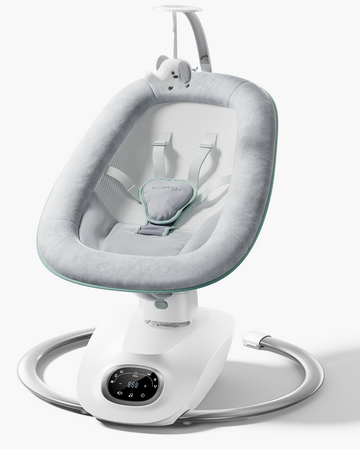
If you are trying to keep your baby close while you eat, pump, or get a few chores done, it is very tempting to move the swing to whatever surface is handy. That shortcut can turn a normal piece of baby gear into a tipping or fall hazard fast, and a safety agency’s infant swing guidance is built around stable, floor-level use. Here is the practical way to think about it at home, along with safer ways to keep baby nearby.
Why a Raised Surface Is the Wrong Place
The federal safety standard for infant swings lives in 16 C.F.R. part 1223, and it includes stability testing, structural integrity, restraint systems, and unintentional folding requirements. That matters because it shows what the product is designed to do: sit low, stay stable, and work from a secure base.
The safety guidance also describes a travel swing as a low-profile swing with 6 inches or less between the underside of the seat and the floor support surface. That is a useful clue for parents. These products are meant to work close to the floor, not balanced on furniture.

Buckles Do Not Make Furniture Safe
Even if your baby is strapped in tightly, the buckle only keeps your baby in the seat. It does not keep the swing from sliding, rocking, or toppling if the base is sitting on a table edge or another unstable surface.
A table can wobble, a countertop can be slick, and soft furniture can compress unevenly under the legs of the swing. Once the base shifts, you do not get much warning.
What Can Go Wrong
The most obvious risk is a fall. If the swing tips, the whole seat can go over the edge, and babies do not have the balance or control to correct that.
A second risk is sleep. On April 17, 2025, a safety agency warned families to stop using certain infant swings marketed for sleep because the incline angle was greater than 10 degrees and created a suffocation hazard. That is a strong reminder that a swing is not a sleep setup, even if baby looks cozy for a minute.

A pediatric organization’s safe sleep advice stays simple for a reason: alone, on the back, in a bare crib. If baby falls asleep in the swing, move baby to a firm, flat sleep surface as soon as you can.
Supervision Can Quietly Slip
The other problem with raised surfaces is that they encourage the wrong kind of use. A swing on a table often ends up farther from your hands, even if it feels closer to eye level.
That is how a supervised moment turns into an unsupervised one. With baby gear, convenience can blur the line faster than most of us expect.
Safer Ways to Keep the Swing Close
The easiest fix is also the safest one: put the swing on the floor in the room where you actually spend time. If you are feeding, pumping, folding laundry, or answering messages, choose one clear floor spot and leave the swing there.

That usually works better than moving the swing around the house. It keeps the base stable, keeps baby within sight, and removes the temptation to park the swing on furniture.
A Simple Floor Setup
A good setup does not need to be complicated. It just needs to be steady and easy to supervise.
- Put the swing on a level floor.
- Keep it away from stairs, cords, and busy foot traffic.
- Leave enough open space so you do not bump the base.
- Stay close while baby is in the swing.
- Move baby to a crib or bassinet if baby starts to doze.
Check the Manual Before You Set It Up
The exact setup can vary by model, so the manual matters. The current safety guidance says products manufactured after September 14, 2024, must meet a current infant swing safety standard, which is another reason not to guess based on a similar swing you used before.
If the manual is missing, look up the model number before using the swing again. Hand-me-down gear especially deserves a fresh check, because a product can look fine and still have limits you do not want to ignore.
When to Stop Using the Swing
The safety guidance says an infant swing is for a seated infant from birth until the baby attempts to climb out, which is roughly 9 months. A cradle swing is for a baby lying flat until the baby starts pushing up on hands and knees, which is around 5 months.

Those age ranges are not something to stretch because the swing is convenient. They are a reminder that the swing is a temporary tool for short, supervised use, not a place to park a baby all day.
Watch for the Point Where It No Longer Fits
If baby is trying to twist out, push up, or climb, the swing has likely outlived its usefulness. That is the moment to stop using it, even if baby still seems interested.
It is also time to stop if the swing is being used as a nap spot. A sleepy baby in a swing should be moved out promptly and placed on a firm, flat sleep surface.
Practical Next Steps
Keep the swing on the floor, use it only the way the manual intends, and treat any raised surface as off limits. That includes tables, counters, beds, sofas, and anything else that can shift, sink, or tip.
A simple rule helps in real life: if the surface is not stable enough for a baby seat to sit on all by itself, it is not the right place for the swing. When in doubt, move the baby gear, not the furniture.
- Use the swing on the floor only.
- Keep baby supervised while it is in use.
- Move a sleeping baby to a crib or bassinet right away.
- Stop using the swing when baby starts to outgrow it.








