


MEDICALLY REVIEWED BY

Mary Bicknell, MSN, BSN, RNC, ANLC
Mary Bicknell comes with over 30 years of experience as an RN in the NICU. Educating mothers on the importance of healthy breastfeeding is important to her. It can be challenging to maintain successful breastfeeding through many difficult situations and long hospitalizations. Mary is committed to helping families define what successful breastfeeding means to them; and to assist them to obtain their goal. After leaving the bedside, Mary became a nurse leader and continued to make sure that breastfeeding education and support was always available to the families in her unit.
Usually, no—not if the swing narrows the galley passage, sits on your route for hot food, is exposed to cooking hazards, or prevents you from actively supervising your baby. A narrow kitchen makes those conflicts especially likely.
There is no universal safe aisle width, stove-to-swing distance, or manufacturer-wide rule that says swings are always allowed or prohibited in kitchens. Review your own model’s manual and warning labels first; the available guidance does not supply a substitute for those instructions. The practical rule is simple: if you must squeeze around the swing, carry something hot near or over it, or turn away from your baby to manage the stove, sink, or oven, choose a different setup for that meal. The Consumer Product Safety Commission (CPSC) infant swing safety guidance explains general swing safety requirements but does not set a kitchen-clearance measurement.
Decide on Placement Before You Turn on the Stove

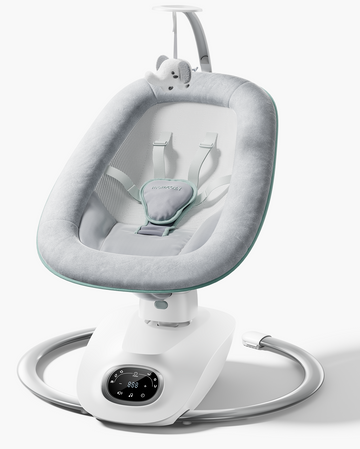
A swing may be permitted by its manual without being workable in your kitchen. Treat the fully opened swing—not the folded product—as part of the room’s traffic pattern.
Before placing your baby in it, walk through the dinner routine: refrigerator to counter, counter to stove, stove to sink, and stove to serving area. Then ask:
- Is the swing completely outside the stove, oven, sink, prep, and dishwashing areas?
- Can you walk normally without stepping around its base or brushing the seat?
- Can cabinet, refrigerator, dishwasher, and oven doors open without striking the swing?
- Will you need to carry hot pans, bowls, drinks, or drained pasta past the baby?
- Is the swing away from steam, grease, smoke, cords, sharp tools, glass, and cleaning products?
- Can you see and respond to your baby without leaving cooking hazards unattended?
- Does the swing sit securely on a firm, level floor?
If any answer is no, the kitchen fails the test for that dinner.
A swing at the far end of a galley can still be a no-go if the only path from stove to sink or table passes beside it. The concern is not merely whether your baby can reach the stove. In a tight aisle, an adult can be bumped, trip around the base, or spill something while trying to move through a constricted route.
Stop rule: Do not use the swing in the kitchen if it occupies the passage, lies on the hot-food route, enters the cooking zone, or cannot stay under active supervision.
Meet the Swing’s Non-Negotiable Conditions

Passing the layout test does not make a swing a sleep space or remove the need to follow its instructions. It only means the location may be worth considering for brief, awake, supervised use, if your model permits it.
Use these conditions every time:
- Put the swing on a stable, firm, flat floor—never on a countertop, table, sofa, or changing table.
- Use the restraint system exactly as the manual directs and adjust it for your baby.
- Only use if your baby is awake and supervised. Cooking can divide your attention quickly, so “in the same room” is not enough if you cannot observe and respond to your baby.
- Follow the model’s age, weight, height, and developmental limits. A product manual may be more restrictive than general guidance.
- For an infant younger than 4 months who cannot hold their head upwithout help, use only the product’s most reclined position permitted. The federal swing warning addresses this developmental stage specifically.
- Keep blankets and swaddles out of the swing.
A secure harness and a level floor address important product-use conditions, but they do not solve a blocked aisle or protect your baby from a dropped utensil, a swinging oven door, or a hot spill.
Keep the Galley Aisle and Cooking Route Baby-Free

A cooking area contains heat, steam, grease, sharp tools, appliance cords, breakable items, and household chemicals. In a galley kitchen, those hazards are concentrated in a small shared space.
Make the cooking process less dependent on moving hot items through the aisle:
- Prep ingredients before you place your baby nearby.
- Choose a simple meal that can be served near the stove rather than transferred across the kitchen in a full pot.
- Use back burners when feasible, and turn pot handles toward the back. These steps reduce access to hot cookware; they do not create a safe buffer around a swing. Mayo Clinic Press kitchen-safety guidance recommends both measures when children are nearby.
- Keep hot mugs, pans, and foods toward the back of the counter, not near an edge.
- Do not carry hot liquids or cookware through a passage occupied by a swing.
- Clean spills promptly. A wet galley floor can create a slipping hazard precisely when you need secure footing.
- Pause cooking if your baby needs to be picked up, repositioned, soothed, or transferred.
Think of the aisle as a work route, not a parking spot. Even if the swing is not directly beside the stove, it does not belong where it changes how you must move while handling a hot item.
Choose a Different Nearby Setup When the Kitchen Fails

When the swing cannot stay fully outside the cooking and traffic zone, moving your baby—not cramping the layout—is the safer decision.
Option |
When It May Work |
Important Limit |
High chair in an adjacent area |
For a child who meets that high chair’s developmental and product instructions |
Position it outside the cooking route and use the safety straps. Do not carry hot food close to the chair. |
Play yard in another safe room |
When baby can be placed according to the play yard’s instructions and supervised as appropriate |
This may mean changing the meal so you can check on your baby without leaving an active stove or hot food unattended. |
Another adult takes over baby care |
When dinner requires frying, draining pots, using sharp tools, or frequent movement |
This is often the simplest option for a more involved meal. |
Simplify or delay dinner |
When you are solo and the kitchen is too tight |
Cold food, make-ahead food, or a one-pan meal can reduce the need to manage your baby and cooking hazards at once. |
Babywearing away from cooking tasks |
Only when the carrier and baby meet its instructions |
Do not cook over heat, fry, drain pots, carry hot liquids, or use sharp tools while wearing your baby. |
None of these choices is automatically safe just because it is outside the kitchen. Check the relevant product instructions, use restraints where required, and keep the child’s developmental stage in mind.
Know When Swing Time Must End
Dinner can run long, and a settled baby may fall asleep. That is the point to stop using the swing—not a reason to let the routine continue.
Move baby out of the swing if:
- Baby falls asleep. Transfer them to a firm, flat sleep surface such as a crib or bassinet.
- Baby reaches any age, weight, height, or developmental limit in the model manual.
- Baby can sit up unassisted, climb out, or otherwise shows a behavior that makes continued use inappropriate.
- Baby’s position needs adjustment, their head falls forward, or you cannot keep watching them.
- You need to leave the room, answer the door, take food out of the oven, or handle a task that prevents active supervision.
Infant swings are generally intended only until a child can sit up unassisted, but your own manual’s will list the earliest limit controls. Do not add a blanket or swaddle to make a tired baby more comfortable in the swing.
A Quick Dinner-Time Decision Checklist
Use the swing only if all of these are true:
- Your swing manual permits the setup and your baby is within every listed limit.
- The swing is on a firm, level floor and fully outside the galley aisle.
- It is not near heat, steam, grease, sharp objects, cords, chemicals, or hot-food routes.
- Doors and appliances can operate without colliding with it.
- Baby is awake, properly restrained, and actively supervised.
- You can cook without carrying hot items beside or over the swing.
- You have a plan to stop and transfer baby if they fall asleep or need attention.
If your narrow galley kitchen cannot meet every item on that list, the answer is no for that dinner setup. Move baby to an approved safer location, make a simpler meal, delay cooking, or ask another adult to supervise baby while you cook.









