


MEDICALLY REVIEWED BY

Mary Bicknell, MSN, BSN, RNC, ANLC
Mary Bicknell comes with over 30 years of experience as an RN in the NICU. Educating mothers on the importance of healthy breastfeeding is important to her. It can be challenging to maintain successful breastfeeding through many difficult situations and long hospitalizations. Mary is committed to helping families define what successful breastfeeding means to them; and to assist them to obtain their goal. After leaving the bedside, Mary became a nurse leader and continued to make sure that breastfeeding education and support was always available to the families in her unit.
White noise or a simple lullaby may help some babies settle, but there is no good evidence that one sound type reliably supports infant sleep better than another. Use a swing’s sounds for supervised calming only. If your baby falls asleep, move them onto their back on a firm, flat, non-inclined, approved sleep surface.
Use Swing Sounds for Supervised Calming, Not Routine Sleep
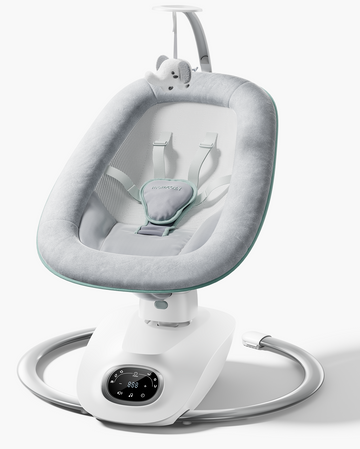
A swing can be a place to soothe an awake baby while you are actively supervising. Its music or white-noise setting may be part of that calming moment, but sound, motion, a timer, or close supervision does not turn a swing into a safe routine sleep space.
For naps and nighttime sleep, infants should be placed on their backs on a firm, flat sleep surface. Sitting devices, including swings, are not intended for routine sleep—even when a baby dozes off peacefully. John Hopkins' safe-sleep guidance makes the distinction clear.
A simple approach is:
- Calm: Use the swing and its sound mode while your baby is awake and supervised.
- Transfer: Once sleep begins, move your baby to their regular approved sleep space.
That rule applies whether the sound is white noise, a heartbeat track, rain, nature sounds, or music.
Which Sound Should You Try First?
Think of built-in sound modes as options to test—not as proven sleep solutions. Start with the least stimulating sound that seems to help your baby relax.
A controlled study of term newborns in a NICU found that both recorded white noise and a lullaby were associated with gradual decreases in heart rate over short sessions. However, the study did not test home bedtime routines, sleep onset, sleep duration, swing use, or whether one sound worked better than the other for sleep.
That leaves caregivers with a practical, baby-specific decision:
If Your Baby Seems to Prefer… |
A Reasonable First Try |
Consistent, unchanging sound |
A steady white-noise-style track at low volume |
Gentle melody |
A simple, slow lullaby without abrupt changes |
Familiar rhythmic sound |
A quiet heartbeat or nature-style track, if available |
No added sound |
Silence—turn the sound off rather than assuming it is needed |
There is no infant-specific basis here to call white noise, pink noise, heartbeat sounds, rain, or music the “best” choice. Research on auditory stimulation and sleep is also limited and mixed, with much of the broader evidence focused on adults rather than infants. A systematic review of auditory stimulation and sleep does not establish a winning sound for babies.

Watch the Baby, Not the Label
A sound mode is worth continuing during supervised soothing only if your baby appears calmer. Look for a more settled body, less fussing, or an easier transition into a quiet, drowsy state.
Change course if the sound seems to make your baby more alert, more upset, or harder to settle. A brighter melody, frequent musical changes, or a louder setting may simply be too much for that moment. Switch to a simpler track, lower the volume, or turn the sound off.
Set Volume, Distance, and Timing Conservatively
With a built-in swing speaker, the sound source may be relatively close to your baby’s head. That makes conservative settings especially important.
Start Lower Than You Think You Need
Use the lowest practical volume that allows the sound to be heard without becoming a dominant part of the room. Avoid using maximum volume as a default.
One source suggests 50 dB or lower as a conservative target for ongoing infant white-noise use, but that is not a universal standard for every device or setting. It is more useful as a reminder to avoid loud playback than as a number to chase.
Testing of separate infant sound machines also found that many could exceed 85 dB at maximum volume when placed within about 3 feet of a crib. That result does not describe every swing speaker, but it shows why a device’s volume control alone is not a guarantee of low sound exposure.
Distance Guidance Has a Built-in-Speaker Limitation
A cautious placement approach for a separate sound machine is to keep it at least 7 feet from the crib and away from the baby’s head. A swing’s integrated speaker usually cannot meet that distance while the baby is in the seat.
Do not try to treat that limitation as a reason to keep a baby sleeping in the swing. Instead, use it as a reason to keep swing sound low, brief, and limited to supervised calming. Once your baby is transferred to a firm, flat sleep space, follow the placement guidance for any separate sound source you use there.
Favor Shorter Use Over Assumed All-Night Playback
The available evidence does not show that continuous all-night playback works better than a timer-based or shorter pattern for infants. Long-term effects of nightly moderate-volume white-noise exposure also remain uncertain.
If your swing has a timer or fade-out function, it may be useful for keeping a soothing session from continuing indefinitely. There is no evidence-based universal timer length, so avoid treating any preset duration as medically meaningful. The goal is simply conservative exposure, not a perfectly optimized number of minutes.
Choose Sound Controls You Can Adjust Quickly
When comparing a baby swing with music or white-noise modes, prioritize controls that let the caregiver respond easily to the baby rather than features that promise better sleep.
Look for:
- A genuinely low starting volume
- Simple volume adjustment without complicated menus
- Easy sound switching so you can move from music to a steady track—or to silence
- A timer or fade-out option, with instructions in the manufacturers' manual or live product page
- Controls that are accessible to the caregiver during supervised use
- Clear operating instructions for sound, motion, seat use, and age and weight limits
Before relying on any sound mode, test it while your baby is awake and supervised. Set the intended volume, then listen from where your baby’s head would rest. A phone decibel-meter app may provide a rough check, but it is not a compliance-grade measurement and should not replace the manual or current safety guidance.
Also check the actual product documentation before buying or using a swing. Sound libraries, timer options, volume ranges, and controls vary by model; do not assume that a particular feature is included. Exact sound behavior, timer settings, age and weight limits, and operating restrictions vary by model, so check the swing’s manual and safety instructions for final setup decisions.
A Safer Sound-Mode Checklist
Before pressing play, use this quick check:
- Choose one simple, low-stimulation sound to try first.
- Set the volume to the lowest practical level.
- Do not default to maximum volume or continuous playback.
- Reassess if your baby becomes more alert, distressed, or difficult to settle.
- Use a timer or stop the sound after the supervised calming period when that option is available.
- Treat the swing as a supervised soothing aid, never as a sleep surface.
- If your baby falls asleep, transfer them to their back on a firm, flat, non-inclined, approved sleep surface.
- Verify current Momcozy swing specifications, controls, and instructions in the relevant product page or manual before making a purchase decision.









