


MEDICALLY REVIEWED BY

Pada Yang is a registered nurse with more than 12 years of experience in obstetrics‑gynecology and an International Board‑Certified Lactation Consultant (IBCLC). Based in Beijing, she works as a maternal‑health content reviewer and freelance health writer. She is dedicated to making reliable, easy‑to‑understand guidance accessible to families navigating postpartum recovery and breastfeeding, empowering parents to build gentle, confident care for their little ones. Outside of work, she enjoys quiet time with her family. Supporting new parents with evidence‑based, compassionate information has always been deeply rewarding for her, both as a clinical professional and a parent.
Yes—usually. A high chair without a footrest is not, by itself, a reason to delay baby-led weaning. The bigger questions are whether your baby is developmentally ready and whether the chair keeps them securely upright, supported, and properly restrained.
That said, dangling feet can make it harder for some babies to feel stable and comfortable during meals. If your baby can sit upright but their feet hang freely, treat foot support as a setup improvement worth addressing—not as a substitute for readiness or as proof that the chair is unsafe.
Start with Readiness and Upright Sitting

Baby-led weaning involves self-feeding, so a tray alone is not enough. Before offering finger foods, your baby should be able to sit up and bring objects to their mouth. Starting solids depends on developmental readiness rather than age alone; common readiness signs include steady head control, interest in food, and the ability to move food back and swallow it, as outlined by the American Academy of Pediatrics’ guidance on starting solid foods.
For the high-chair setup, look for these basics:
- Your baby can sit with minimal assistance rather than being held up by the chair alone.
- Their head and trunk stay upright during the meal.
- They can reach the food without leaning far forward, twisting, or bracing heavily on the tray.
- The chair’s restraint is used exactly as its manufacturer directs.
- The chair is stable on the floor and appropriate for your child’s size and stage.
A footrest cannot compensate for poor head or trunk control. If your baby consistently slumps, slides down, leans to one side, or cannot maintain an upright position, pause finger foods in that setup and speak with your pediatrician or a feeding professional, especially if there are developmental or swallowing concerns.
Why Foot Support Can Help

A footrest gives a baby a place to press their feet rather than leaving their legs to dangle. Feeding-positioning guidance often uses “90-90-90” as a practical target: hips, knees, and ankles are each bent at roughly 90 degrees, with the feet supported.
This is a useful goal, not a regulation or a pass/fail test. Babies vary in size, and high chairs vary in seat depth, tray height, and footrest design. Focus on whether your baby appears well aligned and stable rather than trying to achieve an exact angle.
Signs the Feet May Need More Support
Consider adjusting the chair or exploring an approved foot-support option if your baby regularly:
- Kicks or swings their legs throughout the meal
- Leans back or pushes against the tray to steady themselves
- Wraps their legs around the chair legs
- Has trouble seeing, reaching, or staying engaged with food
- Seems uncomfortable or eager to leave the chair quickly
These behaviors can be associated with less stable, less comfortable positioning. They do not prove that a baby cannot begin solids in the chair, but they are a reason to review the fit.
What a Footrest Does Not Do
Foot support is not known to eliminate choking risk, prevent gagging, or guarantee less mess. Gagging and choking are different events, and no seating feature makes eating unsupervised or risk-free.
Instead, think of a footrest as one part of a supportive eating position. An upright seat, secure restraint, stable base, appropriate tray access, and your baby’s own readiness all matter too.
Improve the Setup Without Improvising

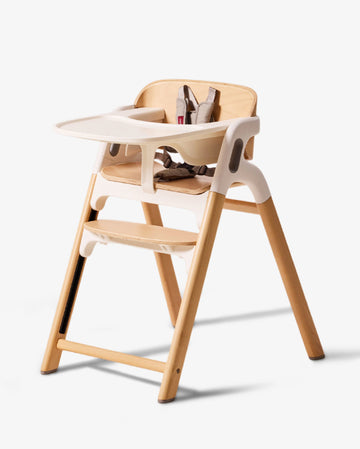
If your chair has a built-in footrest, first check whether it can be adjusted. A footrest that is present but out of reach may simply need to be moved as your child grows.
If the chair has no footrest, use a cautious decision path.
Adjust the Existing Chair When Possible
Review the manufacturer’s instructions for:
- Footrest-height adjustments
- Seat or tray-position adjustments
- Required harness use
- Age and weight limits
- Approved accessories and replacement parts
- Recall notices or other safety updates
A correctly adjusted built-in feature is generally the simplest option because it is part of the chair’s intended design.
Consider Only Compatible, Secure Accessories
Some chairs may be adaptable for better comfort and positioning, but an accessory being sold online does not automatically make it safe for your particular chair.
Before using an add-on footrest, confirm that it is compatible with your chair and does not interfere with the chair’s structure, restraint, folding mechanism, cleaning instructions, or safe use. It should attach securely and remain stable during normal use. Follow all product instructions and limits, and do not use an accessory that conflicts with the high-chair manual.
Avoid loose cushions, rolled towels, unsecured platforms, or homemade modifications as a way to create foot support. They can shift, change the baby’s position, or interfere with the restraint system.
Choose a Better-Fitting Chair If Needed
A different chair may be the better answer when you cannot achieve a secure, upright position in the one you own. This may be true if the seat is too deep, the baby slides or slumps despite proper restraint use, the tray is poorly positioned, or the child cannot be supported without unapproved add-ons.
A booster is not automatically an infant-high-chair substitute. Many booster seats may also leave a child’s feet unsupported, and their suitability depends on the product’s instructions and the child’s age, size, and developmental stage.
If your baby still needs substantial back support in the chair, read more about introducing finger foods when a baby needs high-chair back support before moving ahead.
Run a Pre-Meal Positioning Check
Caregiver checking high-chair recline, harness, tray reach, foot support, and stable setup
Use this quick check before offering food:
- Readiness: Your baby can sit with minimal assistance, has steady head control, and can bring objects to their mouth.
- Upright position: Their head, neck, and trunk are aligned rather than reclined, slumped, or twisted.
- Chair stability: The chair is on a level floor and used according to its instructions.
- Restraint: The harness is fastened and adjusted as directed every time.
- Seat and tray fit: Your baby is not sliding forward, squeezed into the seat, or reaching excessively to access food.
- Feet: Their feet have secure support where feasible, ideally with knees bent rather than legs hanging freely.
- Supervision: An attentive adult remains with the child throughout the meal.
Do not use propped sitting chairs or floor seats intended for brief supported sitting as a feeding workaround. They are not a replacement for a stable, upright high-chair setup.
If posture changes when food appears—such as repeated slumping, arching, coughing, difficulty swallowing, or an inability to stay seated upright—stop and seek individualized guidance from your child’s pediatrician or a qualified feeding specialist.
A missing footrest does not automatically answer whether you can start baby-led weaning. Start when your baby is developmentally ready and can be seated securely and upright. Then improve foot support through approved adjustments or compatible solutions—or choose a better-fitting chair before proceeding.









