


Some families use white noise through the night, but all-night playback should not be treated as the default for every baby. If white noise is part of your routine, start with a safe sleep setup, keep the sound source well away from the crib, use the lowest effective volume, and limit playback to what is actually useful. Families comparing baby sound machines can also look for controls that make these adjustments easier without moving the device closer or making the sound louder.
Key Takeaways
Some families use white noise overnight, but current AAP parent guidance favors keeping infant sleep machines as far from the baby’s head as possible and limiting use to a short time. Continuous playback should not be treated as the default for every baby.
- Start with the safe sleep setup, then maximize practical distance, use the lowest effective volume, and keep sound on only as long as it remains useful.
- Research has not established one exact bedside decibel level or overnight duration that is appropriate for every infant.
- The commonly cited 50 dBA figure is study context, not a universal home-use safety threshold.
- App control can make remote adjustments easier, but it does not make continuous white-noise exposure automatically safer.
- White noise does not replace back sleeping, a firm and flat sleep surface, or an otherwise appropriate infant sleep environment.
Can Babies Sleep With White Noise All Night?
All-night white noise should not be presented as the default recommendation for every baby.
A more cautious approach is to keep the sound source well away from the baby, use the lowest effective volume, and limit playback to the shortest duration that serves a clear purpose. Research has not established one exact overnight duration or bedside sound level that works as a universal safety rule for every infant.
If your family keeps white noise on after your baby has settled or through much of the sleep period, keep the device outside the sleep space, use the lowest effective volume, and periodically reassess whether that duration is still serving a clear purpose.
Your baby’s individual needs matter too. Premature babies and children with hearing, speech, developmental, or complex medical concerns may need more specific advice from their pediatrician or pediatric audiologist.
White noise can be one part of a routine, but it should not replace individualized medical guidance when hearing or development is a concern.

Why Do Parents Leave a Sound Machine On Overnight?
Parents often use white noise because the environment does not become completely quiet after bedtime. Dogs may bark, siblings move through the house, traffic passes outside, apartment doors close, or adults continue normal evening activities.
A steady sound can help make those sudden environmental changes less noticeable. Some families also prefer keeping the same background sound after the baby has settled rather than changing the room environment partway through sleep.
Those routines still deserve regular reassessment.
If the machine gradually moves closer to the crib, gets louder, or stays on longer simply because the household has become used to it, the original purpose can get lost.
Parents also commonly wonder whether turning it off after the baby settles will expose household noise or remove a familiar sleep cue. These are practical routine questions, not proof that continuous overnight sound is necessary for every child.
The broader role of white noise during the newborn period depends on the environment and the family’s needs rather than a rule that all babies need background sound.
Continuous White Noise vs. a Timer vs. Turning It Off
There is no single playback pattern that works for every baby. Think first about what problem the sound is solving.
| Approach | Possible Advantage | Main Concern | Cautious Use Direction |
|---|---|---|---|
| Continuous overnight | Keeps the sound environment consistent | Longer cumulative exposure and gradual volume escalation | Do not present it as the default; seek individual guidance when hearing or developmental concerns exist |
| Timer after settling | Limits duration while preserving a bedtime cue | Household noise may become noticeable after the sound stops | Use a gradual or scheduled change when the verified product controls allow it |
| Turn down after sleep begins | Reduces intensity without abrupt silence | Sound still needs to be checked from the sleep position | Remote adjustment can reduce room entry while the machine stays far away |
| No sound machine | No added device-related sound exposure | Environmental noise remains noticeable | A valid option when the baby settles comfortably without added sound |
Using no sound machine is a completely valid choice. If the room is already quiet enough and your baby settles comfortably, there is no need to add white noise simply because it is common in other households.
How Loud Should a Baby Sound Machine Be?
Use the lowest effective volume rather than relying on one universal percentage setting.
A “30%” setting on one speaker may produce a very different sound level from the same percentage on another device. Room size, surfaces, speaker design, and distance also change what reaches the baby.
A 2014 Pediatrics study measured 14 infant sleep machines at maximum output from distances of 30, 100, and 200 centimeters. At 30 centimeters, all 14 produced more than 50 A-weighted decibels, and three produced more than 85 dBA.
The 50 dBA figure needs context. In that paper, researchers used it as a comparison with the hospital-nursery reference in place at the time. The study did not establish that exactly 50 dBA is a universal bedside level that guarantees safe home use.
More recent evidence also supports a cautious approach. A 2024 scoping review of continuous white-noise exposure during sleep found that optimal exposure parameters for young children remain uncertain and supported limiting maximum sound intensity and duration.
If you use a phone sound-level app, treat it only as an approximate screening check from the baby’s sleep position. A consumer phone app is not the same as a calibrated professional sound-level meter or a hearing test.
Where Should You Place a White Noise Machine?
Keep the machine outside the crib or bassinet and as far from your baby’s head as practical. Place it on a stable surface where the device, cord, charger, and other accessories stay completely out of reach.

Check the sound from your baby’s actual sleep position rather than standing beside the speaker. A setting that feels quiet next to the machine may sound different across the room, so placement and distance should be considered together with volume.
Avoid setups such as:
- placing the machine directly beside the crib;
- attaching it to crib rails;
- putting it inside the crib or bassinet;
- positioning it under a mattress;
- routing a cord near or through the sleep space.
There is no need to create one universal number of feet or meters for every nursery when the device, room, and output can differ.
How Long Should You Use White Noise for a Baby?
Research has not established one optimal number of minutes or hours for every baby. A conservative approach is to tie white noise to a defined purpose. If you are using it to mask noisy evening activity, reconsider whether it still needs to run once the house becomes quiet. If it has become part of the whole sleep period, periodically test whether a shorter duration still serves the routine.
The uncertainty around duration is one reason current research supports limiting both maximum intensity and exposure time instead of assuming continuous playback has one proven safe formula.
Watch for gradual “volume and duration creep.” A setup that started quietly for the first part of bedtime can slowly become louder and longer if nobody reassesses it.
If your family decides white noise is no longer needed for the same amount of time, gradually reducing white-noise use keeps the detailed step-down process separate from this all-night safety decision.
How to Build a Lower-Interruption Routine With the Momcozy App-Controlled Sound Machine
Remote controls can be helpful when you want to make a small change without walking into the nursery or moving the sound source closer to the crib.
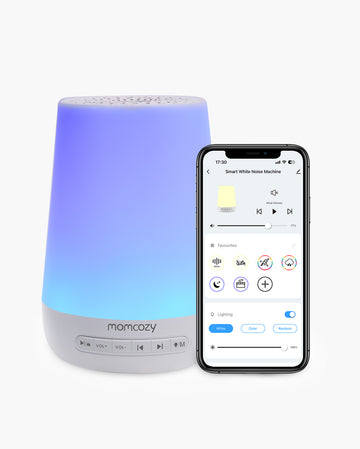
With the Momcozy Smart Baby Sound Machine with App Remote Control, you can adjust the sound from outside the nursery and use scheduling or the auto-off timer when those controls fit your routine. This makes it easier to fine-tune the setup while leaving the machine in its original position. A lower-interruption routine could work like this:
- Place the machine on a stable surface well away from the crib.
- Begin at the lowest useful sound level.
- Listen from the baby’s sleep position rather than beside the device.
- If a small change is needed, adjust the settings remotely instead of moving the machine closer.
- Use the available schedule or timer controls when they match the routine you have chosen.
- Reassess whether the original sound level and duration are still necessary.
The product’s app can change settings remotely, but it does not turn the phone into a calibrated sound meter or prove that continuous playback is appropriate for every baby.
The value of app control here is convenience and routine control. Families comparing other control methods and sound-machine formats can keep the detailed SKU decision on the Momcozy sound machine comparison page.

Member price
$39.99
Signs the Sound Setup Needs to Change
A setup that worked several months ago may not need to stay exactly the same.
Reassess it if:
- you keep moving the machine closer so it seems effective;
- the volume has gradually increased;
- the sound feels prominent when you listen from the baby’s sleep position;
- you find it harder to hear normal baby sounds from outside the room;
- the machine, cord, charger, or accessory can be reached from the sleep space;
- the sound now runs longer than the household-noise problem it was originally meant to mask;
- you are using a phone sound-level reading as though it were a clinical measurement;
- your baby develops hearing, speech, developmental, or other health concerns that need individualized advice.
A sound machine should remain a tool that can be adjusted, shortened, or removed when the original need changes.
Will a Baby Become Dependent on White Noise?
A familiar background sound can become a learned sleep cue, but that is different from describing a baby as medically “addicted” to white noise.
If you no longer need as much masking, test whether a lower level or shorter period still fits the routine. You do not need to suddenly remove the sound simply because it has become familiar.
Keeping the rest of bedtime consistent can make changes easier to observe. You might reduce the sound level first, then shorten how long it runs while leaving feeding, pajamas, lights, and other parts of bedtime unchanged.
Families ready for a fuller transition can use a gradual white-noise step-down process rather than turning this page into a second weaning tutorial.
The aim is to keep the routine flexible, not to prove that babies should always sleep with sound or always sleep in silence.
White Noise Does Not Replace Safe Sleep
White noise and sound-machine controls are separate from the sleep surface itself.
For every nap and nighttime sleep, current CDC safe-sleep guidance calls for placing babies on their backs on a firm, flat sleep surface and keeping soft bedding and loose items out of the sleep area.
The sound machine belongs outside that sleep space.
White noise does not reduce SIDS risk, and app control does not make an otherwise inappropriate sleep setup safer. An adult bed, couch, swing, or inclined surface does not become an appropriate routine infant sleep space because white noise is playing nearby.
Broader questions about using a baby sound machine around sleep should stay secondary to the basic sleep environment.
When to Ask a Pediatrician or Pediatric Audiologist
Individual guidance becomes more important when your child’s situation falls outside an ordinary household sound routine.
Consider professional input when:
- your baby was born prematurely;
- there is a known or suspected hearing concern;
- speech or developmental concerns have been raised;
- your baby has complex medical needs;
- your healthcare team has given you special sleep or monitoring instructions;
- you are unsure how much sound exposure is appropriate for your setup.
Do not try to diagnose hearing changes by raising or lowering a sound machine and watching your baby’s reaction.
Likewise, a phone sound-level app can provide a rough indication that the room may be louder than expected, but it should not be treated as a hearing test or calibrated clinical assessment.

FAQs About Overnight White Noise for Babies
Can Newborns Sleep With White Noise All Night?
A newborn can sleep while white noise is playing, but continuous all-night use should not be treated as the default. Keep the setup conservative and use sound only when it serves a clear purpose. Premature newborns or babies with hearing, developmental, or other medical concerns may need individualized guidance.
Should I Turn White Noise Off After My Baby Falls Asleep?
You can turn it off, lower the volume, or use a timer if the sound is no longer needed to mask household noise. Some families prefer a consistent background sound, but there is no rule that it must continue for the entire sleep period.
Is 50 dB Safe for a Baby Sound Machine?
50 dBA should not be treated as a universal safety cutoff. The number is often discussed because it appeared as a comparison point in infant sound-machine research, but it does not prove that one exact level is appropriate for every baby, room, or device.
How Far Should a Sound Machine Be From a Crib?
Keep the sound machine outside the crib or bassinet and as far from your baby’s head as practical. Place it on a stable surface with cords and accessories completely out of reach, and judge the sound from the baby’s sleep position rather than beside the speaker.
Does App Control Make a Baby Sound Machine Safer?
App control can make adjustments more convenient, but it does not make continuous playback automatically safer. Its practical value is allowing you to change volume or routine settings without entering the nursery or moving the machine closer to the crib.
When Should I Stop Using a Sound Machine for My Baby?
There is no single age when every family needs to stop. Reassess whether white noise is still solving a real problem, and consider reducing the volume or duration when less sound works just as well. A gradual change can also make it easier to see how your baby responds.
Is Pink or Brown Noise Better Than White Noise for Babies?
Infant-specific evidence does not establish one universal winner. White, pink, and brown noise differ in frequency profile and sound character, so the more useful comparison is whether a gentle sound fits the environment and your baby’s response. The distinctions are covered separately in white vs. pink vs. brown noise for babies.
Conclusion: Volume and Placement Decide the Answer
Continuous white noise should not become the automatic default simply because a baby can sleep with it. Start with an appropriate sleep environment, keep the sound source as far from the baby as practical, use the lowest useful volume, and limit playback to the shortest duration that serves your routine.
Families comparing baby sound machines can choose controls that make those habits easier. The Momcozy Smart Baby Sound Machine with App Remote Control adds remote adjustment, scheduling, and routine controls as conveniences, without replacing careful placement, sound-level decisions, or individualized pediatric guidance.








