Traditional audio and video baby monitors can help parents hear crying or see whether a baby is awake, but they do not explain much about still, quiet sleep. Baby monitors that track breathing-related movement add another layer of context by detecting subtle motion patterns, sending alerts, or summarizing sleep trends, depending on the model.
The key point is simple: consumer breathing monitors do not literally “see” air moving in and out of the lungs. They detect physical signals associated with breathing, such as chest movement, abdominal movement, mattress vibration, or radar-reflected micro-movement. These insights can support everyday check-ins, but they are not medical measurements and should not be treated as a guarantee of safety.
Safety Note Before You Start
A smart baby monitor is a support tool, not a medical device or a SIDS prevention device. It should not replace adult supervision, safe sleep practices, or advice from a pediatrician. For sleep, babies should be placed on their backs, on a firm and flat sleep surface, with no loose bedding, pillows, toys, or soft objects in the crib. If your baby was premature, has breathing concerns, or has been prescribed medical monitoring, follow your clinician’s instructions rather than relying on a consumer monitor.
Quick Answer: How Does It Work?
A baby monitor that tracks breathing works by detecting movement patterns that usually happen when a baby breathes. The exact method depends on the product type:
- Wearables detect motion or optical signals from a sock, clip, band, or similar device attached to the baby.
- Under-mattress sensor pads detect tiny pressure changes or vibration through the mattress.
- Camera-based systems analyze video patterns, such as chest or body movement, when the view is clear.
- Contact-free radar monitors use distance-based sensing, such as mmWave radar, to detect subtle movement from a fixed position near the crib.
After the sensor captures movement-related signals, the device or app processes them into alerts, trend summaries, or sleep-related insights. The result is consumer monitoring information, not a clinical diagnosis.
Quick Comparison: Main Types of Smart Baby Monitors
|
Monitor Type
|
How It Works
|
Main Benefit
|
Possible Limitation
|
|
Wearable monitor
|
Attaches to the baby’s foot, clothing, diaper, chest, or ankle and detects movement or optical signals.
|
Can follow the baby across different sleep spaces.
|
May slip, need charging, cause skin irritation, or trigger false alarms if not positioned correctly.
|
|
Under-mattress sensor pad
|
Detects small pressure changes or vibrations through the crib mattress.
|
Nothing is attached to the baby’s body.
|
Performance may depend on mattress type, baby position, and room vibration.
|
|
Camera-based monitor
|
Uses video analysis to identify visible breathing-related or body movement patterns.
|
Combines visual monitoring with smart motion information.
|
Needs a clear angle; lighting, blankets, and camera placement may affect results.
|
|
Contact-free radar monitor
|
Uses distance-based sensing, such as mmWave radar, to detect subtle movement from a fixed position.
|
No wearable, clip, sock, or mattress pad is required.
|
Requires stable placement, proper setup, app connectivity, and clear use instructions.
|
|
Momcozy BM08
|
Uses contact-free mmWave sensing with app-based viewing, sleep insights, and smart notifications, according to current product information.
|
No wearables are required; it may help parents follow breathing dynamics and sleep trends during everyday home monitoring.
|
Not a medical device; insights are not medical measurements and should not replace safe sleep practices or adult supervision.
|
What Is a Baby Monitor That Tracks Breathing?
A baby monitor that tracks breathing is a consumer nursery device designed to display or summarize breathing-related movement patterns. Depending on the model, it may also show motion status, sleep trends, crying events, room conditions, or video footage.
These devices fall into two broad groups: contact-based monitors and contact-free monitors. Contact-based monitors touch the baby or the sleep surface, such as a sock, clip, band, or sensor pad. Contact-free monitors use a camera or radar-style sensing from a stable position near the sleep area.
The goal is usually to give parents more context during everyday sleep monitoring. It is not to diagnose breathing problems, prevent SIDS, replace a prescribed medical monitor, or prove that a baby is safe.
How the Technology Reads Breathing-Related Movement
Although the user-facing app may show breathing dynamics, movement status, or sleep trends, the device is generally working from indirect signals. It may detect:
- the rise and fall of the chest or abdomen;
- small vibrations or pressure changes transferred through the mattress;
- visible body movement, stillness, or shifting sleep activity;
- radar-reflected micro-movement from the baby’s sleep area;
- or, in some wearable products, optical signals such as pulse or oxygen-related data.
The device then uses model-specific software to interpret these signals. Some monitors send alerts when movement-related patterns change according to the product’s settings. Others focus more on trend summaries, sleep reports, or app-based check-ins. Because algorithms, sensors, and setup requirements vary by brand, parents should read the current product instructions carefully before relying on any specific feature.
Technology Tradeoffs Parents Should Compare
|
Type
|
Setup
|
False Alarm Risks
|
Maintenance
|
Privacy / Connectivity
|
Best Fit
|
|
Wearable
|
Must be attached correctly to the baby.
|
Loose fit, slipping, low battery, baby movement.
|
Charging, cleaning, correct fit checks.
|
Often app-connected; review account and data settings.
|
Parents who want body-worn tracking and accept attachment steps.
|
|
Under-mattress pad
|
Placed under the mattress according to instructions.
|
Mattress thickness, room vibration, baby rolling away from sensor area.
|
Position checks and compatibility checks.
|
Varies by model; some are local, some connected.
|
Parents who want no wearable but use a compatible crib mattress.
|
|
Camera-based
|
Requires a clear, stable crib view.
|
Blocked view, poor lighting, heavy blankets, camera angle.
|
Lens cleaning, angle checks, app updates.
|
Often app/cloud connected; review storage and sharing settings.
|
Parents who want video plus smart movement context.
|
|
Contact-free radar
|
Requires stable placement near the sleep area and proper pairing.
|
Poor placement, blocked sleep area, weak WiFi for app features.
|
Placement checks, app updates, signal checks.
|
Often app-connected; review WiFi, account, and storage options.
|
Parents who want smart monitoring without socks, clips, or pads.
|
Common Types of Smart Baby Monitor Technology
Wearable Breathing Monitors
Wearable monitors may use a sock, clip, band, or similar sensor attached to the baby. Some use motion sensing, while others use optical sensing, depending on the product.
Pros: They can follow the baby as long as the wearable is charged and correctly positioned.
Cons: They add one more item to fit, charge, clean, and check. Fit issues can lead to false alarms or incomplete readings, and some babies dislike wearing extra devices.
Under-Mattress Sensor Pads
Under-mattress pads sit beneath the crib mattress and detect movement or vibration through the sleep surface.
Pros: Nothing is attached to the baby’s body.
Cons: Mattress thickness, crib setup, external vibration, or the baby moving away from the sensor area can affect performance.
Camera-Based Breathing Monitors
Camera-based systems use the video feed to identify visible movement patterns. Some systems may require a specific sleep garment or clear visual pattern to make tracking easier.
Pros: Parents can see the baby while receiving motion-related context.
Cons: The camera must have a clear view. Lighting, blankets, camera angle, and obstruction can affect reliability.
Contact-Free Radar Monitors
Contact-free radar monitors use distance-based sensing, such as mmWave radar, to detect subtle movement from a fixed position. This approach does not require a sock, clip, band, or mattress pad.
Pros: No device needs to touch the baby, which can reduce wearable-related hassles.
Cons: Placement still matters. Parents need to set up the monitor according to the instructions and keep the view or sensing area unobstructed.
Why Contact-Free Monitoring May Matter
Contact-free monitoring can be useful for families who want sleep-related insights without putting anything on the baby. It can reduce common wearable frustrations, such as checking whether a sock slipped, repositioning a clip after a diaper change, or worrying that a sensor is bothering the baby.
That does not make contact-free monitoring automatically “better” for every family. Parents who want a medical-grade monitor should talk to a pediatrician. Parents who need a simple local video feed may not need breathing-related insights at all. The best choice depends on the family’s concern, nursery setup, comfort with app-based monitoring, and tolerance for alerts or data review.
Where Momcozy BM08 Fits
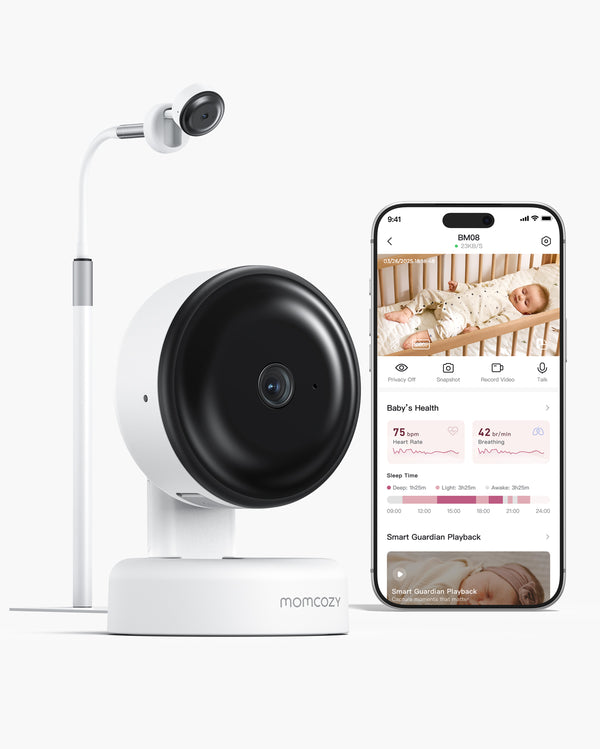
For parents specifically looking for a contact-free smart monitor, the Momcozy Contact-Free Smart Baby Monitor BM08 may be a relevant option to compare. According to current Momcozy product information, BM08 uses contact-free mmWave sensing with app-based viewing, sleep insights, breathing dynamics, heart dynamics, smart notifications, and 2K night vision. It is designed for everyday home baby monitoring without requiring socks, clips, patches, or wearable sensors.
The safer way to describe BM08 is as a consumer monitor that can help parents follow sleep-related trends and check in through the app. Avoid describing it as a device that “accurately tracks vital signs,” prevents emergencies, or replaces professional monitoring. Its breathing dynamics, heart dynamics, and sleep insights should be treated as reference information, not medical measurements.
BM08 may be most relevant for families who want:
- contact-free monitoring with no wearable attached to the baby;
- app-based viewing and smart notifications;
- sleep trend information for everyday routine awareness;
- a setup that can remain stable near the crib rather than being attached and removed each night.
Parents should still confirm the current package, subscription terms, app requirements, WiFi requirements, data settings, and setup instructions before buying, since product features and service terms can change.
No Wearables Required
No Monthly Fees
Cry & Face Covering Notifications
2K Night Vision
What Can a Breathing Monitor Tell Parents?
Depending on the model, a smart baby monitor may provide:
- breathing-related movement trends or status information;
- motion activity, stillness, or sleep pattern summaries;
- crying, movement, face-covering, or wake-up notifications where supported;
- room temperature or humidity data where supported;
- video and night vision for visual check-ins;
- family sharing or app access where supported.
These features can help parents notice patterns and decide when to check the room. They should not be interpreted as proof of health, a diagnosis, or a substitute for a doctor’s advice.
What Smart Baby Monitors Can and Cannot Do
|
What They Can Do
|
What They Cannot Do
|
|
Support everyday check-ins, show video or trend information, help parents notice sleep patterns, and provide model-specific alerts when settings are configured correctly.
|
Diagnose or treat disease, prevent SIDS, replace safe sleep practices, replace adult supervision, or serve as a prescribed medical monitor for babies with known health concerns.
|
|
Help parents decide whether to observe longer or enter the room, especially when combined with a consistent routine and safe sleep setup.
|
Guarantee that a baby is safe, eliminate all false alarms, or remove the need to follow pediatric guidance.
|
A smart monitor is most useful when it supports calm observation. If alerts make parents more anxious, cause constant checking, or lead to ignoring safe sleep basics, the device is not serving its intended purpose.
Who Might Consider a Baby Monitor That Tracks Breathing?
-
First-time parents: Families who want more context during naps and nighttime sleep, while still following safe sleep guidance.
-
Data-oriented parents: Caregivers who want to review sleep patterns and routine changes over several nights.
-
Parents comparing non-wearable options: Families who want smart monitoring without putting a sock, clip, or sensor on the baby.
-
App-focused families: Caregivers who prefer smartphone check-ins and configurable notifications.
If your baby has a known breathing condition, was born prematurely, or has been prescribed monitoring, ask your pediatrician what type of monitoring is appropriate. A consumer smart monitor should not replace prescribed medical equipment.
What to Look for Before Buying
-
Technology type: Compare wearable, under-mattress, camera-based, and contact-free radar systems.
-
Medical vs. consumer use: Confirm whether the device is a consumer wellness monitor or a regulated medical device.
-
Setup requirements: Check placement rules, crib compatibility, mattress compatibility, WiFi needs, and app setup.
-
Alert behavior: Understand what triggers alerts and how false alerts may happen.
-
Video and night vision: Compare resolution, night visibility, viewing angle, and whether the monitor needs a clear crib view.
-
Privacy and storage: Review account controls, data storage, app sharing, firmware updates, and local or cloud storage options.
-
Costs over time: Check whether sleep history, smart notifications, video saving, cloud storage, or reports require a subscription.
-
Safety language: Avoid any product that implies it can prevent SIDS or replace safe sleep practices.
To compare broader options, parents can also review the Momcozy baby monitors collection.
FAQs
How does a baby monitor that tracks breathing work?
It detects breathing-related movement rather than directly measuring airflow. Depending on the model, it may use a wearable sensor, under-mattress pad, camera analysis, or contact-free radar to detect movement patterns associated with breathing.
Are contact-free smart baby monitors better than wearable monitors?
They can be more convenient for families who do not want anything attached to the baby, but they are not automatically better for every situation. Wearables, pads, cameras, and radar monitors each have different setup needs, false alarm risks, and data limitations.
Does Momcozy BM08 require wearables?
No. According to current Momcozy product information, BM08 uses contact-free mmWave sensing and does not require socks, clips, patches, or wearable sensors.
Does Momcozy BM08 require a monthly subscription?
Current Momcozy product information describes BM08 as offering smart monitoring features without monthly fees. Parents should still check the product page and terms before purchase because app features and service terms can change.
Is Momcozy BM08 a medical device?
No. BM08 should be treated as a consumer smart baby monitor, not a medical device. Its sleep insights and breathing or heart dynamics are not medical measurements and should not be used to diagnose, treat, or prevent a medical condition.
Can a breathing monitor prevent SIDS?
No consumer baby monitor should be used as a strategy to prevent SIDS. Parents should continue to follow safe sleep guidance, including placing the baby on their back on a firm, flat sleep surface with no loose bedding or soft objects.
Should I use a baby breathing monitor if my baby has health concerns?
Ask your pediatrician. If a baby needs medical monitoring, the clinician should recommend the appropriate device and instructions. A consumer smart monitor is not a substitute for prescribed medical equipment.
Conclusion
Understanding how a baby monitor that tracks breathing works helps parents compare the technology more realistically. These monitors usually detect breathing-related movement through wearables, mattress sensors, camera analysis, or contact-free radar. They can add useful context to everyday nursery monitoring, but they do not replace safe sleep practices, adult judgment, or pediatric care.
For families who want contact-free monitoring without putting anything on the baby, Momcozy BM08 is one option to compare. The strongest reason to consider it is not that it guarantees safety, but that it combines contact-free sensing, app-based check-ins, smart notifications, and video monitoring in one consumer device. Used with realistic expectations, it can support calmer check-ins and better routine awareness.