


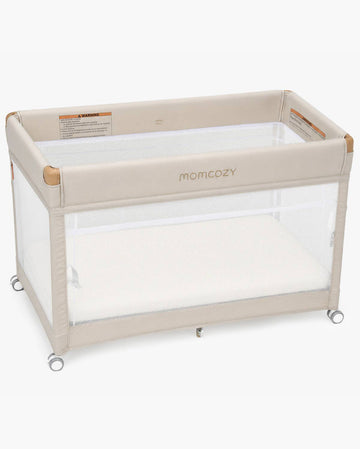
A safe play area for a baby is a controlled, thoroughly hazards-free environment designed for your baby to freely move, play, and explore at their current stage of mobility. A small play mat or corner may work well when your baby is younger, but rolling, crawling, pulling up, and cruising can quickly change what your baby can reach. Creating a **safe play area for baby** is therefore less about finding one "perfect" setup and more about matching the amount of freedom, containment, floor space, and caregiver proximity to your baby's current stage.
A babyproofed room, gated Yes Space, large playpen, or portable playard can all work in different homes and routines. If you are considering a portable option, you can explore Momcozy portable playards alongside the broader setup choices below.
Key Takeaways
-
A daytime play area should evolve as your baby becomes more mobile and gains access to new parts of the room.
-
A safe play area for baby can be a babyproofed room, gated Yes Space, large playpen, or portable playard—not necessarily a purchased enclosure.
-
If you are constantly redirecting your baby away from newly reachable hazards, reassess the room before simply adding more containment.
-
A large playpen provides more movement room but can occupy substantial living-room space, while a portable playard offers a more defined and potentially movable footprint.
-
Wheels can be useful when caregivers regularly need to keep baby nearby in different rooms, but doorway clearance, brakes, flooring, and manufacturer instructions still matter.
-
A playard should not replace age-appropriate movement or broader babyproofing when your child needs more room to explore.

When the Current Play Area Stops Working
The first sign that your baby's play space needs to change is often increased mobility. A mat that once gave a young infant enough room may no longer be sufficient once rolling, crawling, pulling up, or cruising expands the area your baby can reach.
For example, your baby may begin:
- Rolling beyond the edges of a play mat
- Crawling toward furniture, cords, or low shelves
- Pulling up on furniture or other surfaces
- Cruising along edges and discovering previously inaccessible areas
The important question is what actually changed. If the problem is newly reachable hazards, broader babyproofing may solve it. If the problem is that you need a defined area for certain periods of the day, a gated zone, large playpen, or portable playard may make more sense.
The goal is not automatically to contain your baby more. It is to create enough safe space for the type of movement your baby is currently practicing.
What Is a Safe Play Area or Yes Space?
A Yes Space is a deliberately prepared area where a baby can explore with fewer hazards within reach. It can be an entire babyproofed room, a gated section of a room, or a contained space such as a playpen or playard.
That distinction matters because a safe play area for baby does not have to mean buying a specific product.
A practical Yes Space should still be age-appropriate rather than treated as completely risk-free or supervision-free. As your baby develops new skills, the hazards within reach can change, so the space needs to be reassessed.
The American Academy of Pediatrics recommends providing babies with a safe environment to crawl and explore, while noting that portable play yards or safety gates can help keep a crawling child in a safe area when a caregiver is distracted.
For terminology, see B01 — What Is a Pack and Play?
Constantly Redirecting Baby? Reassess the Space, Not Just the Baby
If you find yourself saying "no" or moving your baby away from the same hazards throughout the day, it may be time to reassess the environment.
Start by checking what has recently become reachable:
- Electrical cords and outlets
- Unstable or climbable furniture
- Small objects
- Low shelves and cabinets
- Pet food, toys, or supplies
- Gates and other barriers
- Furniture edges and other surfaces your baby can pull up on
This does not automatically mean you need a playpen. If a room can be thoroughly babyproofed, giving your baby more floor space may be the better fit. If that is difficult in a shared room, a contained area can provide a practical option for particular periods of the day.
A playard is therefore best viewed as one tool within a broader babyproofing strategy, rather than a replacement for it. CPSC requirements for play yards address hazards including entrapment, stability, latching and locking mechanisms, openings, and other potential risks, reinforcing why the product should be used according to its instructions.
Babyproofed Room, Gated Area, Large Playpen, or Portable Playard?
Once you know what problem you are trying to solve, compare the available setups rather than starting with a product.
|
Setup |
Best-fit problem |
Main advantage |
Main trade-off |
What to verify |
Best for |
|
Babyproofed room |
Baby needs broad movement space and the room can be made safe |
Most freedom to move |
Requires room-wide babyproofing |
Furniture, cords, outlets, reachable hazards |
Homes with dedicated play spaces or open layouts where baby needs max exploration |
|
Gated Yes Space |
You want a defined area without enclosing the entire room |
More flexible floor space |
Gate can affect room layout |
Gate stability, shape, climbing changes |
Families wanting a clear boundaries in shared spaces without heavy enclosures |
|
Large floor playpen |
An active crawler needs more contained movement room |
Large interior area |
Can become bulky permanent furniture |
Interior space, stability, entry, floor setup |
Active crawlers spending long daytime hours playing in a designated area |
|
Portable playard |
You need a smaller contained area for specific periods or different rooms |
Defined footprint, foldability, mobility |
Less movement space than a large enclosure |
Product limits, footprint, wheels, setup, approved use |
Small spaces, multi-room supervision, chores, or families needing fold-away options |
There is no universal winner. The right option depends on whether your priority is maximum movement, containment, room layout, or flexibility.
Large Playpen or Smaller Playard — How Much Movement Room Does Baby Need?
The size question is really a question about how your baby will use the space.
If the enclosure will serve as your baby's primary daytime movement area for long periods, a larger playpen may make more sense for an active crawler or toddler who needs room to move. If you mainly need a contained space for shorter periods while you work nearby, cook, tidy, or move between rooms, a smaller portable playard may be more practical.
Avoid relying on a universal square-foot recommendation. Instead, watch how your baby uses the available space.
If your baby spends most of the time moving around comfortably, the setup may still fit. If your baby repeatedly reaches the boundaries, attempts to climb out, or appears to need substantially more room, reassess the setup.
For detailed dimensions and fit considerations, see B06 — Pack and Play Size Guide.

The Living Room Is the Only Play Space — Permanent Zone or Put-Away Setup?
For many families, the living room is the practical daytime play area because it is also where adults spend most of their time.
The challenge is that a large enclosure can quickly become a permanent piece of furniture. A family may want plenty of play space during the day without giving up a large portion of its shared living area.
You can think about the choice in three ways:
- Permanent large playpen: More movement space, but a larger footprint remains in place.
- Gated corner: Keeps a defined play area while allowing more flexible use of the room.
- Foldable or portable setup: Creates a contained area when needed and can be folded or repositioned when the routine changes.
The best choice depends on how often the play space needs to disappear and how much floor area your family wants to preserve.
For detailed apartment layouts, storage, and circulation considerations, see Small-Space Playard Guide.
Need Baby Nearby While You Cook or Do Chores?
Sometimes the problem is not simply safety or floor space. It is proximity.
You may want your baby nearby while you prepare food, do laundry, work from a home office, or handle another household task. In that situation, a babyproofed area close to you, a fixed gated zone, or a movable playard may all be possible solutions.
A movable setup can be particularly useful when the same contained area needs to serve nearby rooms. But mobility should never be treated as permission to move a playard with a child inside unless the manufacturer's instructions specifically allow it.
When evaluating a movable option, check:
- Whether it fits through your home's doorways
- Whether the wheels have secure brakes
- Whether the flooring allows stable movement
- Whether there is enough turning space
- How the unit is intended to be moved according to its instructions
The objective is simple: keep baby nearby without compromising the suitability of the play space.
Are Wheels Actually Useful on a Playard?
Wheels are most useful when you genuinely expect to reposition the same playard regularly.
If the playard will remain in one corner of the living room, wheels may have little practical value. If you frequently move the setup between nearby rooms, mobility can reduce the need to repeatedly disassemble or carry it.
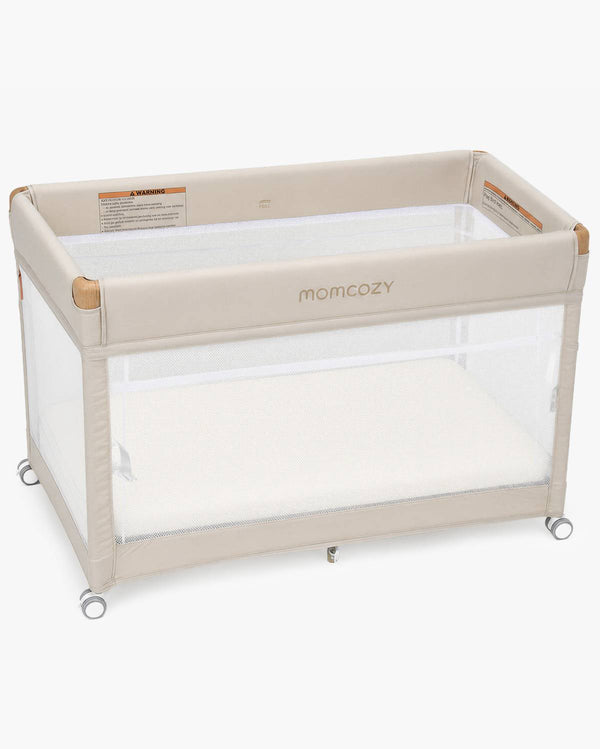
The Momcozy One-Click Foldable Baby Playard, for example, has four swivel caster wheels with individual foot brakes. Its planning specifications list a weight of 10.3 kg (about 22.7 lb), so the wheels can help with repositioning while the unit's weight remains relevant when it needs to be lifted or stored.
Before treating wheels as a must-have feature, consider your actual routine: How often will the playard move, how far will it move, and will it fit through the spaces you use?
For broader feature comparisons, see B02 — Best Playards for Newborns and Infants.
Member price
De$297.48$299.99
Member price
De$278.78$327.98
What Should Go Inside the Daytime Play Area?
More equipment does not necessarily create a better play space.
For daytime play, leave enough open floor area for your baby's current movement rather than filling the enclosure with toys, cushions, and activity gear. A small number of age-appropriate objects can provide opportunities to reach, sit, crawl, explore textures, or practice other emerging skills.
As abilities change, reassess what is inside the area. Objects that were appropriate for a younger baby may become hazards once your child can pull, climb, grasp, or mouth them differently.
The American Academy of Pediatrics emphasizes opportunities for movement and exploration during infancy, including safe environments for crawling and age-appropriate objects within reach.
For that reason, think open movement space first, accessories second.
When the Playpen or Playard Is No Longer the Right Main Play Space
A contained space that worked well for a younger baby may eventually stop matching your child's needs.
Signs that it is time to reassess include:
- Your child needs substantially more room to move.
- Your child repeatedly tries to climb or exit.
- Pulling up and cruising have changed how the space is being used.
- Broader babyproofing has become practical.
- The enclosure no longer matches the family's main daytime goal.
There is no single stop age that applies to every child or every product. Follow the product's developmental and physical limits, while also paying attention to your child's abilities.
A playard can remain useful for specific situations even after it stops being the family's primary daytime play environment. The role can change from main play area to occasional contained space.
Play and Sleep Are Different Use Cases
A product may support both play and sleep, but the setup should not be treated as interchangeable.
For daytime play, toys and other age-appropriate objects may be appropriate. A sleep environment has different requirements. CPSC's safe-sleep guidance recommends a bare sleep surface with only a fitted sheet and says that pillows, blankets, cushions, and other soft items should not be added to the sleep space.
Similarly, CPSC guidance says that only the mattress supplied with the play yard should be used rather than adding a supplemental mattress, because an inappropriate mattress can create an entrapment or suffocation hazard.
So if the same product is used for both purposes, switch the setup according to the approved mode and manufacturer's instructions. Do not assume that everything suitable for awake play should remain in place during sleep.
For detailed sleep-use guidance, see B04 — Can a Newborn Sleep in a Pack and Play?

Where the Momcozy One-Click Foldable Baby Playard Fits in These Daytime-Play Decisions
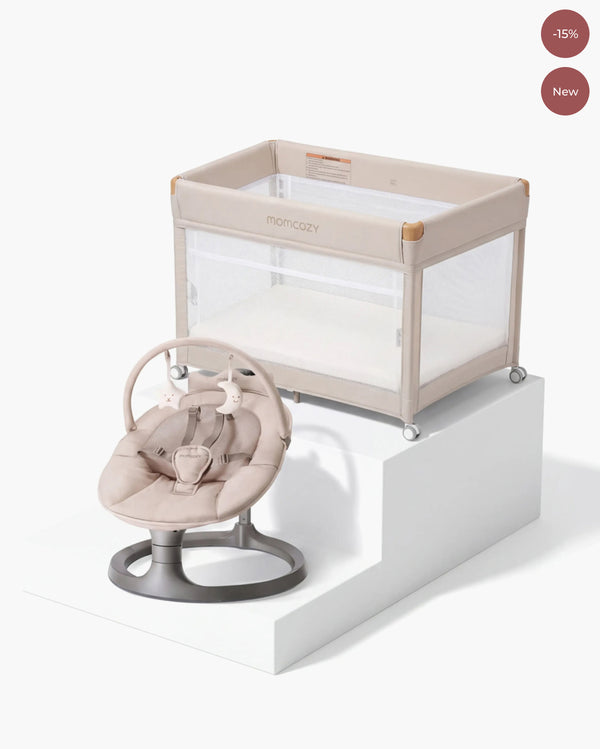
The Momcozy One-Click Foldable Baby Playard is best considered when your household needs a defined, contained play space that can also be repositioned or stored, rather than when you are looking for a replacement for a large babyproofed room.
Its planning specifications include:
- Open dimensions: 112 × 62 × 78 cm
- Folded dimensions: 63.5 × 16 × 78 cm
- Product weight: 10.3 kg
- Mobility: Four caster wheels with individual brakes
- Playard mode: 0–24 months, up to 15 kg (33 lb), according to the supplied product brief
- Setup: One-click folding and unfolding design
- Functions: Bassinet, playard, portable crib, and optional changing-station configuration
That makes it particularly relevant to families who want a smaller contained area for specific daytime periods and may need to reposition or store the unit as their routine changes.
Its role should still be kept in perspective. It is not a large toddler playpen designed to provide unlimited movement space, and it should not be presented as a substitute for broader babyproofing or age-appropriate floor exploration.
The product also features a dual solid-board support structure and a 2.5 cm foam mattress. However, parents should use the supplied mattress and follow the final U.S. manual rather than adding aftermarket sleep surfaces; CPSC specifically cautions against supplemental play-yard mattresses.
Explore the Momcozy One-Click Foldable Baby Playard.
Daytime Play-Space Decision Checklist
Before choosing a setup, ask:
- What changed? Has your baby started rolling, crawling, pulling up, cruising, or reaching new hazards?
- What is the actual problem? Do you need more movement room, fewer reachable hazards, more containment, or closer caregiver proximity?
- Can the room be babyproofed effectively? If yes, a broader movement area may be preferable.
- Would a gated Yes Space solve the problem? This can create a defined area without fully enclosing your baby.
- Does your baby need more movement room? Compare a large playpen with a smaller portable playard based on actual use.
- Will the setup stay in the living room? Consider whether you want permanent furniture or something that can fold or move.
- Does proximity matter? If baby needs to remain near you during household tasks, consider where the setup can safely be positioned.
- If you choose wheels, will you actually use them? Check doorway clearance, brakes, flooring, and manufacturer instructions.
- Is the inside still appropriate? Keep enough open space for movement and reassess toys and objects as abilities change.
- Are you switching from play to sleep? Follow the product's approved sleep mode and remove awake-play items as required.
The right answer may change again in a few months. A good daytime play space is one that adapts to your baby's development without unnecessarily restricting movement.

FAQs
Q1: What Age Can a Baby Start Using a Playpen or Playard for Awake Play?
There is no universal starting age for every product. Follow the specific playard's instructions, age and weight limits, and developmental guidance. AAP guidance supports using a portable play yard or safety gate to help create a safe area when a crawling baby needs to remain in a defined space.
Q2: Is a Playpen Necessary if My Living Room Is Already Babyproofed?
Not necessarily. If your living room can be thoroughly babyproofed and provides enough appropriate movement space, a broader floor area may be a better fit. A playpen or playard can still be useful when you need temporary containment or a defined area.
Q3: Is a Large Playpen Better Than a Portable Playard for Crawling?
Not automatically. A large playpen generally provides more movement room, while a portable playard can be more practical when you need a smaller contained area that can be folded or repositioned. Choose according to how your baby will use the space and how much of the room your family can dedicate to it.
Q4: Can I Keep a Playpen in the Living Room Full Time?
Yes, if its footprint works for your household and it remains appropriate for your child's stage. However, a permanent large enclosure may take over shared floor space, so a gated area or foldable setup may work better for families who want the room to serve multiple purposes.
Q5: Are Wheels Useful if I Want Baby Near the Kitchen or Laundry Area?
They can be useful when you regularly need to reposition the playard. Check doorway width, turning space, flooring, and brakes, and follow the manufacturer's instructions for moving the product. Never assume an occupied playard can be rolled unless the instructions specifically permit it.
Q6: Should I Put a Play Mat or Many Toys Inside a Portable Playard?
Prioritize enough open space for movement and use only age-appropriate objects. Do not add a supplemental mattress or other sleep surface unless the manufacturer specifically provides and approves it; CPSC advises against supplemental play-yard mattresses.
Q7: How Do I Know When My Baby Needs More Play Space?
Look at your baby's movement rather than relying only on age. If your child increasingly reaches the boundaries, tries to climb out, or needs more room for crawling and cruising, reassess whether a larger or more open play area would better fit the current stage.
Q8: Can the Same Playard Be Used for Daytime Play and Sleep?
Some play yards are designed for both functions, but the setup and approved mode matter. Use only the manufacturer's approved sleep configuration and follow safe-sleep guidance; a daytime play setup should not automatically be treated as a sleep environment.
Choose a Daytime Play Space That Can Change With Your Baby
The best daytime play space is not necessarily the biggest enclosure or the most portable product. It is the setup that matches your baby's current mobility, provides appropriate room to explore, addresses the hazards in your home, and fits the way your family actually uses its space.
A babyproofed room, gated Yes Space, large playpen, or portable playard can each be the right answer at different stages. If your routine calls for a defined space that can be folded, repositioned, and used across different parts of the home, a portable playard such as the Momcozy One-Click Foldable Baby Playard can be one option to consider. Explore Momcozy portable playards.








