


Key Takeaways
- “Non-toxic” is a consumer-facing term, so parents should look beyond labels and review a nursing pillow’s materials, certifications, testing, and product claims. Momcozy Nursing Pillow
- Organic, natural, plant-based, and certified materials describe different attributes; none should automatically be treated as proof that an entire pillow is non-toxic.
- A useful materials review covers the cover, liner, filling or foam, treatments, and other disclosed components rather than focusing on one headline material.
- Certifications can provide evidence about specific materials or emissions, but their scope matters and no single label proves every aspect of a pillow’s safety.
- Material preferences should be balanced with intended feeding use, fit, cleanability, and active supervision; a nursing pillow is not an infant sleep space.
If you are searching for a non toxic nursing pillow, it helps to start by looking past the phrase itself. “Non-toxic” is not one universal construction method or a single certification that automatically applies to every part of a nursing pillow. Instead, the useful question is what evidence sits behind the claim: what the pillow is made from, which components have been tested, what certifications apply, and what the manufacturer actually discloses.
That distinction also matters because a nursing pillow has a specific purpose. Katie Clark, IBCLC, explains that parents do not need a nursing pillow to breastfeed successfully, although one can provide useful support and comfort when used intentionally. Her safety guidance also puts the pillow in its proper context: it is a feeding-support tool, not an infant sleep surface. Katie Clark, IBCLC: How to Safely Use a Nursing Pillow
With that in mind, evaluating a non-toxic breastfeeding pillow is less about finding a perfect label and more about learning how to interpret the information available.

What Does “Non-Toxic” Mean for a Nursing Pillow?
“Non-toxic” is generally used as a consumer-facing description rather than a universal certification that defines one particular type of nursing pillow.
That means two separate questions can easily become mixed together:
- What is the pillow made from?
- What evidence is available about those materials and their chemical-related characteristics?
There is also a third question that should remain separate: How is the pillow used?
A pillow may have transparent material information and relevant testing while still requiring appropriate supervision during feeding. Likewise, a natural or organic material does not automatically answer every question about the finished product.
A useful way to assess the product is to follow four steps:
- Read the claim. What exactly does the manufacturer say?
- Identify the material or component. Does the claim apply to the cover, filling, foam or entire pillow?
- Check the relevant certification or testing. What does that standard actually evaluate?
- Review the manufacturer’s disclosure. Is there enough information to verify the claim?
This approach is more useful than treating phrases such as “chemical-free” or “100% toxin-free” as complete answers. Broad claims can sound reassuring while providing little information about the actual construction.

Organic vs. Natural vs. Non-Toxic: What’s the Difference?
These terms are often used together in product descriptions, but they do not mean the same thing.
Organic
An organic claim can refer to a particular fibre, textile or component. For example, a product may use organic cotton for its cover without every part of the pillow being made from certified organic materials.
So, when you see “organic nursing pillow”, check whether the claim applies to:
- The outer cover
- The inner fabric or liner
- The filling
- The entire finished product
The certification, if one is named, should also be checked for its scope.
Natural
“Natural” or “plant-derived” usually describes where a material comes from or how it is categorised. Buckwheat, kapok and some plant-derived fibres can therefore be described in natural or plant-based terms.
That does not automatically tell you the complete chemical profile of a finished pillow. Processing, dyes, finishes, adhesives, liners and other components may still be relevant.
Non-toxic
“Non-toxic” is broader and should therefore prompt more questions rather than fewer.
Instead of assuming the label proves everything about the product, look for:
- Clear material disclosure
- Named certifications or testing
- The component covered by the certification
- Specific substances that are excluded or tested for
- Manufacturer information that allows the claim to be checked
Parents may reasonably prioritise natural materials, organic textiles, third-party testing, or a combination of these. There is no need to treat one category as universally safest.
How to Read a Nursing Pillow’s Materials List
A materials list is often more informative than a large headline printed on the product page.
Start by looking for the main parts of the pillow:
- Cover: The outer fabric that you or your baby may come into contact with.
- Inner liner: A layer between the cover and filling, if one is present.
- Filling or core: This could be foam, fibrefill, buckwheat hulls, kapok or another material.
- Treatments or coatings: Look for any disclosed finishes, waterproofing or other treatments.
- Closures and hardware: Zips, straps, fasteners and other components may also form part of the finished product.
This matters because an organic cotton cover does not necessarily tell you what is inside the pillow.
Common materials found in nursing pillows include organic cotton, polyester or recycled polyester fibrefill, polyurethane or memory foam, buckwheat hulls, kapok and plant-based PLA. The important question is not simply which material sounds most natural. Instead, ask what the material is, where it is used, what is claimed about it, and what evidence supports the claim.
Parents also have different practical preferences. Discussions among parents may favour foam, polyfill, buckwheat or other fillings for reasons such as firmness, weight, shape and feel. Those experiences can be useful for understanding personal preferences, but they should not be treated as scientific evidence that one material is inherently safer.
Similarly, words such as “plant-based”, “hypoallergenic”, “breathable” and “organic” should be assessed individually. None should automatically become shorthand for the entire pillow being non-toxic.
Which Certifications and Testing Actually Matter?
Certifications are useful when you understand their scope.
For example, OEKO-TEX STANDARD 100 is a textile safety standard that tests textiles and their components for harmful substances. Its requirements vary according to the intended use and level of skin contact, and its certification scope identifies the specific articles and components covered.
That means an OEKO-TEX certification can provide useful evidence, but you should still check exactly which part of the nursing pillow carries the certification.
CertiPUR-US works differently. It applies specifically to flexible polyurethane foam rather than certifying an entire finished product. The programme evaluates foam for content, emissions and durability through independent laboratory testing.
Its own programme rules are particularly useful here because they explain what manufacturers may and may not claim. CertiPUR-US says certified foam can be described in terms such as low VOC emissions and screening for relevant chemicals, but it specifically does not allow the foam to be described as “chemical-free” or “non-toxic”.
Other names you may encounter include GOTS, MADE SAFE, GREENGUARD Gold, UL and GOLS. They should not be treated as interchangeable badges. Each has its own purpose, criteria and scope.
A simple verification method is: Certification name → covered component → manufacturer information → exact claim
If a product page says “certified”, but does not explain what was certified, pause before treating that statement as proof about the whole pillow.
What About Off-Gassing, Chemical Smell, Flame Retardants, and Preservatives?
A new foam product may have an odour when first removed from its packaging. Some parents associate that smell with chemical exposure, but an odour alone does not establish that a product is harmful or unsafe.
“Off-gassing” generally refers to the release of volatile substances from a material. It is therefore more useful to think of it as an emissions and odour issue than as a diagnosis or automatic proof of toxicity.
Foam certifications can provide more specific information. For example, CertiPUR-US evaluates certified polyurethane foam for emissions and sets a low-VOC emissions requirement.
Manufacturer instructions also matter. My Brest Friend, for example, provides guidance about airing out a slight foam smell. That should be understood as that manufacturer's product-specific advice rather than a universal rule for every nursing pillow.
The same principle applies to flame-retardant and preservative claims. If a product page makes a specific statement, look for the material or treatment to which it applies and any supporting testing information.
If a new pillow has a noticeable smell, follow the manufacturer's instructions for airing, preparation and first use. Do not assume that every smell indicates dangerous toxicity, but do not ignore the manufacturer's care or preparation guidance either.
For parents who place particular importance on chemical-related concerns, transparent material disclosure and relevant third-party testing provide a stronger basis for comparison than a vague “chemical-free” statement.
What Product Claims Should Parents Look at More Carefully?
Marketing language can be useful, but the evidence behind it matters more than how reassuring the wording sounds.
|
Label / claim |
What it may describe |
What it does NOT automatically prove |
What to verify |
|
Organic |
A specific fibre or textile may meet organic requirements |
The entire pillow is organic or free from all chemicals |
Exact component and certification scope |
|
Natural / plant-derived |
A material source such as buckwheat, kapok or PLA |
The finished product has no synthetic processing or chemical concerns |
Full construction and supporting evidence |
|
OEKO-TEX / GOTS |
A textile-related certification with a defined scope |
The entire pillow is certified for every safety attribute |
Exact standard, certificate and covered component |
|
CertiPUR-US |
Certain polyurethane foam criteria |
The whole pillow is certified or organic |
Exact foam certification and current product information |
|
“Non-toxic” / “chemical-free” |
A manufacturer's consumer-facing material or safety claim |
A universal guarantee or proof of zero chemical substances |
Specific wording, excluded substances, testing and evidence |
When reading any of these claims, ask four questions:
- Is the claim specific?
- Which component does it describe?
- Is a certification or test actually named?
- Can the claim be verified on the product page or through the certification body?
“Free from” wording can be meaningful when the excluded substance or treatment is clearly defined. It becomes much less useful when it is presented as a broad guarantee about the whole product.
The best comparison is therefore not which product has the strongest marketing language, but which product provides the clearest evidence for its claims.
Does Material Choice Affect Feeding Comfort and Fit?
Material evidence is only one part of choosing a nursing pillow.
Different constructions can feel different in terms of firmness, weight, mouldability, height and stability. A foam pillow may maintain its shape differently from a fibre-filled or natural-fill design, while a buckwheat-filled pillow may feel different again.
Parents also vary in body shape and feeding needs. A taller or petite parent may have different preferences for feeding height, while postpartum comfort can affect how a pillow feels around the body. These are practical considerations rather than proof that one material is safer.
For detailed guidance on choosing firmness, shape and support, parents can refer to Momcozy's broader breastfeeding essentials guide rather than using the word “non-toxic” as a substitute for overall fit.
Why Cleanability Still Matters — Without Calling It “Non-Toxic”
Nursing pillows are exposed to everyday feeding messes. Milk, spit-up, sweat and food residue can all make cleaning instructions important.
Check whether the product has:
- A removable, washable cover
- A protective liner
- A washable pillow core
- Specific washing-temperature instructions
- Restrictions on machine washing or drying
These details should come directly from the care label or manufacturer.
A removable cover is not the same thing as a pillow that can be machine washed in its entirety. For example, Momcozy's current nursing-pillow information advises checking the care label for the specific product and not machine washing the pillow core unless the instructions permit it.
Most importantly, cleanability and chemical safety are separate questions. A machine-washable pillow is not automatically non-toxic, just as a non-washable product is not automatically unsafe.
For more detailed cleaning advice, use existing product-specific care instructions rather than treating washability as a certification of material safety.
A Practical Checklist for Evaluating a Non-Toxic Nursing Pillow
Before buying, work through this short evidence-first checklist:
- Identify every disclosed material. Look beyond the cover and find out what is used for the core or filling.
- Identify certifications and testing. Write down the exact certification name rather than relying on a generic “certified” statement.
- Check the certification scope. Determine whether it applies to the foam, fabric, accessories or finished product.
- Review chemical-related claims. Look for specific substances, treatments, emissions testing or other verifiable details.
- Read the care instructions. Make sure the cleaning requirements work for your routine.
- Review safety warnings. Confirm how the manufacturer expects the pillow to be used.
Watch for these red flags
- Vague descriptions such as “premium safe materials” without further information
- Unsupported “chemical-free” or “100% toxin-free” claims
- Certification names without an explanation of scope
- Missing manufacturer information
- Claims that cannot be verified through the product page or certification body
Finally, step back from the materials list. Does the finished pillow still fit your body and support a comfortable, supervised feeding setup?
Katie Clark, IBCLC's guidance is useful here because it keeps the purpose of the product clear: a nursing pillow is optional feeding support, not something an infant should be left sleeping on.
How Momcozy MaxSupport Fits Into the Non-Toxic Nursing Pillow Conversation
Once you have a framework for evaluating claims, you can apply the same questions to individual products.
The Momcozy MaxSupport Nursing Pillow is one example. Its current product page identifies a 45D memory-foam construction, firm and anti-sagging support, optimal latch height and a wider support surface. It also states that the product has been tested in a CPSC-accepted lab, is ACA certified for spine health and uses OEKO-certified skin-friendly materials.
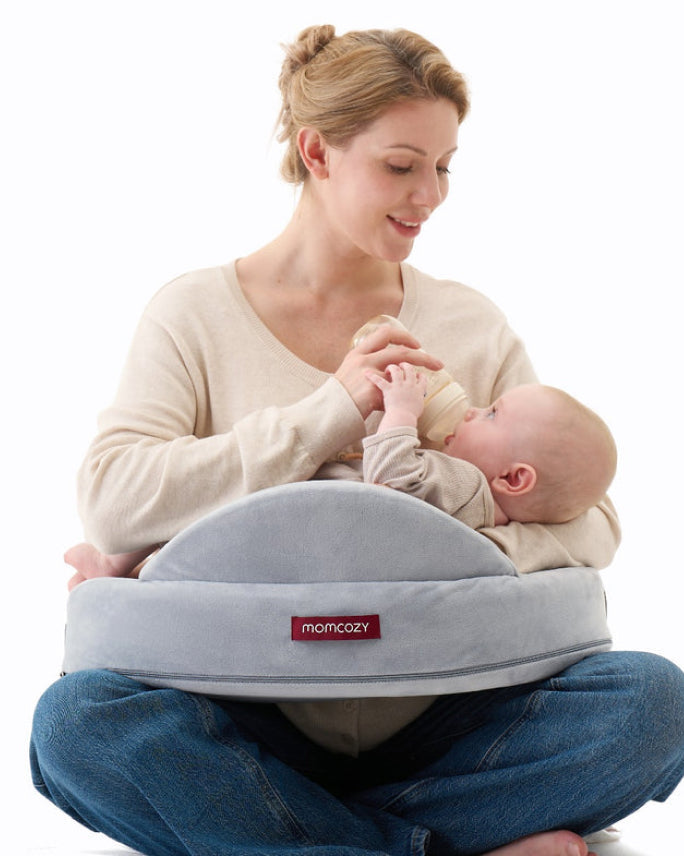
Those claims can be assessed using the same evidence-first approach described above.
For example, the product's memory-foam construction may appeal to parents who prefer a stable shape and consistent support. Parents specifically looking for natural-fill materials may instead want to compare other categories.
What the available information does not justify is calling MaxSupport “100% non-toxic”, “chemical-free” or “organic”. Those would be broader claims than the product information supports.
Parents who want to compare different support constructions can start with the Momcozy Nursing Pillow Collection, which includes several nursing-pillow designs.

The product page also gives specific care information, including a machine-washable cover and instructions not to wash the pillow core.
The wider feeding routine matters too. Parents dealing with persistent latch or nipple discomfort should not assume that changing pillow materials will solve a feeding problem. Momcozy's breastfeeding problems and solutions guide can provide a deeper resource for issues that go beyond pillow construction.
For families combining nursing with pumping, this guide to combining breastfeeding and pumping can also be used as a separate resource rather than turning the nursing-pillow article into a broader feeding guide.
Frequently Asked Questions About Non-Toxic Nursing Pillows
Is an organic nursing pillow automatically non-toxic?
No. Organic may describe a particular fibre, textile or component. Check whether the organic claim applies to the whole pillow and whether supporting certification covers the components you are evaluating.
Is memory foam safe for a nursing pillow?
Memory foam is a type of polyurethane foam. Its suitability should be assessed using the manufacturer's material information, relevant testing and intended-use instructions rather than assuming that all memory foam is either safe or unsafe.
What certifications should I look for in a non-toxic nursing pillow?
Look for certifications relevant to the actual material in question. For example, OEKO-TEX STANDARD 100 relates to textiles and harmful-substance testing, while CertiPUR-US applies specifically to flexible polyurethane foam.
Does OEKO-TEX mean the whole nursing pillow is non-toxic?
Not automatically. OEKO-TEX certification has a defined scope identifying the articles and components covered. Check the certificate rather than extending the certification to parts that are not included.
Does GOTS certification apply to the whole pillow or only certain materials?
It depends on the certification and product information. Look for the exact certified component and scope instead of assuming that one certified textile means every part of the finished pillow carries the same status.
Does a new foam smell mean a nursing pillow is unsafe?
Not necessarily. A new-material smell can relate to emissions, but odour alone does not establish toxicity. Follow the manufacturer's preparation and airing instructions and look for relevant emissions information where available.
How can I tell if a nursing pillow has harmful chemicals?
No single label answers this for the entire product. Review the materials list, relevant third-party testing, certification scope and manufacturer disclosures. Be cautious of claims that cannot be verified.
What does “chemical-free” mean on a nursing pillow product page?
The phrase is too broad to treat as proof that a product contains no chemicals. Ask what substance or treatment is being excluded and what evidence supports the claim. Even CertiPUR-US specifically prohibits describing its certified foam as “chemical-free”.
Are buckwheat or kapok nursing pillows automatically safer than foam?
No. A natural or plant-derived material does not automatically establish that the entire finished product has a particular chemical profile. Compare the complete construction and supporting evidence.
Does a removable organic cotton cover make a synthetic-filled pillow non-toxic?
No. The cover and filling are separate components. An organic cotton cover may have its own material or certification attributes, but that does not automatically describe the material inside the pillow.
Can I wash the entire nursing pillow in a washing machine?
It depends on the product. Some have removable washable covers, while the core may have different care requirements. Follow the manufacturer's instructions rather than assuming the whole pillow can be washed.
Can I let my baby sleep on a nursing pillow if I am watching them?
A nursing pillow should not be treated as an infant sleep space. It is intended as feeding support during active, supervised use. Keep your baby within reach and follow safe-sleep guidance.
What should I do if my baby falls asleep while using a nursing pillow?
Move your baby to an appropriate infant sleep surface rather than allowing them to continue sleeping on the nursing pillow. The pillow's role is supervised feeding support, not infant sleep.
Conclusion
There is no single material, label or certification that automatically makes a nursing pillow “non-toxic”. A better approach is to evaluate the whole product.
Start with the materials list. Identify the cover, liner, filling or foam and any other disclosed components. Then look at the certifications and testing that apply to those specific materials. Finally, compare the manufacturer's claims with the evidence behind them.
The Momcozy MaxSupport is one example that can be assessed using the same framework: look at its memory-foam construction, stated testing and certification information, product disclosures and intended use rather than assigning it a blanket “non-toxic” label. Most importantly, remember Katie Clark, IBCLC's safety boundary: a nursing pillow is a feeding-support tool, not an infant sleep surface.








