


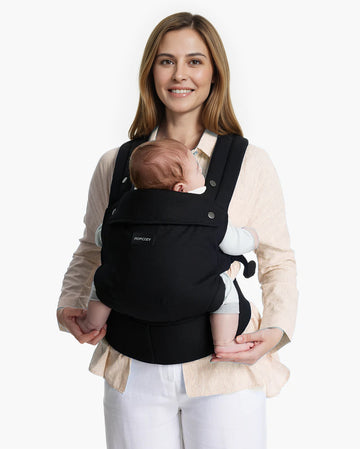
For parents choosing the best baby carrier for a newborn, start with newborn readiness: secure head and neck support, healthy hip positioning, a fit that works for a small body, and a design you can use correctly every time. For the earliest months, the Momcozy WeeSnug Newborn Carrier remains the strongest starting point in this guide. As your baby grows, however, parents who need an easy-to-use baby carrier for quick errands or more supportive everyday carrying may prioritize a structured design such as the Momcozy PureHug Ergonomic Baby Carrier, which is designed around lightweight carrying, lumbar support, and more even weight distribution.
Choosing the best baby carrier for your newborn feels like a big decision — because it is. The right carrier keeps your baby safe, supports healthy hip development, and makes those exhausting early weeks a little more manageable. This guide breaks down exactly what to look for, flags the one safety concern most parents miss, and lists the top picks new parents are reaching for in 2026. For parents who want to explore more options designed specifically for the earliest stage, our newborn baby carrier collection is a helpful place to compare supportive styles made for little ones from day one.
At a Glance: Best Baby Carriers for Newborns Compared
| Model | Best For | Price | Key Feature |
|---|---|---|---|
| Momcozy WeeSnug Newborn Carrier | Best Overall | $59.99 | Visual adjustment scale + foldable head support, 100% cotton, IHDI recognized |
| Momcozy Easy to Wear Hands Free Baby Wrap Carrier | Best for Skin-to-Skin Bonding | From $32.99 | Stretchy polyester-spandex wrap, ring adjustable XXS–XXL, hands-free, IHDI recognized, fits 8–35 lbs |
| Momcozy Blue Mesh Baby Wrap | Best for Warm Climates | $42.99 | 87% polyester 13% spandex cooling air mesh, moisture-wicking, M-position support, fits 8–35 lbs |
| Momcozy SnapLite Cooling Mesh Wrap Carrier | Best for Airflow | $42.99 | 87% polyester 13% spandex cooling air mesh, moisture-wicking, ring adjustable XXS–XXL, includes storage pouch, fits 8–35 lbs |
| Ergobaby Embrace | Best Structured Carrier | $99 | Works from birth without insert, ponte knit fabric (no wrapping or tying), IHDI recognized |
| Infantino Flip 4-in-1 | Best Budget Pick | ~$29.99–$34.99 | Multiple carry positions, infant insert included, fits 8–32 lbs |
| Maya Wrap Ring Sling | Best Ring Sling | ~$79.99 | 100% cotton, two-ring adjustable fit, compact and nursing-friendly |
| Boba Wrap | Best Classic Wrap | $39.99 | Stretchy 95% cotton blend wrap, fits 7–35 lbs, machine washable and dryer-safe, IHDI certified hip-healthy |
| LILLEbaby Complete Airflow | Best for Longer Wear | From $140 | Lumbar support panel, six carry positions, airflow mesh panel |
| Ergobaby Omni Breeze | Best for Dads | From $246 | SoftFlex mesh, no insert needed, adjusts across very different body sizes |
In This Article
- Best Overall — Momcozy WeeSnug Newborn Carrier
- Best for Skin-to-Skin — Momcozy Easy to Wear Hands Free Baby Wrap Carrier
- Best for Warm Climates — Momcozy Blue Mesh Baby Wrap
- Best Airflow — Momcozy SnapLite Cooling Mesh Wrap Carrier
- Best Structured Carrier — Ergobaby Embrace
- Best Budget Pick — Infantino Flip 4-in-1
- Best Ring Sling — Maya Wrap Ring Sling
- Best Classic Wrap — Boba Wrap
- Best for Longer Wear — LILLEbaby Complete Airflow
- Best for Dads — Ergobaby Omni Breeze
Why the Fourth Trimester Makes Your Carrier Choice Matter
The fourth trimester refers to the first three months after birth — a period when newborns are still adjusting to life outside the womb. During this time, babies are calmed by warmth, closeness, and the sound of a familiar heartbeat. Research consistently shows that babywearing during this window can reduce crying, support healthy weight gain, and strengthen the parent-child bond. That's why the carrier you choose for this stage isn't just a convenience item — it's a tool that can support your newborn's development. Getting the right one from the start makes a real difference.
What Should You Look for in a Baby Carrier for Newborns?
Shopping for a newborn carrier can get overwhelming fast. Here are the features that actually matter when your baby is this small.
Key Safety and Comfort Features to Check
Before you commit to any carrier, run through this checklist. Each of these directly affects how safe and comfortable the experience will be for your newborn:
- Head and neck support — Newborns can't hold their heads up independently. Your carrier must provide full head and neck support, ideally with a structured or foldable headrest that stays in place during movement.
- M-position leg support — Baby's knees should sit higher than their bottom, with thighs fully supported and legs spread out like a natural frog-leg position. Picture a frog sitting on a lily pad — that's exactly the shape your baby's legs should form inside the carrier. This is the correct ergonomic position for newborn hip and spine development, and it's the standard all Momcozy carriers in this guide are built to achieve — each of them is officially recognized by the International Hip Dysplasia Institute (IHDI) for meeting this standard.
- Adjustable fit for small bodies — Newborns are tiny. Look for carriers that accommodate babies from around 7 lbs, with a clear adjustment system that's easy to use with one hand.
- Breathable fabric — Newborns overheat easily. Cotton or air mesh fabrics allow airflow and help regulate your baby's temperature during longer carries.
- Ease of use — If you can't figure it out at 3 a.m. with one hand, it's not the right carrier for this stage. Simpler is almost always better for new parents.
Hip Dysplasia and Baby Carriers — What Every New Parent Should Know
Hip dysplasia is one of the most important safety topics pediatric orthopedic specialists raise in relation to baby carriers. It refers to abnormal development of the hip joint, and in newborns, incorrect positioning in a carrier can put unnecessary stress on those joints during a critical window of development.
The key problem is carriers that force a baby's legs to hang straight down. This position doesn't support the natural frog-leg spread that newborn hips need. Over time, sustained incorrect positioning can contribute to hip joint problems that may require medical intervention.
The good news is that this is easy to avoid. The International Hip Dysplasia Institute (IHDI) evaluates and publicly recognizes baby products that support healthy hip positioning. When shopping for the best baby carrier for your newborn, look specifically for the IHDI "hip-healthy" designation. All four Momcozy carriers featured in this guide carry that recognition. If a carrier you're considering doesn't mention IHDI certification, confirm that it achieves the M-position before purchasing.

Top Best Baby Carriers for Newborns in 2026
Here are the ten best baby carriers for newborns available in 2026, each chosen for a different strength so you can find the one that actually fits your lifestyle.
1. Momcozy WeeSnug Newborn Carrier — Best Overall
The Momcozy WeeSnug Newborn Carrier is purpose-built for the newborn stage and earns its top spot through a combination of safety credentials, parent-friendly design, and genuine ease of use. Made from 100% premium cotton, it fits babies from 7 to 25 lbs (0–12 months) and features a visual adjustment scale — a standout detail that takes the guesswork out of sizing for first-time parents who aren't sure if they've got the fit right. The foldable head and neck support adapts as your baby grows, and the X-shape padded shoulder straps distribute weight across your back and shoulders evenly, reducing strain during longer carries. It's CPC Safety Certified and IHDI hip-healthy acknowledged, with a 5.0-star rating across 102 reviews at $59.99.
| Feature | Detail |
|---|---|
| Age range | 0–12 months |
| Weight range | 7–25 lbs (3.2–11.3 kg) |
| Material | 100% cotton |
| Head support | Foldable, adjustable |
| Hip certification | IHDI recognized |
| Price | $59.99 |
Why parents love it: The visual adjustment scale removes guesswork for first-time parents. Pure cotton is gentle on newborn skin. Simple enough to put on solo, even in the early weeks.

2. Momcozy Easy to Wear Hands Free Baby Wrap Carrier — Best for Skin-to-Skin Bonding
If close contact is your priority in those early weeks, a wrap carrier delivers it better than anything else. The Momcozy Easy to Wear Hands Free Baby Wrap Carrier uses soft, stretchy polyester-spandex fabric that molds to both your body and your baby's, keeping them in the inward-facing position that's safest for newborns. It fits babies from 8 to 35 lbs (0–12 months), is IHDI hip-healthy recognized, and is fully hands-free once you've put it on. The breathable fabric and hands-free design make it a practical, comfortable choice for extended wear in any season.
| Feature | Detail |
|---|---|
| Age range | 0–12 months |
| Weight range | 8–35 lbs (3.6–15.9 kg) |
| Material | 95% polyester, 5% spandex |
| Hip certification | IHDI recognized |
| Price | From $32.99 |
Why parents love it: Maximum skin-to-skin closeness in the fourth trimester. Stretchy fabric accommodates postpartum body changes. Lightweight and easy to pack for outings.
3. Momcozy Blue Mesh Baby Wrap — Best for Warm Climates
Summer babies and parents living in warmer regions need a carrier built specifically for heat. The Momcozy Blue Mesh Baby Wrap is made from 87% polyester, 13% spandex cooling air mesh fabric that is moisture-wicking and breathable, helping to keep both parent and baby comfortable during the carry. It maintains the safe inward-facing position for newborns and is lightweight enough that it doesn't add any bulk or warmth on hot days — a genuine practical advantage when temperatures rise and a heavier carrier becomes uncomfortable for everyone involved.
For times when your arms need a rest but baby still craves motion, a baby swing offers the same rhythmic comfort they enjoy while being carried—without the physical strain on you.
Why parents love it: Breathable mesh fabric prevents overheating on warm days. Lightweight and easy to pack for outings. Ergonomic wrap design supports the M-position throughout the carry.
4. Momcozy SnapLite Cooling Mesh Wrap Carrier — Best for Airflow
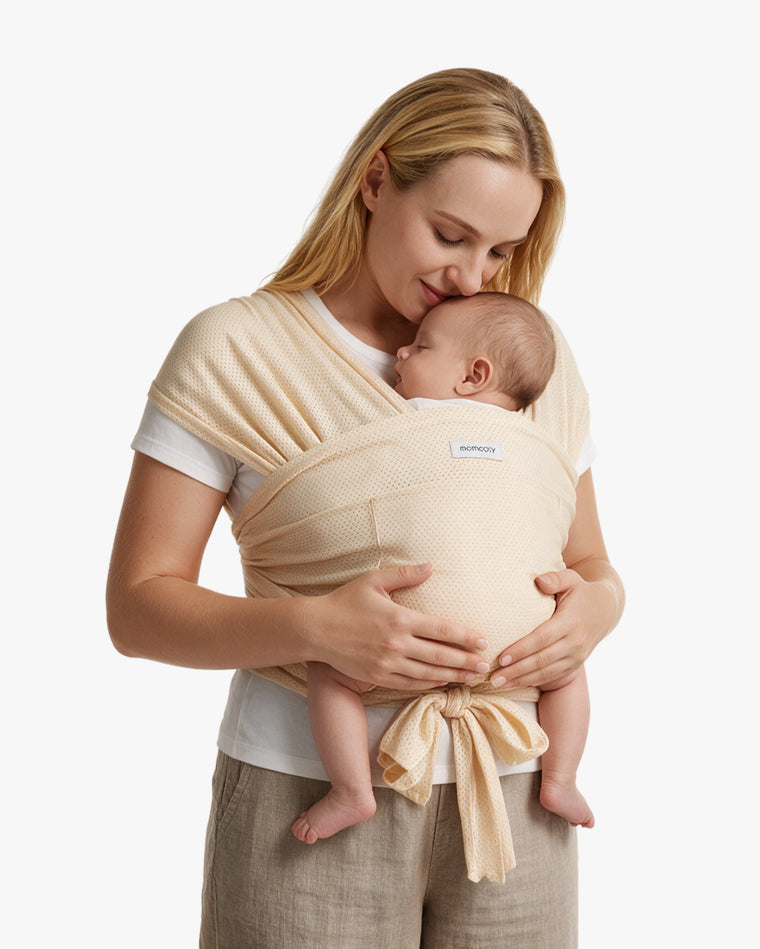
For parents who want maximum ventilation without sacrificing the closeness of a wrap, the Momcozy SnapLite Cooling Mesh Wrap Carrier is made from 87% polyester, 13% spandex cooling air mesh fabric that wicks moisture and promotes airflow for both parent and baby. Designed to work from the newborn stage, it supports the ergonomically correct M-position leg positioning and is light enough that it won't trap heat during longer carries or active days out. It's a particularly good choice for parents who want the snug feel of a wrap with built-in temperature management.
Why parents love it: Cooling mesh structure maximizes ventilation during extended wear. Suitable from the newborn stage without modifications. A comfortable, practical choice for active parents on the go.
5. Ergobaby Embrace — Best Structured Carrier for Newborns
The Ergobaby Embrace is one of the few soft-structured carriers that works from birth without a separate newborn insert. It's made from soft ponte knit fabric (79% polyester, 17% rayon, 4% spandex), fits babies from 7 to 25 lbs, and provides the inward-facing position for the newborn stage. Parents consistently praise it for being faster to put on compared to traditional wraps, and it's IHDI hip-healthy recognized.
Why parents love it: No insert needed from birth. Quick buckle system versus tying a wrap. Structured back panel for lumbar support. Trusted brand with strong safety credentials.
6. Infantino Flip 4-in-1 — Best Budget Pick
If budget is a primary factor, the Infantino Flip 4-in-1 is a solid entry-level option. It supports babies from 8 to 32 lbs across multiple carry positions and includes an infant insert for the earliest weeks. It's not as refined as higher-end carriers, but it covers the basics at a price point that works for families watching their spend.
For parents who love being active outdoors, alternating between a carrier and a travel stroller prevents fatigue and lets you enjoy longer excursions without cutting them short.
Why parents love it: One of the most affordable structured options available. Multiple carry positions grow with your baby. Infant insert is included in the box.
7. Maya Wrap Ring Sling — Best Ring Sling
Ring slings have a devoted following among parents who prefer a one-shouldered carry. The Maya Wrap is made from 100% cotton, adjusts via two rings for a custom fit, and works well for newborns when positioned correctly. It's compact, quick to put on, and easy to adjust for a nursing session. Note that ring slings require more attention to positioning than structured carriers — always follow the manufacturer's safety guidelines closely.
Why parents love it: Quick to put on and adjust on the go. Compact enough to fit in a diaper bag. Strong track record in the babywearing community.
8. Boba Wrap — Best Classic Wrap
The Boba Wrap is a stretchy fabric wrap that fits all body sizes from XXS to XXL, with enough give to create a snug, customizable fit for a wide range of parents. It supports babies from 7 to 35 lbs, is machine washable, and comes in a wide range of colors. The learning curve for tying is moderate, but most parents get comfortable with it within a few days.
Why parents love it: Stretchy fabric adjusts to fit all body sizes, from petite to plus. Wide weight range from newborn through toddler. Machine washable for easy care.
9. LILLEbaby Complete Airflow — Best for Longer Wear
If you plan to babywear for extended periods — think full-day outings or parents who carry their baby throughout the workday at home — the LILLEbaby Complete Airflow is worth considering. It features a lumbar support panel that genuinely reduces lower back strain, an airflow mesh panel for ventilation, and six carry positions. No newborn insert is required — the carrier accommodates babies from 7 lbs through 45 lbs with an adjustable seat.
Why parents love it: Lumbar support panel reduces back strain during long carries. Six carry positions extend usability as baby grows. Mesh panel promotes airflow for all-day comfort.
10. Ergobaby Omni Breeze — Best for Dads
Carriers with a wider size range and more robust waist support tend to work better for larger-framed wearers. The Ergobaby Omni Breeze fits a broad range of body sizes, includes a newborn position without an insert, and features a breathable SoftFlex mesh. It's one of the few carriers that adjusts well between two parents of significantly different builds without a full re-fitting.
Why parents love it: Adjustable fit works across very different body sizes. No newborn insert required. Four carry positions from newborn through toddler.
What Makes an Easy-to-Use Baby Carrier for Quick Errands?
An easy-to-use baby carrier for quick errands solves a different problem from a carrier chosen mainly for newborn closeness. For short grocery runs, daycare pickup, a walk around the block, or getting from the car into a store, parents often need a carrier that can go on quickly, adjust without a long tying routine, and stay comfortable while they move.
That usually means looking for three things: a straightforward buckle or adjustment system, enough structure to distribute your baby's weight, and a design that does not feel bulky when the outing only lasts 20 or 30 minutes. Breathability also matters when errands involve moving between the car, outdoors, and heated or air-conditioned indoor spaces.
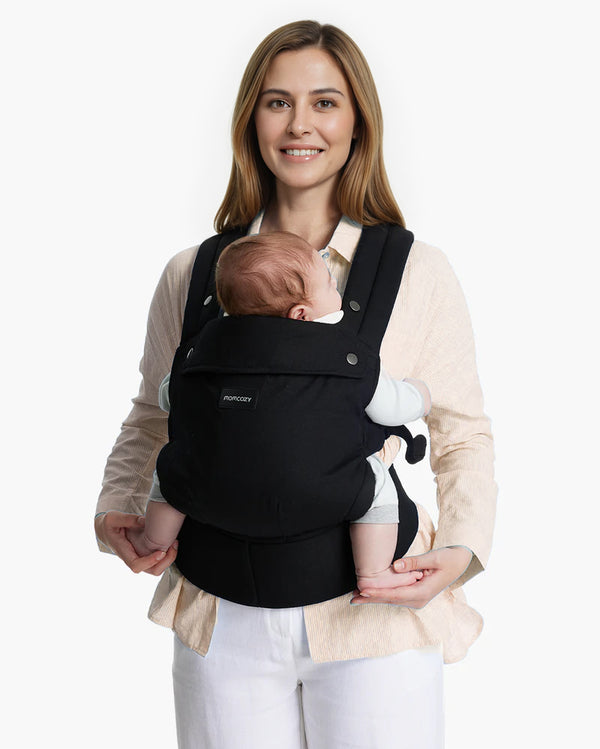
The Momcozy PureHug Ergonomic Baby Carrier fits this use case particularly well once your baby is developmentally ready for it. Momcozy positions PureHug as a lightweight carrier for everyday use, outings, and travel, with adjustable shoulder and waist straps and an X-shaped back design intended to spread weight more evenly. It is recommended for babies around 3–24 months, so it complements rather than replaces newborn-specific options such as WeeSnug.

What Should You Look for in a Baby Carrier for No Back Pain?
No baby carrier can guarantee no back pain, especially if you already have back discomfort or are recovering postpartum. A better goal is to choose a carrier that distributes weight across more of your torso instead of concentrating the load on your shoulders or lower back.
Look for a supportive waistband, padded and adjustable shoulder straps, a close fit that keeps your baby's weight near your center of gravity, and a back-panel or strap layout that spreads pressure rather than creating a single high-load point. Fit matters just as much as the carrier itself: even a supportive design can become uncomfortable if the waistband sits too low or the shoulder straps are uneven.
PureHug uses built-in EVA lumbar support together with padded shoulder and waist straps, while its X-shaped back is designed to distribute weight across the back more evenly. Those features make it relevant for parents searching for a baby carrier with back support or trying to reduce strain during everyday carrying. If back pain is persistent, severe, or related to postpartum recovery, a carrier should not replace medical or physical-therapy guidance.
For Momcozy Brand Day, this is also a useful way to compare carriers by real-life use rather than simply by product type: newborn-specific support for the earliest stage, wrap-style closeness for skin-to-skin carrying, or more structured back support for errands and everyday movement as baby grows.
Wraps vs. Structured Carriers: Which Type Is Right for Your Newborn?
Both wraps and structured carriers can be excellent choices for newborns — the difference comes down to how you plan to use yours. Here's a side-by-side comparison to help you decide.
| Aspect | Wrap Carriers | Structured Carriers |
|---|---|---|
| Ease of use | Learning curve for tying; takes practice | Buckle system — faster to get on |
| Fit | Fully customizable; molds to any body | Adjustable but within set parameters |
| Newborn readiness | Works from birth without inserts | Some require a separate newborn insert |
| Skin-to-skin closeness | Maximum closeness and body contact | Good, but slightly less enveloping |
| Lumbar support | Depends on tying technique | Built-in structured back panel |
| Portability | Lightweight but bulky when untied | Compact with buckles clipped together |
| Best for | Parents who prioritize closeness and fit | Parents who want speed and simplicity |
If you're a first-time parent who wants the closest possible contact during the fourth trimester and doesn't mind a short learning curve, a wrap is a great match. If you're sharing carrier duties between two parents of different sizes, or you need to get in and out of the carrier quickly throughout the day, a structured carrier will serve you better. If soft, flexible support and close body contact sound like the right fit for your routine, you can browse our wrap carrier styles for more wrap-inspired options.

Can You Breastfeed in a Baby Carrier?
Yes — and for many parents, nursing while babywearing is one of the most practical things they discover in the newborn stage. Wrap carriers and ring slings offer the most flexibility here because the fabric can be loosened and repositioned to create a nursing cradle hold without fully removing the carrier. Soft-structured carriers can also work, though they typically require more adjustment.
A few safety points to keep in mind when nursing in a carrier:
- Keep your baby's airway visible at all times. Never let carrier fabric cover your baby's face during a feed.
- Check the latch and head position regularly. Babies can slip into a chin-to-chest position during nursing, which restricts airflow — especially in the early weeks when they have limited head control.
- Return to the upright position after feeding. Once nursing is done, reposition your baby back to the supported, upright carry position before continuing your activity.
Find Your Best Baby Carrier for Newborn and Start Carrying with Confidence
The best baby carrier for your newborn is one that supports healthy hip development, keeps their head and neck safe, and fits into your real daily life. For most new parents, the Momcozy WeeSnug Newborn Carrier is the clearest starting point — purpose-built for the newborn stage, IHDI certified, and simple enough to use from day one. If you want to compare the full range, the Momcozy baby carrier collection covers every carry style from wraps to structured carriers to hip seats. And if you're also thinking ahead to hands-on support for quick ups and downs as your baby grows, take a look at our hip seat baby carrier options for another carrying style to consider.
As your baby moves beyond the earliest newborn stage, parents who prioritize quick errands and more structured back support can also compare the Momcozy PureHug Ergonomic Baby Carrier. The important distinction is stage and use case: WeeSnug is the newborn-focused recommendation in this guide, while PureHug is better positioned for everyday structured carrying as baby grows.
Baby Carrier for Newborn FAQs
Q1: When can I start using a baby carrier with my newborn?
You can start using a baby carrier from birth, as long as the carrier is specifically designed for newborns and provides full head and neck support. Look for carriers that accommodate babies from around 7 lbs and always follow the manufacturer's age and weight guidelines. Make sure your baby's airway stays clear and their chin stays off their chest throughout the carry.
Q2: Is a wrap or a structured carrier better for a newborn?
It depends on what matters most to you. Wraps offer closer skin-to-skin contact and a fully customizable fit, which many fourth-trimester parents prefer. Structured carriers are quicker to put on and easier to share between two caregivers of different sizes. Both can be safe and comfortable for newborns — the key is choosing one that achieves the M-position and fully supports the head and neck.
Q3: How do I know if a baby carrier is safe for my newborn's hips?
Look for carriers recognized by the International Hip Dysplasia Institute as hip-healthy products. Beyond certification, check that the carrier keeps your baby's knees higher than their bottom, with thighs fully supported and legs in a natural frog-leg spread. Any carrier that lets baby's legs hang straight down is not achieving the correct ergonomic position for newborn hip development.
Q4: How long can a newborn stay in a baby carrier at one time?
For newborns, most babywearing educators recommend limiting continuous carrier time to around one to two hours per stretch. This gives baby time to move freely outside the carrier, which supports healthy muscle and joint development. As your baby grows and gains better head control, you can gradually extend that time. Always watch for signs of overheating, fussiness, or unusual positioning and take breaks as needed.
Q5: Can I use a baby carrier after a C-section?
Not always right away. Most healthcare providers recommend waiting until your incision has healed — typically four to six weeks — before using a carrier with a waistband that sits across the incision site. During recovery, a ring sling or tie-style wrap worn higher on the torso may be more comfortable. Always get clearance from your doctor before resuming babywearing after a C-section.
Q6: Are cooling baby carriers actually worth it for newborns?
Yes, especially for parents in warm climates or anyone babywearing through summer. Newborns regulate body temperature less efficiently than older babies, which makes overheating a real concern during extended carries. Carriers made from air mesh or moisture-wicking fabric maintain better airflow and help keep both parent and baby comfortable. If you live somewhere warm or your baby was born in a hot season, a cooling carrier is a practical choice rather than just a marketing feature.
Q7: What is the best easy-to-use baby carrier for quick errands?
For quick errands, look for a carrier that is fast to put on, simple to adjust, lightweight, and structured enough to distribute your baby's weight comfortably. For newborns, choose a model specifically designed for the newborn stage, such as WeeSnug. Once your baby is developmentally ready for a structured everyday carrier, PureHug is designed for outings and everyday use with adjustable straps, an X-shaped back, and lumbar support.
Q8: What should I look for in a baby carrier for no back pain?
No carrier can guarantee pain-free babywearing. To reduce unnecessary strain, prioritize a supportive waistband, adjustable padded shoulder straps, close positioning, and a design that distributes weight across your torso. PureHug combines an X-shaped back design with built-in EVA lumbar support, making it relevant for parents who prioritize back support during everyday carrying. Persistent or significant back pain should be discussed with a healthcare professional.








