Knowing when to stop using a baby swing comes down to one rule: stop as soon as the first applicable limit is reached, whether that's your specific model's age or weight limit, a developmental milestone, or a change in how the swing fits your baby. This guide walks through each stop-use condition so you can make the right call for your indoor infant swing.
For general setup, harness guidelines, and daily-use safety, see our baby swing safety guide.
Quick Answer - When Should You Stop Using a Baby Swing?
Stop using swing mode on your indoor infant swing when any of the following arrives first:
- Your baby reaches the manufacturer's stated weight limit for swing mode
- Your baby reaches the manufacturer's stated age limit for swing mode
- Your baby can sit up independently, roll over, or pull toward standing in the seat
- Your baby leans forward out of the reclined position
- Your baby attempts to climb out of the seat
- The harness no longer fits securely or positions correctly on your baby
- Your baby's body no longer fits in the seat as the manufacturer intended
The exact limit depends on your specific model, not a general estimate and not another swing's specifications. Check your product's label, manual, and current product page. When any one of these conditions is reached, it controls, regardless of where your baby stands on the others.

What Is the Typical Baby Swing Age Limit?
Age is a useful planning reference, but it is not a standalone stop rule. Some babies reach developmental milestones before the typical age window; others hit the weight limit first. No single age applies to every indoor infant swing or every baby, always defer to your specific model's stated age guidance.
General orientation framework based on common pediatric guidance:
|
Age Range
|
Swing Use Guidance
|
|
0-3 months
|
Appropriate for supervised, short-session soothing use
|
|
3-6 months
|
Begin watching for developmental changes; reduce frequency as milestones appear
|
|
6-9 months
|
Most babies are ready to stop swing mode during this window
|
|
9+ months
|
Swing use is generally no longer appropriate or safe for most models
|
Most babies stop swing mode somewhere between 6 and 9 months. Some transition earlier. Always check your specific model's age guidance first, manufacturer instructions control over any general reference range.
What Is the Baby Swing Weight Limit?
Most indoor infant swings support swing mode up to 25-30 lbs, but this varies by model. The only weight limit that matters is the one printed on your specific swing's label or stated in its manual.
- Check your specific model's label, not a general estimate, not a limit from a different swing.
- Swing mode and stationary seat mode have separate weight limits. If your product has a stationary seat function, that mode may carry a different capacity. Never apply swing-mode limits to stationary mode, or vice versa.
- Stop swing mode when your baby is at or near the limit. Exceeding the stated weight limit compromises harness and frame integrity.
- If you no longer have the manual, check the manufacturer's current product page, safety information is sometimes updated.
If you are comparing current models and their exact swing-mode limits, the baby swing collection lists current specifications for each option.
Signs Your Baby Has Outgrown the Swing
Fit and physical changes to watch for:
- Baby's weight is at or near the model's swing-mode weight limit
- Baby can sit up independently
- Baby rolls over or attempts to pull toward standing in the seat
- Baby leans forward out of the reclined position
- Baby attempts to climb out of the seat
- The harness no longer fits securely or positions correctly
- Baby's body no longer fits in the seat as the manufacturer intended
Behavioral signals:
- Baby fusses, arches their back, or resists being placed in the swing
- Baby rocks or shifts weight in ways that destabilize the swing
- Baby no longer seems calmed or engaged by the swing motion
Any one of these is enough to stop swing mode. You don't need to wait for a weight limit if a developmental sign appears first, and you don't need to wait for developmental changes if the weight limit is reached first.
Age vs. Weight vs. Developmental Milestones - Which Comes First?
When different limits seem to give different answers, the rule is straightforward: the first applicable stop condition controls.
|
Condition
|
Stop swing mode?
|
|
Reached manufacturer's weight limit for swing mode
|
Yes - stop immediately
|
|
Reached manufacturer's stated age limit
|
Yes - check model instructions
|
|
Baby can sit up independently
|
Yes - even if under the weight limit
|
|
Baby rolls over or pulls up in the seat
|
Yes - even if under the weight limit
|
|
Harness no longer fits securely
|
Yes - regardless of age or weight
|
|
Baby attempting to climb out of the seat
|
Yes - regardless of age or weight
|
|
Under weight limit, no milestones reached, harness and seat fit correctly
|
Continue with supervised sessions per model instructions
|
There is no single universal age or weight that overrides every other condition. A baby who can sit up at 5 months stops swing mode at 5 months, even if well under the weight limit. A baby who hits the weight limit at 4 months stops at 4 months, regardless of developmental stage. Default to whichever applicable limit arrives first.
What If Your Baby Is Under the Weight Limit but Can Sit Up?
Stop swing mode as soon as your baby can sit up independently, even if they haven't reached the model's weight limit.
Swing seats are designed for babies who remain in a reclined, supported position. Once a baby develops the core strength to sit up, and especially to shift weight, lean, or move purposefully, the risk of tipping, sliding, or falling from the seat increases significantly, regardless of where they fall on the weight chart.
Your specific model's manual may address this directly. Some manufacturers list 'baby attempting to sit up' as an explicit stop condition, separate from and independent of the weight limit. Check your product's current manual or product page for the exact language, that guidance controls over any general estimate.
For harness fit guidance and daily-use instructions, see how to use a baby swing safely.
Can You Keep Using the Swing as a Stationary Seat?
Only if your specific indoor infant swing model has a separately approved stationary seat mode , with its own published weight limits and instructions.
Not all swings include this function. If your model doesn't explicitly describe a stationary seat mode in its manual or product page, do not use it as one.
If your model does support stationary use:
- Follow the stationary mode's weight limit independently , it differs from swing mode's limit
- Check whether stationary mode has its own recline position or harness requirements
- Do not assume swing-mode stop conditions automatically apply to stationary mode. Read the stationary mode instructions specifically for your product.
- Power-use instructions may also differ between modes , check both sets separately.
The 2-in-1 Electric Baby Swing is an example of a swing with distinct, separately instructed swing and stationary seat modes, each with their own limits. If you are evaluating this option, compare the current specifications for each mode on the product page before use.
How to Transition Baby Away From the Swing
A gradual approach works better than an abrupt stop:
Step 1: Reduce swing speed gradually. If your swing has speed settings, begin dialing them back over one to two weeks. Reducing motion incrementally helps your baby adjust without a sudden change in environment.
Step 2: Shorten each swing session. Cap sessions at 20 minutes, then 15, then 10. Reduce session length progressively rather than cutting all at once.
Step 3: Introduce floor time during wake windows. A play mat, activity gym, or time on a firm blanket helps your baby get comfortable being still and engaged without motion. This also supports the motor development that swing time doesn't.
Step 4: Move sleep to a flat, firm surface. If your baby has been napping in the swing, transfer them to a crib or bassinet once drowsy or in a light sleep , consistently. Swings are not safe sleep surfaces; see whether babies can sleep in a swing.
Step 5: Stay consistent. Consistency matters more than a perfect schedule. Most babies adjust within one to two weeks when parents hold the routine. Expect some regression, it is normal and temporary.
What also helps during the transition:
- White noise bridges the gap between the swing's ambient sound and a quieter sleep environment
- Swaddling younger babies can replicate the snug feeling of the swing seat
- A consistent routine , bath, feed, quiet time , helps your baby learn new settling cues that don't depend on motion
For more on sleep surface safety, see our guide on whether babies can sleep in a swing.

What Can You Use After Baby Outgrows the Swing?
Once swing mode ends, there are several stage-appropriate options for awake time:
- Play mat or activity gym - encourages floor time, reaching, and motor development
- Bouncer seat - gentle motion with less intensity than a full swing
- Floor time on a firm blanket - most effective for rolling, pushing up, and building strength
- Baby carrier - hands-free soothing that keeps your baby close without a powered device
For choosing a next product or comparing current swing models, see our guide on how to choose a baby swing and the electric baby swing comparison.
If you are still in the swing window and looking for a model, the baby swing collection covers current options with their individual weight and age limits.
Which Baby Swing Is Worth Using While Your Baby Still Needs One?
If your baby still has time left in the swing stage, two options worth reviewing from the current baby swing collection:
Best for Versatile Soothing: Momcozy CocoSway 3D-Motion Electric Baby Swing
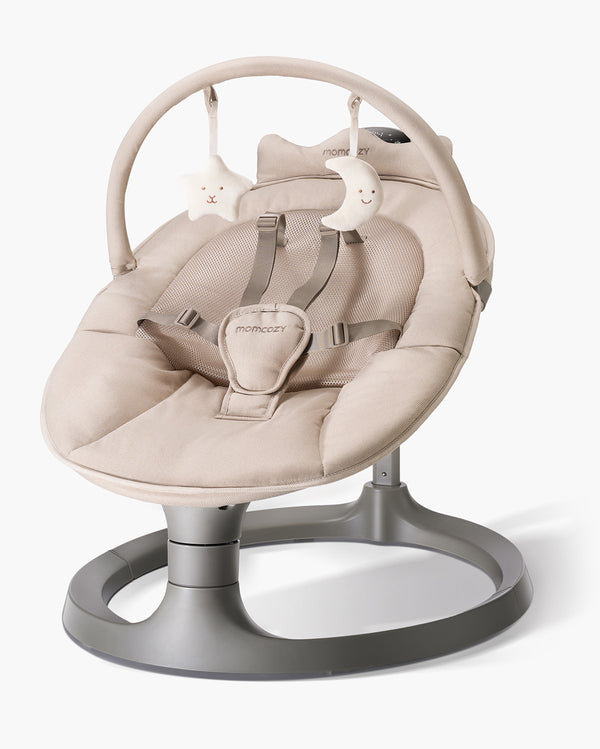
For parents who want versatile soothing, the Momcozy CocoSway 3D-Motion Electric Baby Swing uses patented 3D swing technology to deliver 6 distinct motion types across 4 speed settings. The seat rotates 180 degrees, includes a 5-point harness and metal base, reclines between 15 and 28 degrees, and the seat pad is machine washable. As with any indoor infant swing, stop use when the first applicable limit , weight, age, fit, or developmental milestone , is reached for this specific model. Verify current stop-use and fit instructions on the product page before use.
Best for the Transition Stage: Momcozy 2-in-1 Electric Baby Swing
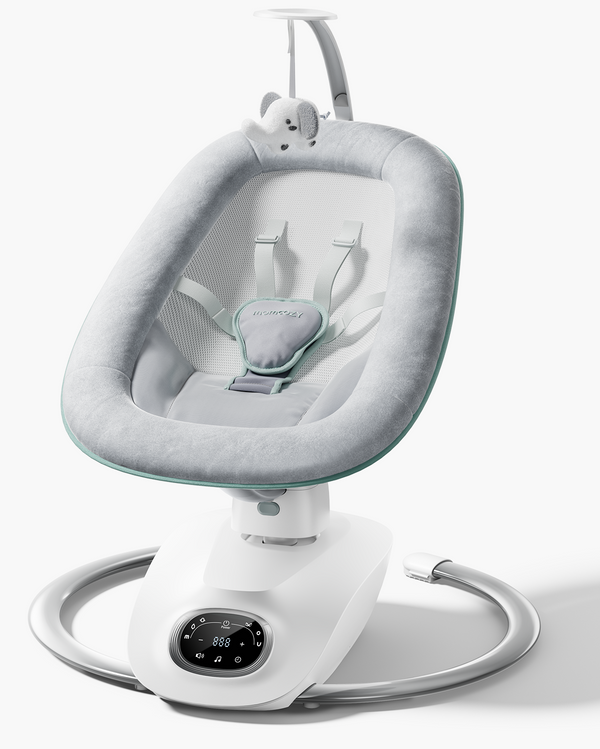
The Momcozy 2-in-1 Electric Baby Swing converts from swing mode to a stationary seat, with separate limits and instructions for each mode. Dual-arm support adds stability, and stationary mode accommodates babies up to 66 lbs , well beyond the typical swing window. Check the current product page for the swing mode's specific weight and age limits before use.
Double support pour les bras
Mouvements inspirés des parents
Assise confortable
Peut également servir de siège fixe
Technologie brevetée 3D Swing
6 mouvements de balancier
Siège pivotant à 180
Harnais 5 points
FAQ About Baby Swing Age and Stop-Use Limits
At what age should a baby stop using a swing?
Most babies stop using swing mode between 6 and 9 months, but age alone is not the stop rule. A baby who reaches the model's weight limit or a developmental milestone , such as sitting up independently , before that window needs to stop sooner. Always check your specific model's age guidance as the authoritative reference.
What is the typical weight limit for a baby swing?
Most indoor infant swings support swing mode up to 25-30 lbs, but the limit varies by model. Always check the label, manual, or current product page for your specific swing. Never apply one model's weight limit to a different swing.
Should I stop using the swing when my baby can sit up?
Yes. The ability to sit up independently is a stop condition for swing mode, even if your baby is under the model's weight limit. Once a baby can sit up, they can shift weight and move in ways that make a reclined swing seat unsafe. Check your model's manual for the specific language it uses around this milestone.
Can my baby keep using the swing if they are below the weight limit?
Not necessarily. Being below the weight limit means one condition hasn't been reached , but a developmental milestone, a harness fit issue, or a manufacturer-specified stop condition can still require stopping swing mode. All applicable conditions apply at the same time.
Is rolling over a sign that my baby has outgrown the swing?
Rolling over on its own may or may not be a stop condition depending on your model. The more directly relevant signals are whether your baby can shift their weight, lean out of position, or attempt to pull up in the seat. Check your product's manual for the specific language it uses around motor milestones.
What if the harness no longer fits correctly?
Stop swing mode immediately. A harness that doesn't fit securely , whether too tight, too loose, or incorrectly positioned , means the swing is no longer safe for your baby, regardless of age or weight.
Can I use the swing as a stationary seat afterward?
Only if your specific product has an approved stationary seat mode with its own published limits and instructions. Not all swings have this function. If yours does, follow the stationary mode's guidance separately from swing mode guidance , weight limits, position requirements, and power instructions may all differ.
How do I transition my baby away from a swing?
Reduce speed settings gradually over one to two weeks, shorten sessions progressively, introduce floor time during wake windows, and move sleep to a firm flat surface consistently. Most babies adjust within one to two weeks when parents stay consistent.
Can I use a secondhand swing without its instructions?
No. The weight limit, age limit, harness use guidelines, and stop conditions for any specific model are only authoritatively stated in that model's manual and current product information. Without those, you don't have the safety guidance specific to that unit. Look up the model on the manufacturer's current website before use.
What should I use after my baby outgrows the swing?
Stage-appropriate awake-time options include play mats, activity gyms, baby bouncers, and floor time on a firm surface. For product guidance, see how to choose a baby swing or the baby swing collection for current models and their limits.