A pregnancy pillow for all-night support should cushion the areas you need without making every change of position a new setup task. If you keep moving pillows, feel a support gap after turning, or find a large design too warm or crowded, start by identifying what stops working. As you compare pregnancy pillows, consider shape, support under your usual resting position, and the space available beside you. Sometimes a small adjustment is enough; other times a different format is more useful than a bigger pillow.
Key Takeaways
- A pregnancy pillow for overnight support should cushion the intended areas while fitting your movement habits, temperature preferences, and available bed space.
- U-shaped pillows offer support on both sides, but their larger footprint may be inconvenient for readers sharing a smaller bed.
- A supportive pillow needs suitable loft and firmness for its intended placement; choosing the firmest option does not guarantee better comfort.
- Cover material and surrounding contact can affect perceived warmth, so compare the exact variant instead of relying on a brand-wide cooling claim.
- Check the arrangement and approved adjustment instructions before replacing a pillow; an existing setup or targeted cushion may still meet your needs.
What Stops Working in Your Nighttime Setup?
If your pillow feels comfortable at bedtime but later feels awkward, begin with the one thing that you need to do most. You don’t necessarily need a new pillow; you may just need to take a closer look at the current arrangement.
A support gap
- Missing contact: You are no longer in contact with the part of the body you want cushioned.
- Less support: The area beneath you feels flatter than it did when you first settled in.
- Frequent adjustments: You keep moving the cushions around, hoping to get back the comfort and support you once had.
A comfort or space problem
- Excessive heat: The layer nearest to your body starts to feel too warm.
- Constrained mattress: Rising or turning feels confining, or the pillow shoves your partner.
- Head-pillow option: You're fine using your body pillow but still need a regular pillow under your head.
A pillow may provide the support you need, yet it can also leave you feeling confined or overheated. These signs can help you spot what’s changing, though they may not explain why you wake up or feel uncomfortable.
Start with the issue you understand most clearly. If you’re shopping for a pregnancy pillow, this guide on how to choose a pregnancy pillow will help you narrow your search by comparing the choices based on your specific needs.

Choose Support Areas Before Choosing a Pillow Shape
Consider what parts of your body require additional support. A supportive pregnancy pillow for side sleeping will have support for these areas of your body, let you move positions without too much trouble, and still allow you to have space in the bed. For more assistance, see the pregnancy pillow buying guide.
Full-body contact
A full-length pillow can support your stomach, back, and legs at the same time. If your usual pillow works well for your neck, there’s no need to replace it. Keep in mind, though, that a larger pillow needs more room and may make it harder to change positions.
Targeted support
If your head pillow is already adequate, you just might need a little support for your stomach or legs. Separate cushions are a bit more flexible, although you might have to move them around every time you change sides.
A pregnancy pillow comparison can assist you in narrowing down your options. First, decide which two parts of your body you want to support the most, and then think about how much space you want and how you like to move with your pillow setup.
Compare What Happens When You Change Sides
If it’s pregnancy pillow support all night you’re after, see how each arrangement feels as you shift from one sleeping position to another and not just when you first lie down on it at first night.
|
Arrangement |
What to check after changing sides |
Trade-off |
|
U-shaped |
Is cushioning available on either side? |
Takes up more bed space. |
|
C/J-shaped |
Does the open side still reach the area you want to support? |
May need repositioning. |
|
Flexible body pillow |
Can you reposition it to cushion the areas you need? |
May require a separate head or back cushion. |
|
Targeted cushions |
Do the individual cushions stay near the intended areas? |
Compact, but multiple pieces can complicate setup. |
Support already on both sides
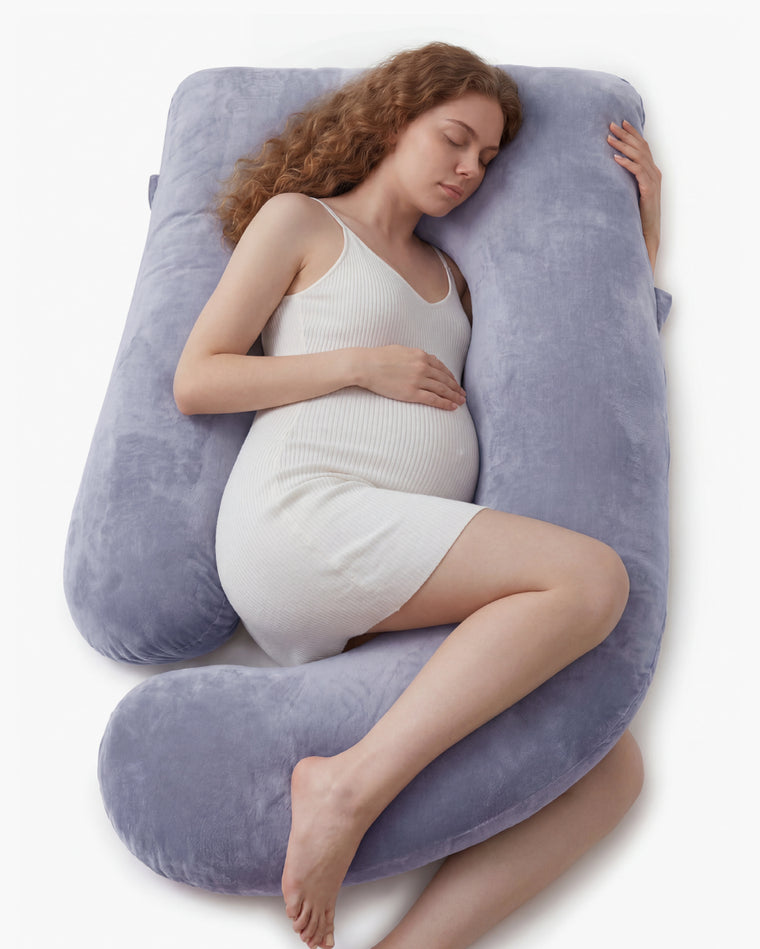
A U-shaped pillow supports both sides of your body, so you can switch positions without flipping the pillow. The downside is its size: it can take up much of the bed, leaving less room to move or share.
A more open arrangement
C- and J-shaped pillows, flexible body pillows, and small support cushions can be arranged in different ways. However, you might need to reposition them when you turn over, and they can move out of place while you sleep.
Before you buy, test the alignment from both sides of your normal setup. Your ideal fit will depend on how much firmness you require and how much space you have to move around.
Check Firmness and Loft Where Your Body Loads the Pillow
A pillow can seem soft when you press it, but it might compress more than you think when you rest your head on it. Try it out under the part you need support, and don’t decide just by touch.

Firmness and loft
Firmness is the level of resistance the pillow offers, and loft is the height or thickness of the pillow. A pillow can be too firm and too high for your sleeping position while being soft and still offering adequate loft.
Fill distribution and compression
If your pregnancy pillow loses support in one spot, check that section before you go and replace the whole pillow. The stuffing could have moved, or the area might be compressing more than you'd like to while using it.
Try these tests:
- Notice the padding on the spot that you use mostly.
- Test to see if it feels too thick, too thin, or just plain uncomfortable when you put pressure on it.
- Before adding or removing any filling, read the product instructions.
A higher loft pillow isn’t necessarily better, as it can be too firm, making it less comfortable to lie on or harder to move around with. Only modify the filling if the manufacturer states that your exact model is designed for that. Don’t rip open the pillow or try to repair it with instructions for other products.
Consider Warmth Without Confusing It With Support
The pillows can hold where you need them to but still be way too warm. Before you shift your setup, think about the cover, the amount of material you have around you, and the temperature in the room.
Check the exact cover
Verify the cover fabric for the model and version you buy. Material on its own isn’t enough to prove that a pillow sleeps cool, and one cover review shouldn’t be translated across all versions.
Consider less surrounding contact
If the pillow feels confining, try making a smaller pile. A lighter setup may be more comfortable, but it might change which parts of your body are supported.
Before switching to a different product, check what the cover is made of and how the pillow feels in your normal sleeping position. Treat cooling claims with caution unless they’ve been verified for the exact version you’re considering.
Check Bed Space and Ease of Repositioning
A full-length body pillow may fit on your bed, but it can leave little space to move around or share the mattress. Before buying a new one, measure your bed and consider how much room you’ll have left.
Shared space
- Start by measuring the area you have available on the bed.
- Make sure there’s enough space for your regular pillow and for your partner’s, if you share a bed.
- Before you buy, draw the pillow’s outline on paper and check it against the dimensions provided by the seller.
Entry and exit
Consider what happens when you turn over in bed, or get out of bed. Is the pillow where you want it, or do you have to keep adjusting yourself and the pillow every time?
While a bigger size can give you support on either side, the extra coverage can make it more difficult to move. A bigger body pillow or some strategic cushions can give you a little more space to move around if you are currently feeling too restricted.
Calculate before you compare the layouts. There is no pillow shape that fits all shared beds.
A Step-by-Step Support Check Before Replacing Your Pillow
If you find that your pregnancy pillow needs repositioning often, just change one thing at a time. You’ll be able to tell what helps before deciding whether you need a different pillow.
Locate the gap
1. Find the area that needs some support. Is there space under your back, your knees, or your hips, or is there a gap somewhere above those levels toward your head? Start at the place that most needs support.
Reassess the arrangement
2. Confirm the recommended position. Abide by the instructions provided with your pillow and avoid trying to force it into a non-manufacturer recommended shape.
3. Recheck after switching sides. Is it the full pillow that moves or just a section? See if it still covers the areas you want to support.
4. Consider the loft, heat, and size. A pillow may be well-filled but still be too high, too hot, or too wide for your bed. Tackle each problem in turn so you know what you’re fixing.
Choose the next action
5. Retain, adjust, or replace the positioning. Remain in the existing position if you are at ease. For a little more support, you can make a model-approved adjustment or add a cushion where you need it. You may need to try a different shaped pillow if the pain continues.
This is just the bottom-line check on comfort, not a clinical trial or any suggestion that you’ll sleep better. Record what you have changed already and what still doesn’t feel right before changing anything else.
When a Momcozy U-Shaped Pillow Is Worth Considering
If you prefer a single connected system that cradles both sides of your body, you might want to opt for a U-shaped pillow. The Momcozy Huggable U-shaped pregnancy pillow is a full-body pregnancy pillow made with polyester stuffing.

Relevant features
The design has support on the two sides and provides the back, belly, and legs with a comfortable resting place. Both the inner and outer cover have zippers, so you can add or remove filling to customize the pillow to the height you want. See your model's manual for how to adjust.
When another arrangement may suit you
Its coverage is bulky. Several customer reviews mention the size of the pillow and how warm it is, but a few people wish it was a bit firmer. These are individual experiences, and not every version will necessarily feel like this.
If you have a small bed or you like to spread out, a body pillow with a narrow width or a few smaller pillows may work better for you. Check the size, fabric and care instructions for your edition before you buy. You may get some different support from a U-shaped pillow, but don’t expect it to keep you from waking up in the middle of the night.
Frequently Asked Questions
Do I have to buy a dedicated pregnancy pillow?
No. Before purchasing a new pillow, see if the ones you currently have are supportive enough.
Can I use my usual head pillow with a body pillow?
Yes. You can use separate pillows together. Follow the body pillow’s directions to position them, then make sure the arrangement is comfortable and that your head and neck are not pushed up too high.
Can I add stuffing to every pregnancy pillow?
No. Change the filling only if your particular model allows for it. A review about an adjustable pillow doesn’t mean that another model has the same feature.
Can washing or drying change the feel of my pillow?
How you maintain a pillow can affect how comfortable it feels. Before washing the insert or cover, check the manufacturer’s care label. Only use a dryer to fluff the pillow if the instructions say it’s safe.
Does a supportive pillow guarantee that I’ll sleep through the night?
No. A pillow can help you stay comfortable and maintain a supportive position, but it won’t resolve every reason you might wake up. If the pain continues or gets worse over time, speak with a qualified healthcare professional.
Conclusion
A pregnancy pillow should offer comfort without making it difficult to move or sleep beside someone. Start by noticing what feels uncomfortable. Pay attention to how the pillow shifts when you turn over, then adjust one thing at a time. Most likely your existing pillows will do, and you don’t have to go out and buy more. If you still have those worries, shop for a pregnancy pillow with your needs for support, comfort, and bed space in mind.