Picking a baby high chair feels simple — until you start looking. There are dozens of options, and not all of them are as safe or practical as they look in photos. This guide breaks down the 7 key safety features every parent should check before buying, plus honest advice on chair types, cleaning, ergonomics, and when a high chair is even the right choice for your baby.
What Safety Features Should You Look for in a Baby High Chair?
Not every high chair that looks sturdy actually is. Here are the seven features that matter most for your baby's safety at mealtime.
1. Safety Certification
Before anything else, check whether the chair meets recognized safety standards. In the U.S., look for ASTM F404 certification. In Europe, EN14988 is the equivalent. These certifications mean the chair has been tested for structural strength, stability, and restraint system performance. If a chair doesn't list its certifications, that's a red flag worth taking seriously.
2. Five-Point Harness
A five-point harness — two shoulder straps, two waist straps, and one crotch strap — is the safest restraint option available. It keeps your baby securely in place even when they start squirming, leaning, or attempting their first great escape. Three-point harnesses exist, but they leave more room for a baby to slide forward or climb out. When you're evaluating a chair, also check that the buckles are easy for adults to fasten and unfasten but not something a toddler can figure out on their own.
3. Wide, Stable Base With Anti-Slip Feet
Tipping is one of the most common causes of high chair injuries. A chair with a wide base and a triangular frame structure distributes weight more evenly and is harder to knock over. Rubber anti-slip feet are a small detail that makes a big difference — especially on tile or hardwood floors. Give the chair a gentle push test before committing: it should feel solid, not wobbly.
4. BPA-Free Tray With a Secure Lock
The tray sits right in front of your baby's face, so material safety matters. Look for trays labeled BPA-free and food-grade safe. Beyond the material, check how the tray locks in place. A one-hand locking mechanism is convenient, but more importantly, it should click securely so the tray doesn't pop off when your baby pushes against it. A wider tray — around 23 inches or more — also helps contain the mess and reduces the chance of your baby leaning out to reach food.
5. Adjustable Footrest (The 90-90-90 Rule)
This one surprises a lot of parents. A footrest isn't just a comfort feature — it's a safety and developmental one. When a baby's hips, knees, and ankles are each at roughly 90-degree angles, they have better trunk stability, which means less risk of slumping or choking during meals. Look for a footrest that adjusts to multiple positions so it stays useful as your baby grows.
6. Grow-With-Me Adjustability
A high chair that only works for one stage of your child's development isn't a great long-term investment — and constant seat changes can create safety gaps. Look for chairs with multiple height settings, adjustable seat depth, and a high weight limit. Some chairs are designed to convert from an infant seat to a toddler chair to a full-sized stool, which means they stay useful well beyond the baby years.
7. Easy-to-Clean Surfaces
Hygiene is a direct safety concern, not just a convenience preference. Food residue that's hard to wipe off becomes a bacteria trap. Look for smooth surfaces with no deep crevices, a removable harness that's machine washable, and a dishwasher-safe tray. If the chair has a cushion or seat pad, check whether it's removable and washable too.
What Makes a Baby High Chair Structurally Safe?
Stability comes down to a few physical design factors that are easy to overlook when you're shopping online.
A wider base creates a lower center of gravity, which makes the chair harder to tip. A triangular frame distributes weight more effectively than a straight-leg design. And the chair's maximum weight capacity tells you something important about overall build quality — a chair rated for 250 lbs or more is generally built to a higher structural standard than one rated for 50 lbs, even if your baby only weighs 20.
Also pay attention to how the joints are constructed. Chairs that rely on plastic clips to hold major components together are more likely to loosen over time than those with solid wood joints or reinforced hardware.
Why Does Ergonomics Matter When Choosing a Baby High Chair?
Ergonomics affects more than comfort. A poorly positioned baby is more likely to slump, gag, or lose interest in eating altogether.
The ideal seated position for a baby in a high chair follows the 90-90-90 rule: hips at 90 degrees, knees at 90 degrees, and ankles at 90 degrees with feet flat on the footrest. This posture supports trunk stability, reduces the risk of choking, and helps babies focus on the meal rather than trying to keep themselves upright.
When evaluating ergonomics, look for:
- A seat with a slight recline option for younger babies who are just starting solids.
- Adequate back support that doesn't force the baby into an unnatural position.
- An adjustable footrest that can be repositioned as your baby grows taller.
What If Your Baby Can't Sit Up in a High Chair Yet?
Most babies are ready for a high chair somewhere between 4 and 6 months, but the real indicator isn't age — it's development. Your baby should be able to hold their head steady and sit upright with minimal support before you introduce a high chair.
Start With a Nursing Pillow for Supported Feeding
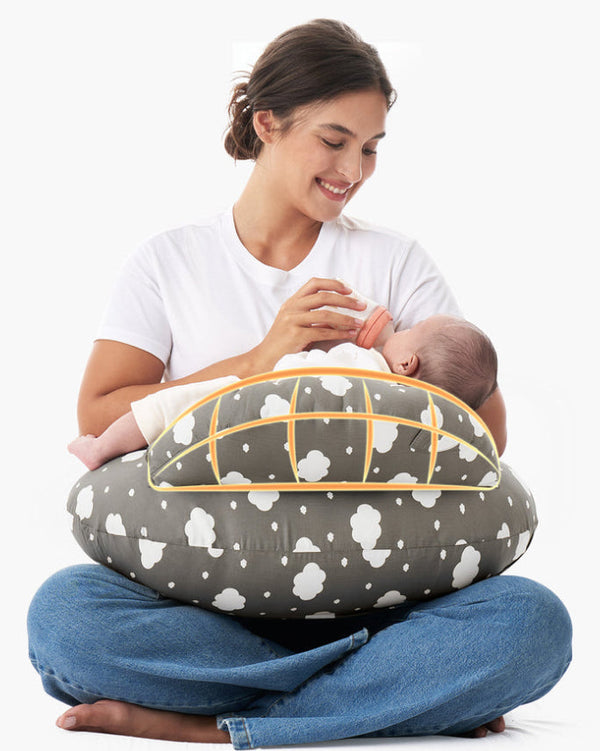
If your baby isn't there yet, a nursing pillow is one of the best tools for supported feeding in the early months. The Momcozy Multifunctional and Adjustable Nursing Pillow is a great starting point — it features an adjustable waist strap that hugs your body securely, a built-in 14cm security fence that keeps baby from rolling off during feeding, and a 100% breathable cotton cover that's fully removable and machine washable. It's also genuinely multipurpose: it supports feeding from birth, propping at 3 months, tummy time at 6 months, and sitting practice at 9 months.
Need More Structure? Try Memory Foam Support
If you're looking for firmer, more structured support, the Momcozy MaxSupport Memory Foam Nursing Pillow is built with 45D premium memory foam that contours to both mom and baby while maintaining consistent support throughout the feed. It's 28% wider than standard nursing pillows at 22.6" x 14.5", includes the same safety fence design to prevent slipping, and is certified to CPSC safety standards. The adjustable waist strap works for most body types — including dads.
Both are solid options for the early feeding stage before your baby is ready for a high chair. You can browse all available styles in Momcozy's nursing pillow collection to find the right fit for your setup.
Which High Chair Type Is Right for Your Space and Lifestyle?
There's no single best type — it depends on your home setup, how often you move the chair, and how long you want it to last. Here's a straightforward comparison:
| Type |
Best For |
Safety Strengths |
Limitations |
| Wooden grow-with-me |
Long-term home use |
High stability, high weight limit, durable construction |
Larger footprint, higher upfront cost |
| Multi-functional plastic |
Families needing recline |
Often includes recline for younger babies |
Can feel bulky; joints may loosen over time |
| Hook-on / portable |
Travel and dining out |
Compact and easy to carry |
Less stable; not for everyday primary use |
| Booster seat |
Small spaces, older toddlers |
Space-saving, attaches to existing chair |
Not suitable for babies who can't sit independently |
If you're looking for a chair that covers the most bases in terms of safety, ergonomics, and longevity, a wooden grow-with-me design is typically the strongest all-around choice.
Why Is Cleaning Part of High Chair Safety?
A chair that's hard to clean doesn't just create extra work — it creates a hygiene problem. Food that gets stuck in crevices, under removable trays, or in harness straps can harbor bacteria that puts your baby at risk, especially once they start picking food up and putting their hands in their mouths.
Here's what to look for when evaluating how cleanable a chair actually is:
- Smooth wood or plastic surfaces that can be wiped down quickly without food getting trapped.
- A dishwasher-safe tray that you can run through a full wash cycle rather than just wiping down.
- A removable, machine-washable harness so you're not stuck spot-cleaning straps by hand.
- Moisture-resistant materials on the frame — heat-treated wood, for example, resists mold and warping better than untreated alternatives.
High Chair Safety Tips for Everyday Use
Even the safest chair needs to be used correctly. Here are practical habits that reduce risk at every meal:
- Always buckle the harness, even for short meals. Babies move fast.
- Keep the chair away from walls, counters, and tables your baby could push off from.
- Never leave your baby unattended in a high chair, even if they're securely strapped in.
- Check all joints, screws, and snap connections regularly and tighten anything that feels loose.
- Limit mealtime to 20–30 minutes to prevent fatigue and restlessness in the seat.
- Follow the manufacturer's weight and age limits — don't keep using a chair your child has outgrown.
Quick Safety Checklist: How to Choose a Baby High Chair
Before you buy, run through this checklist:
- ✅ Certified to ASTM F404 (U.S.) or EN14988 (EU)
- ✅ Five-point harness with secure, adult-operable buckles
- ✅ Wide base with anti-slip feet
- ✅ BPA-free, food-grade tray with a locking mechanism
- ✅ Adjustable footrest that supports the 90-90-90 position
- ✅ Multiple height and seat adjustments for growing babies
- ✅ Easy-to-clean surfaces, removable tray, and washable harness
- ✅ High weight capacity that reflects solid construction
Why the Momcozy DinerPal High Chair Is Worth a Closer Look
If you want a chair that checks all seven safety features without compromise, the Momcozy DinerPal High Chair is one of the most complete options available in the Momcozy baby high chair collection.
Here's what it offers:
-
Certified safety: Meets both ASTM F404 (U.S.) and EN14988 (EU) standards.
- Five-point harness with a fully removable, machine-washable design.
- FSC-certified beechwood frame with a triangular anti-tip structure and rubber anti-slip feet.
- 308 lb weight limit — built to last well beyond the toddler years.
- 5-in-1 convertible design with 7 height positions, adjustable seat depth, and a tool-free 20-second adjustment system.
- 23.5-inch extra-wide BPA-free tray that's fully dishwasher safe.
- 248°F heat-treated wood that resists moisture, mold, and warping without chemical treatments.
It's also available as a bundle with a soft cushion for added comfort during the early months of solid food introduction.
5 Modes
Conception Sécurisée
Utilisation à Vie
Facile à Nettoyer
5 Modes
Conception Sécurisée
Utilisation à long terme
Nettoyage aisé
Choose the Right Baby High Chair — and Feel Confident at Every Meal
Knowing how to choose a baby high chair comes down to one thing: not cutting corners on safety. Check the certifications, prioritize a five-point harness, test the stability, and think about how long the chair will actually serve your family. If you're still in the early feeding stage, starting with good baby nursing pillows gives your newborn the supported positioning they need before they're ready for a seat at the table. When that time comes, the Momcozy Baby High Chair is built to meet every safety standard covered in this guide — and then some. Either way, you've got the information you need to make a confident, well-informed choice.
FAQs About How to Choose a Baby High Chair
Q1: When can a baby start using a high chair?
Most babies are ready between 4 and 6 months, but age alone isn't the deciding factor. Your baby should be able to hold their head steady and sit upright with minimal support before you introduce a high chair. If they're still working on head control, a supportive nursing pillow is a better feeding option for now.
Q2: Is a five-point harness really necessary in a baby high chair?
Yes. A five-point harness — with shoulder, waist, and crotch straps — offers significantly more restraint than a three-point design. Babies who are learning to move and shift their weight can slide forward or climb out of a three-point harness more easily, making the five-point system the safer standard for everyday mealtime use.
Q3: Do I need a high chair with a footrest?
Yes, and it matters more than most parents realize. A footrest that supports the 90-90-90 seated position — hips, knees, and ankles each at roughly 90 degrees — gives your baby better trunk stability during meals. Without it, babies tend to slump, which increases choking risk and makes it harder for them to focus on eating.
Q4: How long can a baby sit in a high chair at one time?
Most feeding and child development guidance suggests limiting high chair sessions to 20–30 minutes. Beyond that, babies tend to get fatigued and restless, which increases the chance of unsafe movement in the seat. Keeping mealtimes to a reasonable length also helps build a positive association with the chair over time.
Q5: Are wooden high chairs safer than plastic ones?
It depends on the specific chair, but wooden high chairs — particularly those with heat-treated frames and reinforced joints — tend to offer better long-term structural integrity than plastic models. They typically have higher weight limits and are less likely to develop loose joints over time. The trade-off is that they're usually heavier and less portable than plastic alternatives.
Q6: What does BPA-free mean on a high chair tray, and does it matter?
Yes, it matters. BPA (bisphenol A) is a chemical found in some plastics that can leach into food, particularly under heat. Since the tray is in direct contact with your baby's food and hands, choosing a BPA-free, food-grade tray is a straightforward safety decision. Most reputable high chairs now offer this as standard, but it's still worth confirming before you buy.