



Parents often wonder, "What age do babies sleep through the night?" Most infants learn to sleep periods stretching longer than nighttime during their development between 6 and 9 months of age. The time needed to achieve this goal varies among infants, as each baby matures at its own pace.
Understanding your baby's sleep patterns and knowing what to expect at each stage can help you navigate those challenging early months with confidence. This guide covers everything from typical sleep milestones to practical strategies that actually work.
Before answering when do babies sleep through the night, it's helpful to understand what "sleeping through the night" actually means. The phrase means different things depending on who is using it. In research, it often refers to a continuous stretch of 5-8 hours of sleep. Parents, however, usually mean sleeping from bedtime until morning without needing help. Those are very different milestones, and it's common for babies to achieve one long before the other. Understanding your baby's sleep patterns and knowing what to expect at each stage can help you navigate those challenging early months with confidence.
Quick Answer
Frequent night waking is common in babies, especially in the first few months and during major developmental changes. The goal is not to force a young baby to sleep through the night, it is to help them sleep more continuously and comfortably.
Here are six small, practical changes you can make starting today.
- protect daytime naps so your baby does not become overtired;
- keep the sleep space comfortably cool (around 64–68°F / 18–20°C) and avoid overheating;
- use natural daylight during the day and dim, low-stimulation light at night to support a developing day-night rhythm;
- pause briefly before picking your baby up at every sound, since some noises are simply part of normal sleep transitions;
- follow safe-swaddling rules and stop swaddling as soon as your baby shows signs of trying to roll;
- build a calming, predictable bedtime routine with cues such as a bath, gentle massage, dim lights, and quiet time.
These adjustments will not eliminate every night waking—and babies still need to feed and be comforted when they need it—but they can make sleep feel more manageable for both baby and parent. If your baby has fever, breathing difficulties, poor feeding, fewer wet diapers, persistent vomiting, or behavior that seems unusual, focus on getting medical advice rather than trying another sleep strategy.
What Is Considered Sleeping Through the Night for a Newborn?
For newborns, "sleeping through the night" means a continuous sleep stretch of five to six hours—not the full 10-12 hours adults enjoy. Newborns have tiny stomachs that require frequent feeding, so they typically wake every 2-4 hours during the first three months.
As babies mature, their sleep stretches naturally lengthen. By 3-6 months, many babies can sleep 6-8 consecutive hours at night, which pediatricians consider "sleeping through the night" for this age group.
When Do Babies Start Sleeping Through the Night?
Infants generally develop nighttime sleep abilities up to 6 to 8 hours in duration between their 3-month and 6-month stages. The readiness to sleep through the entire night develops differently in every baby according to their unique timeline.
- By 3 months: Some babies may sleep 4-6 hours continuously
- By 4-5 months: Many babies achieve 6-8 hour stretches
- By 6-8 months: Most babies can sleep through the night without feeding[1]
Many healthy babies are physiologically capable of going longer stretches overnight by around 6 months, though some continue to need night feeds beyond this age based on growth, feeding patterns, or individual needs."

What are the Nighttime Sleeping Patterns of Infants?
As babies grow, their sleep patterns naturally evolve and nighttime sleep periods extend. The following table provides a helpful overview of what to expect at each developmental stage[1]:
|
Age Group |
Total Sleep per Day |
Nighttime Sleep |
Sleep Characteristics |
|
Newborns (0-3 months) |
15-17 hours |
4-6 hour stretches |
Frequent waking due to hunger;No well-established sleep-wake cycle;Irregular and fragmented sleep. |
|
Infants (4-5 months) |
14-16 hours |
6-8 hour stretches |
Gradual increase in nighttime sleep;May still wake for feedings;Developing more consistent sleep-wake cycle. |
|
Older Infants (6-12 months) |
13-15 hours |
10-12 hours (with 1-2 daytime naps) |
Can sleep through the night (6-8 hours);Longer periods of deep sleep;Occasional waking due to teething, growth spurts, or Separation anxiety. |
|
Toddlers (12+ months) |
12-13 hours |
10-12 hours (with 1-2 daytime naps) |
More consistent sleep schedule;Usually uninterrupted nighttime sleep;Occasional disruptions due to nightmares or fear of separation. |
Should You Worry if Your Baby isn't Sleeping at Night?
Frequent night waking alone isn't necessarily a medical problem after six months. However, if sleep has suddenly changed, your baby seems uncomfortable, isn't growing well, snores or struggles to breathe during sleep, or you're concerned something feels different, it's worth discussing with your pediatrician.
Why Your Baby May Not Be Sleeping Through the Night?
Several factors contribute to why babies do not sleep all night. Knowing the causes behind sleep disruptions allows parents to develop more effective solutions for their babies' issues. Your baby might wake up at night because of these usual causes[1]:
- Hunger: Baby stomachs remain small, so newborns, especially during their first few months, require many small feedings each night. Even babies who are 4-6 months old may still require one nighttime feeding before they fully achieve uninterrupted nighttime sleep.
To make these inevitable late-night sessions smoother, many parents rely on the Momcozy Night Pro Baby Bottle Warmer - Night Feeding. As the world’s first night feeding bottle warmer, it features a see-through water chamber and a soft two-level night light, allowing you to prep milk in the dark without fumbling. Its science-powered fast heating and smart memory modes ensure a perfectly warmed bottle in minutes, while the real-time countdown lets you focus on soothing your baby instead of guessing when the milk is ready.
- Growth Spurts: There’s surprisingly little evidence for scheduled growth spurts, however, periods of rapid growth can temporarily increase hunger and night waking.
- Teething: Some babies seem more unsettled while teething, although teething usually causes only mild, temporary sleep disruption. Teething typically begins between 4 and 6 months of age.
- Developmental Milestones: Sleep disturbances occur when babies achieve developmental behavioral milestones, including rolling over, crawling, and reaching the sitting milestone, because these achievements lead to advanced mental functions and alter physical development patterns. To help you track these evolving milestones and monitor their sleep quality without entering the room, a high-quality baby monitor can be an essential tool for quiet observation.
- Separation Anxiety: Around 6-8 months, separation anxiety may make some babies more likely to seek reassurance during night wakings.
- Illness or Discomfort: Any physical medical condition the baby faces, including ear infections or gastrointestinal discomfort, can lead to increased nighttime disturbances. Check that your child feels no discomfort or pain.
- Sleep Associations: Some babies who consistently rely on rocking, feeding, or being held to fall asleep may look for that same support after normal night waking. Others transition between sleep cycles without needing help. This varies from baby to baby.
- Sleep Environment: The sleep environment will interfere with the baby's sleep due to noise, temperature changes, and physical transfers to a different sleeping space.

$79.99código Ahorrar 10%
6 Fast-Acting Tips to Help Reduce Night Wakings Tonight
1. Protect Daytime Sleep to Help Prevent Overtiredness
It is tempting to shorten naps in hopes of getting a longer night, but an overtired baby may be harder to settle and may wake more often. Rather than trying to keep your baby awake until bedtime, aim for enough total sleep across the day and watch for their early tired signs [1].
Use the total daily sleep ranges below as a flexible reference, not a pass-or-fail target [1]:

These ranges are guideposts. Your baby's sleep needs can vary from day to day, so focus on patterns in mood, feeding, and how easily they settle.
To protect daytime sleep without letting late naps crowd bedtime:
- Use age-appropriate wake windows: During awake time, offer feeding, interaction, and supervised tummy time, then begin winding down when your baby shows tired cues.
- Adjust late-day naps gradually: For babies older than 3 months, a very late nap can make bedtime harder. Shift timing in small increments rather than skipping sleep altogether.
- Start the bedtime wind-down early: In the last 15-30 minutes, lower stimulation, dim the lights, and move through the same calming steps each night.
If your baby seems chronically overtired and keeps waking, read our detailed guide on why an overtired baby keeps waking up.
2. Keep the room at about 64-68°F
A room that is too warm or too cold can make sleep less comfortable. Babies are still developing their ability to regulate body temperature, so check the baby rather than relying only on how the room feels to you [3].
A room temperature of about 64 to 68°F (18 to 20°C) is often used as a reference [4], but it is not a rule for every home. Humidity, insulation, illness, clothing, and climate all matter. The priority is to avoid overheating and follow safe-sleep guidance.
- Check your baby's chest or back of the neck: Sweating, a hot chest, flushed skin, or damp hair can be signs that they are too warm [3][5]. Cool hands and feet alone are not a reliable guide.
- Dress for sleep, not for the weather outside: Avoid hats, thick loose blankets, and overheating. If extra warmth is needed, use a well-fitting, non-weighted sleep sack and keep the sleep surface bare, flat, and firm [3].
3. Use Bright Days and Dim Nights to Support Your Baby's Body Clock
Newborn sleep is naturally fragmented because the day-night rhythm is still developing. From about 6-12 weeks, regular light and predictable routines can help babies begin to tell day from night [1].
- During the day: Open the curtains after morning wakes and include safe outdoor time when you can. The goal is regular daytime light exposure, not direct sun on a young baby [6].
- In the evening: Use softer, warmer light and keep play calm as bedtime approaches.
- At bedtime: Make the sleep space as dark and quiet as practical. If you room-share, avoid television and bright screens after your baby is asleep.
- For night feeds and diaper changes: Keep lights low, voices quiet, and interactions brief. This can be especially helpful when a baby is wide awake after a night feeding, because it limits the cues that signal daytime [7].
4. Pause, Observe, Then Respond to Night Wakings
A baby who is awake at night but not crying may be moving between sleep cycles rather than needing help. Brief grunts, squirms, or short cries can be normal. If your baby's eyes are closed and the sounds are not escalating, pause for a moment before intervening. For repeated hourly wake-ups, see our guide to a newborn waking every hour.
If your baby is fully awake or the crying is building, start with the least stimulation that is likely to help: check for hunger, a wet or uncomfortable diaper, temperature, or signs of illness. Then try a calm voice, gentle patting, or a steady hand on the chest.
Feed when your baby is hungry, especially in the early months. Do not ignore hunger cues in the name of sleep training. Observing first is about avoiding unnecessary stimulation, not withholding comfort or care [8].
5. Swaddle Only When It Is Still Safe for Your Baby
For some young babies, the startle reflex can interrupt sleep. Research suggests that swaddling may reduce some spontaneous awakenings, but it must be used safely [9].
If you choose to swaddle, follow these safety basics:
- Stop at the first signs of rolling: Swaddle only babies who are not yet attempting to roll. Once rolling attempts begin, switch to an arms-free sleep sack [3].
- Always place your baby on their back to sleep. Never swaddle for side or stomach sleeping.
- Skip weighted products: Do not use weighted swaddles, weighted sleep sacks, weighted blankets, or hats during sleep. Avoid overheating.
- Keep hips and legs free to bend and move. The swaddle should be snug around the chest but never tight around the hips, and no loose fabric should be able to cover the nose or mouth.
- Keep the sleep space simple: Swaddling does not replace a bare, flat, firm sleep surface. If your baby sleeps comfortably with their arms out, there is no need to swaddle just to pursue a longer stretch of sleep.
6. Repeat a Short, Predictable Bedtime Routine
Choose a short routine you can repeat most nights: for example, a feed, diaper change, pajamas or sleep sack, dim lights, a brief song or book, and into the sleep space. Keep it calming rather than elaborate.
A bedtime routine can be one of the quickest changes to try. In one study, improvements in settling and night waking were seen from the first night the routine was used, with the fastest changes over the first three nights [10]. Every baby is different, so do not expect overnight perfection, but a consistent routine can create a helpful sleep cue right away.

If the main difficulty is that your baby wakes up when put down, follow that guide for transfer-specific strategies instead of trying to solve the full issue in this overview.
How to Get Your Baby to Sleep Through the Night
The process of helping your baby sleep through the night becomes easier when parents use suitable techniques. Proper development of healthy sleep patterns requires time for babies, so consistent routines help them transition better. The following strategies will help your baby sleep consistently throughout the night.
Establish a Consistent Bedtime Routine
The first step should be implementing a peaceful nighttime routine. The combination of a warm bath and gentle rocking motions, or gently sung lullabies, helps your baby recognize it is bedtime [10]. Consistency is key—perform the same activities in the same order each evening.
Create a Sleep-Friendly Environment
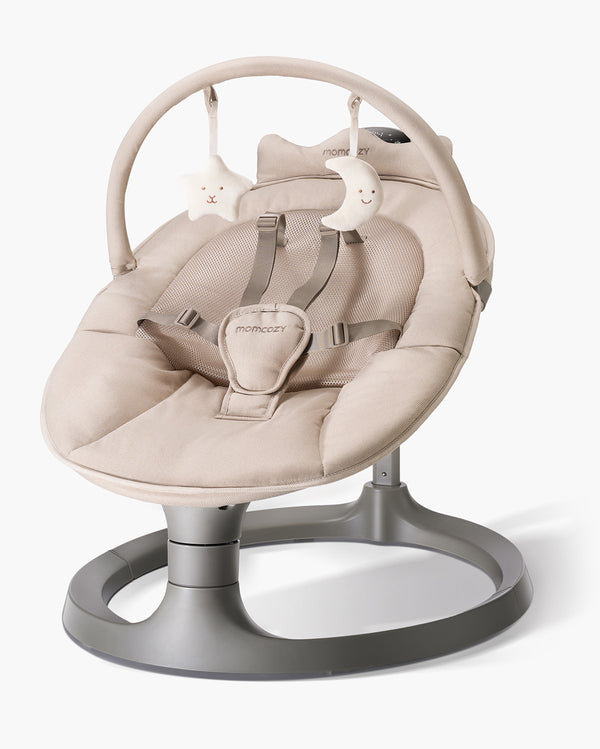
Establish a sleep-friendly environment by setting the baby's room to have dim lighting and low noise along with a comfortable room temperature (64-68°F[4]). The Momcozy Sound Machine functions excellently in sleep areas because it generates soothing background tones, which promote better rest for your baby. This noise machine works to minimize background noises from the area. If your baby struggles to settle down, a baby swing can provide soothing motion to help calm them before bedtime.

Encourage Daytime Sleep and Avoid Late Naps
Make sure your baby takes enough daytime naps, but avoid late naps, as they may interfere with nighttime sleep. A baby who receives proper rest during the day tends to sleep well at night. Aim to have the last nap end by 4-5 PM to protect nighttime sleep quality.
Before bedtime, give your baby warm comfort with a soft Momcozy Baby Pajama. Using soft pajamas provides warmth and comfort, helping your baby achieve better quality nighttime rest for a more peaceful sleep.
Put Your Baby to Bed Drowsy, Not Asleep
To help your baby learn independent sleep, put them in their bed when they become sleepy but remain conscious.
Drowsy but awake works well for some babies, but it isn't the only healthy way to support sleep. If your baby falls asleep while feeding or being held, you don't need to force this approach. Many families gradually work toward putting their baby down more awake over time.
Independence in falling asleep is learned by following this technique, which enables babies to settle themselves if they wake at night. This process takes some time, but it will create beneficial sleep patterns for your baby.
Gradually Reduce Sleep Associations
Your baby requires time to learn independent sleep skills when sleep associations such as rocking, holding, or feeding have become essential for sleeping. Gradually reduce the sleep associations so they can learn new ways of falling asleep with less assistance and feel secure in their crib.
Be Patient and Consistent
Your patience, along with consistency, will guide your child through the process of sleep training, although adaptation time may vary from baby to baby. Consistency, together with patience, marks the key to your success. You should consult your pediatrician about medical causes for your baby's sleep problems, especially when you experience ongoing sleep challenges together with indications of distress.

When to See a Doctor for Your Baby Not Sleeping Through the Night?
While it is normal for infants under six months to wake up at night, you should consult your pediatrician if sleep issues persist after the six-month mark.
- Excessive Crying or Distress: A baby continuously crying beyond their normal range or appearing excessively upset while sleeping might signal an actual medical problem such as reflux, ear infections, or other medical conditions.
- Difficulty Settling After 6 Months: Settling problems in babies after following bedtime procedures and calming methods, especially past six months of age, may indicate issues that require medical evaluation.
- Breathing Problems or Sleep Apnea: Snoring, gasping, pauses in breathing, or other respiratory difficulties during sleep warrant immediate medical attention.
- Poor Weight Gain or Feeding Issues: If sleep problems accompany feeding difficulties or inadequate weight gain, medical evaluation is necessary to rule out underlying health concerns.
- Sudden Unexplained Sleep Regression: A prolonged issue with sleep regression in your baby that obvious reasons cannot explain will need medical assessment, as this might signal developmental or health issues requiring professional guidance.
FAQs About Babies Sleeping Through the Night
Q1: When Do Babies Start Sleeping Longer Stretches?
Infants typically reach the milestone of extended night sleep between three and six months of age. Newborns take multiple brief sleeping intervals that usually last between 2-4 hours throughout each day. During their second or third month, they may sleep four to six hours without interruptions. Between 4 and 6 months of age, most infants reach the stage where they require no feedings during the night. On average, babies reach the ability to rest continuously throughout the night between 6 months of age. Sleep patterns differ from one baby to another[1].
Q2: When Do Babies Start Sleeping Through the Night Without Feeding?
Most infants become able to sleep through night-time without needing feedings at approximately six months of age. The time schedules for nighttime unattended sleep differ between babies[1].
Q3: Do Babies Naturally Drop Night Feeds?
Yes, babies typically drop night feeds as they grow, and their bodies can go longer between feedings. Infants begin to sleep through the night when they are 4 to 6 months old, as their sleep patterns develop and their capacity for nighttime rest extends. Every baby experiences night feed drop at different times during their growth.
Helping Your Baby Sleep Through the Night
Most babies sleep 6-8 hour stretches between 3-6 months, though timing varies for each child. Growth spurts, teething, and hunger naturally disrupt sleep patterns. Create consistent bedtime routines and a comfortable sleep environment to support better rest. Contact your pediatrician if sleep problems persist past 6 months or if you notice concerning symptoms.
Disclaimer
The information provided in this article is for general informational purposes only and does not constitute medical advice, diagnosis, or treatment. Always seek the advice of your physician or other qualified health provider regarding any medical condition. Momcozy is not responsible for any consequences arising from the use of this content.
References
[1] O’Connor, C., Ventura, S., Proietti, J., O’Sullivan, M. P., & Boylan, G. B. (2026). Sleep and infant development in the first year. Pediatric Research. Advance online publication. https://doi.org/10.1038/s41390-026-04780-4
[3] Moon, R. Y., Carlin, R. F., & Hand, I. (2022). Sleep-related infant deaths: Updated 2022 recommendations for reducing infant deaths in the sleep environment. Pediatrics, 150(1), Article e2022057990. https://doi.org/10.1542/peds.2022-057990
[4] Weiss, S. (2022). Protecting infants from sudden unexpected infant death: Guidelines for interventions during the perinatal period from the French National College of Midwives. Journal of Midwifery & Women’s Health, 67(Suppl. 1), S83–S92. https://doi.org/10.1111/jmwh.13430
[5] Darrow, H. J., Carman, K. A., & Wheeler, V. (2025). Sudden infant death syndrome: Common questions and answers. American Family Physician, 111(2), 164–170.
[6] Harrison, Y. (2004). The relationship between daytime exposure to light and night-time sleep in 6–12-week-old infants. Journal of Sleep Research, 13(4), 345–352. https://doi.org/10.1111/j.1365-2869.2004.00435.x
[7] What you need to know about sleep for your child. (2022). American Family Physician, 105(2), online. https://www.aafp.org/pubs/afp/issues/2022/0200/p168-s1.html
[8] Quante, M., McGee, G. W., Yu, X., von Ash, T., Luo, M., Kaplan, E. R., Rueschman, M., Haneuse, S., Davison, K. K., Redline, S., & Taveras, E. M. (2022). Associations of sleep-related behaviors and the sleep environment at infant age one month with sleep patterns in infants five months later. Sleep Medicine, 94, 31–37. https://doi.org/10.1016/j.sleep.2022.03.019
[9] Dixley, A., & Ball, H. L. (2022). The effect of swaddling on infant sleep and arousal: A systematic review and narrative synthesis. Frontiers in Pediatrics, 10, Article 1000180. https://doi.org/10.3389/fped.2022.1000180
[10] Mindell, J. A., Leichman, E. S., Lee, C., Williamson, A. A., & Walters, R. M. (2017). Implementation of a nightly bedtime routine: How quickly do things improve? Infant Behavior and Development, 49, 220–227. https://doi.org/10.1016/j.infbeh.2017.09.013
[11] American Academy of Pediatrics. (2025, September 23). Fever and your baby. HealthyChildren.org. https://www.healthychildren.org/English/health-issues/conditions/fever/Pages/Fever-and-Your-Baby.aspx








