


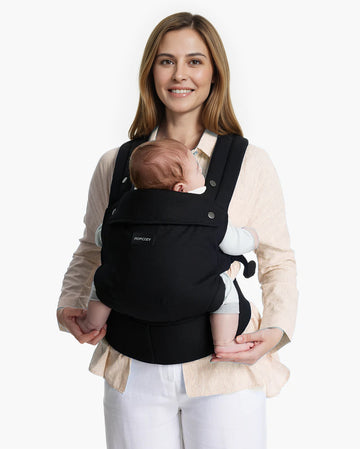
An ergonomic baby carrier is not defined by a single padded strap, lumbar panel, or seat shape. It is the fit outcome created when your baby is positioned securely and close to your body, the carrier adjusts to your body, and the load is distributed in a way you can maintain comfortably.
The simplest way to judge it is to check three things: baby fit, caregiver fit, and weight distribution—then re-check them as your baby grows. When you're ready to explore options, you can also browse ergonomic baby carriers after understanding the fit criteria. Remember that ergonomic fit can change. Your baby grows, caregivers change, routines change, and carrier settings may need to change with them.
Key Takeaways
- An ergonomic baby carrier is a fit outcome, not simply a product label or one particular feature.
- Baby fit includes an unobstructed airway, close positioning, appropriate support, suitable seat support, and secure but non-restrictive tension.
- Caregiver fit depends on waistband placement, shoulder-strap path, back or chest connections, and how closely the baby sits to the wearer.
- Weight distribution connects baby fit and caregiver fit. A small change in baby’s height or distance from the torso can change how the carrier feels.
- Baby growth can change seat support, panel relationship, center of gravity, and caregiver settings, so a previously successful setup may need adjustment.
- A carrier with many features is not automatically more ergonomic than a simpler carrier. What matters is whether those features help create and maintain an appropriate fit.
- The right carrier also depends on your routine. Newborn closeness, quick errands, longer everyday carrying, and shared caregiving can create different priorities.
- A quick Airway–Height–Position–Tension–Movement check can help you screen the fit after changing settings, switching wearers, or as your baby grows.
- If your current carrier already fits you and your baby well, you may not need to buy another one. Ergonomic babywearing is about the result, not purchasing the most feature-rich option.

What Does “Ergonomic” Mean in a Baby Carrier?
When you see the word “ergonomic” on a baby carrier, it is easy to assume it describes a particular component. Maybe it means a wide seat, padded shoulders, a lumbar area, a certain strap design, or a specific position for the baby.
Those features can matter, but none of them tells the whole story.
An ergonomic carrier is better understood as a system of fit. The baby needs to be positioned appropriately, the caregiver needs to be able to adjust the carrier to their body, and the baby's weight needs to be transferred through the carrier in a way that feels stable and manageable.
Ergonomic Is an Outcome, Not a Label
A useful way to think about an ergonomic baby carrier is to ask what happens when the carrier is actually being worn.
Does the baby remain close and supported?
Can the caregiver see and monitor the baby's face?
Can the waistband and straps be adjusted to the wearer's body?
Does the carrier remain stable during ordinary movement?
Does the baby’s position allow the wearer to maintain a balanced, natural posture?
These questions are more useful than simply counting ergonomic features.
A carrier can have padding, a structured seat, adjustable straps, and additional support areas but still require adjustment to work properly for a particular baby and wearer. Conversely, a simpler carrier can provide an appropriate fit when its design, settings, and the user's routine are well matched.
The word “ergonomic” therefore should not be treated as a guarantee that every configuration will work for every caregiver and baby.
The Three Parts of the Fit Outcome
The easiest framework is:
1. Baby positioning: Baby is close, visible, supported, and positioned according to the carrier's design and instructions.
2. Caregiver fit: The waistband, shoulder straps, and other contact points are adjusted for the person wearing the carrier.
3. Weight distribution: The carrier transfers the baby's load through its intended contact areas rather than leaving the wearer with an unnecessarily concentrated or unstable load.
These three elements interact.
If the baby moves lower, the wearer may feel a different load. If the waistband shifts, the baby's position can change. If the shoulder straps are adjusted differently, the carrier may sit closer or farther from the torso.
That is why an ergonomic fit is something you establish and maintain rather than something you simply identify on a product package.
How Should Your Baby Fit?
The baby side of ergonomic fit begins with positioning that is appropriate for the carrier design, the baby's stage, and the manufacturer's instructions.
The goal is not to force every baby into an identical position. Different carriers are designed differently, and stage-specific requirements can vary. Instead, look for observable signs that your baby is positioned appropriately.
Airway and Visibility
Your baby's face should remain visible and the nose and mouth should not be obstructed by fabric or pressed against the caregiver's body.
This is one of the first things to check whenever you put a baby in a carrier.
You should be able to see your baby's face without having to move a panel or fabric out of the way. The baby's position should also allow you to monitor them during normal activity.
If the airway is obstructed, stop the carry and correct the setup before continuing. If you cannot determine whether the position is appropriate, consult the carrier's instructions or dedicated babywearing safety guidance.
Momcozy's baby carrier safety guide provides additional guidance on safe carrier use and common mistakes.
Close, Supported Position
The baby should sit close enough to the caregiver that the carrier does not allow unnecessary space between baby and the torso.
A close position can also influence how the carrier feels. When the baby sits farther away from the caregiver, the wearer may notice more movement or a different sensation of load.
The baby's back should be supported according to the carrier's design. The carrier should not be so loose that the baby shifts excessively, but it should also not depend on excessive tightening to create security.
Think of the goal as stable support rather than maximum compression.
Seat Width and Leg Support
The seat is another important part of baby fit.
A carrier should provide appropriate support for the baby's lower body according to its design and the baby's stage. Seat width can affect how the baby's legs and hips relate to the carrier.
For this reason, an adjustable seat can be useful when it allows the caregiver to change the carrier as the baby grows. However, an adjustable feature does not mean that every setting is appropriate for every baby. The correct configuration should always be determined using the carrier's current instructions.
Momcozy's baby carrier positions by age guide provides additional stage-specific information and emphasizes that a baby's development and the specific carrier instructions should be considered when choosing a carrying position.

Tension Without Compression
The carrier should feel secure without requiring you to tighten every strap as much as possible.
Too much slack may allow unwanted movement. Excessive tension can make the setup feel restrictive and may alter the way the carrier contacts the baby and caregiver.
A useful check is whether the carrier remains stable when you move without feeling as though you need to constantly hold the baby in place yourself.
If you find yourself repeatedly tightening or readjusting the carrier during ordinary movement, stop and reconsider the setup.
Baby Fit Is More Than One Position
It can be tempting to reduce ergonomic babywearing to one concept, such as the M-position.
An M-position can be part of appropriate baby positioning, but it is not the complete definition of ergonomics.
Baby fit also includes:
- Airway visibility
- Appropriate height
- Close positioning
- Back support
- Seat support
- Leg positioning appropriate to the carrier
- Secure tension
- Correct stage and configuration
This broader view helps prevent one-feature thinking.
A carrier should not be judged solely by the appearance of the baby's legs, the amount of padding, or the presence of a particular seat shape.
How Should the Carrier Fit the Caregiver?
An ergonomic baby carrier has to work for the person wearing it as well as the baby.
A carrier can position a baby appropriately but still feel poorly matched to the caregiver if the waistband, shoulder straps, or back connection are not adjusted correctly.
This is especially important because caregivers do not all have the same torso length, shoulder width, waist placement, or preferred carrying position.
Waistband Position
The waistband is one of the major parts of the carrier's load path.
Its position can influence where the baby sits relative to the caregiver and how much load is transferred through the lower torso rather than concentrated around the shoulders.
The correct placement depends on the carrier design, so follow the manufacturer's instructions rather than assuming that one waistband position is universal.
After fastening the waistband, check whether it stays where it was positioned during normal movement.
If it continually slides, rotates, or loosens, the issue may be the adjustment rather than the carrier category itself.
Shoulder-Strap Path
Shoulder straps help connect the carrier to the wearer's upper body.
Their path and tension matter because they influence where contact occurs and how the carrier stays positioned.
If the straps feel concentrated around the neck, excessively loose, or difficult to keep in place, revisit the adjustment sequence.
Do not assume that pulling every strap tighter is the solution.
Instead, work through the carrier's intended adjustment points. Make one change at a time and observe what happens to the baby's position and your own load.
Back or Chest Connection
Many structured carriers use a back or chest connection to help position the shoulder straps.
This connection may need to be adjusted according to the wearer's torso and the carrier's design.
A setup that works for one caregiver may not work for another.
That is normal.
An ergonomic outcome is individualized because the wearer is part of the system.
Keep Baby Close to Your Center of Gravity
Caregiver fit is also connected to how close the baby sits to the torso.
When the baby moves farther away from the body, the carrier may feel different because the load is no longer as integrated with the caregiver's movement.
If the carrier suddenly feels heavier, check baby height and closeness before assuming that the carrier is unsuitable.
A small adjustment can sometimes change how the load is experienced.
Fit Must Be Rebuilt for Each Wearer
If two caregivers share one carrier, each person should establish their own fit.
Do not assume that the settings used by one caregiver will automatically work for another.
The second wearer may need to change:
- Waistband position
- Shoulder-strap length
- Back or chest connection
- Carrier height
- Baby's position
- Strap tension
The same carrier can therefore support different caregivers, provided it can be appropriately adjusted for each person and each configuration is used according to the manufacturer's instructions.
For detailed shared-wearer guidance, a dedicated shared-fit baby carrier guide can be used as the next resource once the basic ergonomic framework is understood.
How Should Weight Be Distributed?
Weight distribution is the bridge between baby fit and caregiver fit.
A baby may feel noticeably heavier in one configuration than another even though the baby's actual weight has not changed.
The reason is that the carrier changes how that weight reaches the caregiver.
Keep Baby Close to the Wearer's Center
A baby's distance from the caregiver can influence how the load feels.
A close-to-body position keeps the baby more integrated with the caregiver's torso. A position that allows the baby to move farther away can create a different sensation during walking, bending, or other movement.
That does not mean “closer is always better” in every possible configuration. It means closeness should be considered as part of the carrier's intended fit.
If your baby seems to be sitting lower or farther away than before, check the carrier settings before concluding that the carrier has suddenly become too heavy.
Share the Load Across Contact Areas
The carrier transfers weight through its intended contact points.
Depending on the carrier design, those may include:
- Waistband
- Shoulder straps
- Upper back
- Torso contact
- Structured support areas
The purpose is not to make the baby's weight disappear.
No carrier eliminates the fact that you are carrying your child.
Instead, an appropriate setup should create a stable load path that is manageable for the wearer.
Symmetry Matters
Look at the carrier from the front and side when possible.
Are the straps sitting evenly?
Is the waistband staying level?
Is the baby centered according to the carrier's intended configuration?
Is the carrier twisting?
Small asymmetries can become more noticeable over time, particularly during longer everyday carries.
A mirror or second person can be useful when you're learning a new baby carrier.
Slack and Tension Affect the Load Path
Slack can allow a baby or the carrier to move more than intended.
Excessive tightening can make the carrier feel restrictive and may change the location of contact.
The aim is a secure, stable configuration—not the tightest possible one.
If the carrier feels heavy, start with fit:
- Check baby height.
- Check closeness to the torso.
- Check waistband position.
- Check strap path.
- Check overall tension.
- Reassess the load after making adjustments.
Fit Before Feature Comparison
This is why feature lists should come after fit criteria.
A carrier with more padding may not feel better if it is poorly adjusted.
A carrier with fewer visible features may feel more manageable when its design and adjustments match the caregiver and baby.
Instead of asking, “Which carrier has the most support?” ask:
What kind of support do I need, where should that support contact my body, and can the carrier be adjusted to create that configuration?
That question leads to a more useful evaluation.
Which Features Can Support an Ergonomic Fit?
Features matter when they help create or maintain an appropriate fit.
The most useful way to evaluate a feature is to translate it into an outcome.
|
Feature |
Function |
What to Observe |
|
Adjustable seat |
Changes the baby-support configuration |
Baby remains appropriately supported |
|
Adjustable shoulder straps |
Changes wearer fit |
Straps remain secure without unnecessary pressure or slack |
|
Adjustable waistband |
Changes lower-torso fit |
Waistband stays stable |
|
Structured back connection |
Helps maintain carrier position |
Carrier remains centered and stable |
|
Accessible adjustment points |
Makes fit changes easier |
Caregiver can reproduce the intended setup |
Adjustable Seat Support
An adjustable seat can be useful because babies grow.
A setting that works at one stage may not be appropriate at another. The ability to change the carrier can make it easier to maintain appropriate support.
But adjustability only helps when the caregiver knows which setting to use.
Always follow the current carrier instructions rather than assuming that the smallest or widest configuration is automatically correct.
Adjustable Strap and Waist System
Adjustable straps and waistbands allow a carrier to be adapted to the wearer.
This is especially relevant for shared caregiving.
A carrier may need to be reset when another person puts it on. That does not necessarily indicate poor design. It reflects the fact that the caregiver's body is part of the fit.
Back Structure and Contact Area
Structured contact areas can help distribute the carrier's load through defined parts of the body.
However, structure alone does not determine the result.
A structured carrier still needs to be positioned correctly, adjusted correctly, and appropriate for the baby and caregiver.
Ease of Re-adjustment
A feature can be useful simply because it makes it easier to repeat a good setup.
This matters in everyday life.
A carrier may be removed and put back on several times during a day. A baby may grow. A different caregiver may take over. The family may move from a short errand to a longer walk.
The ability to make appropriate adjustments is therefore part of practical ergonomics.
How Does Fit Change as Your Baby Grows?
Baby growth is one of the biggest reasons an ergonomic fit should be treated as an ongoing process.
A setup that worked when your baby was smaller may feel different later.
Growth can change:
- Seat support
- Back-panel relationship
- Baby height
- Baby's distance from your torso
- Center of gravity
- Strap settings
- Waistband position
- Perceived load
Re-check Seat Support
As your baby grows, look at how their lower body relates to the carrier's seat.
Does the current configuration still provide the intended support?
If the answer is unclear, check the current product instructions.
Do not make changes based only on what looks right in a photograph. Carrier designs vary, and the manufacturer's instructions should determine the approved configurations.
Re-check Baby Height and Panel Fit
Growth can change the relationship between your baby's body and the carrier panel.
If the baby suddenly seems lower, farther away, or differently supported, re-check the setup.
A common mistake is to solve every change by tightening the shoulder straps.
Instead, reassess the entire system.
Re-check Caregiver Load
You may also notice that the carrier feels different as your baby gets bigger.
That does not necessarily mean the carrier has stopped working.
First check:
- Baby height
- Closeness
- Waistband
- Strap path
- Carrier symmetry
- Overall tension
If the carrier still feels difficult to use after adjustment, consult the manufacturer's instructions or a more specialized fit resource.
Growth Means Re-checking, Not Guessing
Even when a carrier is designed for a broad range of baby sizes, that does not mean one static configuration works throughout the entire range.
Growth is dynamic.
The carrier should be treated as an adjustable system rather than a piece of equipment you configure once and never revisit.
For age-specific positioning questions, use the baby carrier positions by age guide rather than recreating an age-by-age chart inside an ergonomic overview.
How to Choose an Ergonomic Carrier by Daily Routine
Once you understand ergonomic fit, the next question is often: Which carrier should I choose?
The answer depends partly on what you actually do with it.
Rather than looking for a universally “best” carrier, consider which carrier format and adjustment system can repeatedly create the fit you need during your normal routine.
Newborn Closeness
For newborn-stage carrying, the priority is appropriate support and close positioning.
The carrier must be specifically approved for your baby's stage and size, and the baby's airway and body position need to remain observable.
Do not assume that a carrier is suitable for a newborn simply because it looks small or soft.
Check the manufacturer's current minimum requirements.
Momcozy's current baby carrier collection presents different carrier options by intended stage and use, reinforcing the importance of matching the carrier to the baby's needs rather than treating every format as interchangeable.
Quick In-and-Out Errands
If you frequently put the carrier on for short errands, ease of adjustment can become important.
You may want a system that allows you to establish a secure configuration without an unnecessarily complicated setup.
But convenience should not replace fit.
Even for a five-minute carry, check airway, height, position, tension, and movement.
Longer Everyday Carry
For longer walks or extended everyday use, weight distribution may become more noticeable.
Consider whether:
- Baby stays close
- The waistband remains stable
- Shoulder straps remain positioned correctly
- The load feels reasonably distributed
- The carrier stays comfortable as you move
This is where a carrier that can be adjusted precisely may be useful.
Still, no feature guarantees that a carrier will feel the same for every wearer.
Shared Caregiving
Shared caregiving introduces another variable: the wearer changes.
If two adults regularly use the same carrier, prioritize a system that can be re-adjusted to each person's body.
Each caregiver should repeat the fit check rather than assuming that the previous person's settings are correct.
Routine-Based Decision Table
|
Routine |
Main Priority |
Questions to Ask |
|
Newborn closeness |
Stage-appropriate baby support |
Is this carrier approved for my baby's current size and stage? |
|
Short errands |
Repeatable setup |
Can I establish the intended fit efficiently? |
|
Longer everyday carry |
Stable load distribution |
Does the carrier remain stable as I move? |
|
Shared caregiving |
Adjustability |
Can each caregiver recreate their own fit? |
|
Growing baby |
Reconfiguration |
Can settings be adjusted as the baby grows? |
The important takeaway is that ergonomics and routine are connected.
A carrier can be well designed but still be the wrong choice if it cannot be adjusted or used comfortably within your everyday routine.
A 30-Second Ergonomic Fit Check
After putting on the carrier, use this five-part check.
1. Airway
Can you clearly see your baby's face?
Is the nose and mouth unobstructed?
If not, stop and correct the setup.
2. Height
Is the baby positioned at an appropriate height for the carrier and current stage?
You should be able to monitor the baby's face and position without unnecessary difficulty.
3. Position
Does the baby appear supported according to the carrier's intended configuration?
Check the relationship between the seat, back support, and baby.
4. Tension
Is the carrier secure without being excessively tight?
Look for unnecessary slack, slumping, or shifting.
5. Movement
Can you move normally without the carrier changing dramatically?
Take a few ordinary steps.
Notice whether the waistband shifts, the straps slide, or the baby moves farther away from your torso.
If any check fails, stop and adjust the carrier before continuing.
This five-part check is a quick screening routine, not a replacement for the product manual or a complete babywearing safety guide.
Repeat it when:
- Baby grows
- Another caregiver takes over
- You change the carrier configuration
- The carrier starts feeling heavier
- You notice increased movement
- You are using the carrier after a period of storage

Where Does a Structured Carrier Fit?
Structured carriers are one option within the larger baby carrier category.
They may be useful for routines that benefit from repeatable adjustments, defined support areas, and a more structured connection between baby and caregiver.
However, structure does not automatically mean more ergonomics.
A wrap, hip seat, or other carrier format may suit a different routine.
When Structured Adjustability Helps
A structured carrier may make sense if you value:
- Defined adjustment points
- Repeatable setup
- A structured seat
- Waistband support
- Adjustable shoulder straps
- A carrier that can be reset for different wearers
The important question is still whether the carrier can create an appropriate fit for your baby and your body.
When Another Format May Fit Better
Another format may be more suitable if your routine prioritizes different characteristics.
For example, a caregiver may prefer a softer wrap-style experience for a particular stage or routine. Another person may prefer a hip-seat design for a different carrying pattern.
There is no universal rule that says one carrier category is always more ergonomic.
The ergonomic outcome depends on the combination of carrier, baby, wearer, adjustment, and routine.
How PureHug BC001 Can Be Evaluated Against the Same Fit Criteria
Once the neutral criteria are established, a specific carrier can be evaluated using the same framework.
The current Momcozy PureHug product page identifies the PureHug as an ergonomic baby carrier and describes it as a lightweight carrier intended for everyday use, outings, and travel. The current page also states that the carrier is designed to grow with a child and provides adjustable sizing and a stated weight range.
The official Momcozy BC001 support instructions also provide specific setup guidance, including centering the body panel, securing the waistband, adjusting the shoulder straps, and checking the baby's position.
That information can be evaluated against the same three-part framework:
|
Criterion |
What to Evaluate on PureHug BC001 |
|
Baby fit |
Follow the current BC001 instructions for the approved configuration and check baby positioning during use. |
|
Caregiver fit |
Use the carrier's waistband and shoulder-strap adjustments to establish the intended wearer fit. |
|
Weight distribution |
Assess how the carrier sits on the torso and whether the load feels stable and manageable during movement. |
|
Growth |
Re-check the configuration as the baby grows rather than assuming one setting remains appropriate. |
|
Re-adjustment |
Follow the official setup instructions whenever the carrier is put on or settings change. |
The current official BC001 instructions specifically direct users to check that the baby's knees are positioned higher than the thighs in the carrier's intended M-shaped configuration and provide steps for fastening and adjusting the carrier.
That makes PureHug a useful example of how to apply an ergonomic framework, not a reason to skip the framework.
You can review the PureHug ergonomic baby carrier directly for current model specifications and product information.

A Verified Example, Not a Universal Winner
A carrier can satisfy many ergonomic criteria and still not be the right choice for every family.
Your baby's stage matters.
Your body matters.
Your routine matters.
Your ability to reproduce the intended fit matters.
The most useful approach is therefore to compare a product against the same questions you would ask of any other carrier.
If your current carrier already meets your needs, there may be no reason to replace it.
Frequently Asked Questions
Is an M-position enough to make a carrier ergonomic?
No. An M-position can be one part of appropriate baby positioning, but it does not define the entire ergonomic outcome. You also need to consider airway visibility, baby height, caregiver fit, carrier tension, closeness, and weight distribution. For detailed M-position instructions, follow your carrier's current manual and dedicated safety guidance.
Does more padding mean a carrier is more ergonomic?
Not necessarily. Padding can affect how a carrier feels against the body, but padding alone does not determine whether the baby is positioned appropriately or whether the carrier distributes the load well for a particular wearer. Adjustability, contact area, carrier design, and correct setup all matter.
Can two caregivers use the same ergonomic carrier?
Potentially. A carrier can be shared when it can be appropriately adjusted for each wearer. Each caregiver should reset the waistband, straps, and other relevant settings instead of simply using the previous caregiver's configuration.
How do I know if my baby has outgrown the current settings?
Look for changes in seat support, panel relationship, baby height, closeness to your torso, or how the carrier feels on your body. Then check the current product manual for stage and weight requirements. Do not assume that a broad age range means the carrier should remain on one static setting.
Should a baby carrier feel weightless if it is ergonomic?
No. Carrying a baby means carrying the baby's weight. An ergonomic setup does not eliminate that weight. Instead, the carrier should provide a stable configuration in which the load is transferred through its intended contact areas in a way that is manageable for the wearer.
What if my shoulders or back still hurt after I adjust the carrier?
Start by re-checking the entire setup rather than treating “ergonomic” as a promise that discomfort cannot occur. Review baby height, closeness, waistband placement, strap path, and tension. If persistent pain, numbness, or weakness continues, stop treating the issue as a simple product-fit question and seek appropriate professional guidance.
Is a structured carrier always more ergonomic than a wrap or hip seat?
No. Ergonomics depends on the actual fit and use rather than the category name alone. A structured carrier may be useful for one routine, while another format may better suit a different caregiver, baby stage, or carrying pattern.
Can a carrier still be ergonomic if it has fewer features?
Yes. Feature count is not the same as ergonomic performance. What matters is whether the carrier's design and adjustments allow you to establish an appropriate baby position, caregiver fit, and manageable load distribution.
Can an ergonomic carrier become uncomfortable over time?
Yes. The carrier itself may not have changed, but your baby, your body, your routine, or the carrier's settings may have changed. Baby growth can alter the relationship between the seat, panel, wearer, and center of gravity. Re-check the setup before deciding that the carrier no longer works.
Does an ergonomic carrier automatically prevent back discomfort?
No. An ergonomic design does not guarantee that a particular wearer will experience no discomfort. Body differences, baby weight, carrying duration, carrier adjustment, posture, and individual circumstances can all affect how a carrier feels. If discomfort persists, review the fit and seek appropriate guidance.
Conclusion
So, what is an ergonomic baby carrier? It is not simply a carrier with extra padding, a lumbar panel, a wide seat, or an “ergonomic” label. It is the overall result of baby fit, caregiver fit, and weight distribution working together.
Start with your baby. Check that the airway remains visible and unobstructed, the baby is appropriately positioned and supported, and the carrier is configured according to the product instructions.
Then check yourself. Look at the waistband, shoulder straps, back connection, closeness, and overall stability. Finally, consider how the baby's weight is being transferred through the carrier and whether the load feels reasonably distributed during movement.
Before every new configuration, use the Airway–Height–Position–Tension–Movement check as a quick screen, while relying on the current product instructions and dedicated safety resources for detailed guidance.
If your current carrier already creates a good fit for you and your baby, you may not need a new purchase. If you are shopping, use the same criteria to compare ergonomic baby carriers based on your baby's stage, your body, and the way you actually carry every day.








