


WRITTEN BY

Dr. Andrea Braden, OB/GYN
Dr. Andrea Braden is a board-certified OB/GYN, International Board Certified Lactation Consultant (IBCLC), and nationally recognized expert in breastfeeding medicine with over 14 years of experience supporting moms through pregnancy, postpartum, and infant feeding. She has served on the American College of Obstetricians and Gynecologists (ACOG) Breastfeeding Expert Working Group since 2018, guiding clinical best practices for over 60,000 providers.
She is also the founder and CEO of Lybbie, a health tech startup transforming breastfeeding support through wearable innovation. As a passionate educator and advisor to several leading companies in infant nutrition and women’s health, she bridges the gap between clinical science and everyday care. A mother of five herself, she’s committed to empowering parents with the tools and knowledge they need to thrive.
I have spent my career as an OB/GYN telling patients that strange jolts and twinges in pregnancy are usually nothing to worry about. Then I got pregnant myself, and I was surprised how little that knowledge helped. Every mystery pain in my first pregnancy sent my mind to the worst case, despite years of training telling me otherwise. It took several pregnancies before I truly believed my body could feel strange and sharp without something being wrong.
If that sounds familiar, you are far from alone. Sharp belly pain while pregnant is one of the most common reasons patients call their OB. Your body is changing faster than at almost any other point in your life. It is not always easy to tell normal changes from a real warning sign. My first instinct is always to rule out anything serious first. Most of the time, the answer turns out to be completely normal. This guide walks through both sides, drawing on what I know as a doctor and what I have felt myself.
Is it normal to have sharp stabbing pains in your stomach while pregnant?
In most cases, yes. Pregnancy involves a huge amount of physical change in a short amount of time. Your uterus is stretching, ligaments are loosening, organs are shifting to make room, and your balance is shifting too. All of that can feel alarming even when nothing is wrong.
Harmless stomach pains in pregnancy
Harmless stomach pain tends to be brief, with a clear trigger like standing up fast or rolling over, and it gets better with rest or a position change. It does not come with bleeding, fever, or ongoing contractions, though it is still worth mentioning at your next visit.
What are the most common causes of abdominal pain during pregnancy?
Sharp lower abdominal pain during pregnancy, sometimes described as lower sharp abdominal pain during pregnancy, has several common causes. Here are the ones I see most often.
Round ligament pain
As your uterus grows, the ligaments holding it in place stretch to keep up. Round ligament pain feels like a quick, sharp poke in the lower belly or groin, usually on one side. It is often set off by a sudden move. This is one of the most common types of sharp lower abdominal pain during pregnancy, especially in the second and early third trimester.
Pelvic girdle pain
Pelvic girdle pain is pain around your pelvis, hips, or lower back. It happens because the joints there loosen up as your body gets ready for delivery. It can feel like a deep ache or a sharp catch, especially with walking or stairs. It affects most women by the third trimester.
Braxton Hicks contractions
These practice contractions feel like a tightening across the belly that comes and goes with no set pattern. They ease up with water, rest, or a position change, unlike true labor.
Gas and constipation
Pregnancy slows down digestion, so gas and constipation are common causes of sharp, crampy pain. It can feel surprisingly bad but usually gets better with diet changes, movement, and fluids.
Urinary tract infection
A UTI can cause sharp lower belly pain along with burning when you pee, urgency, or pressure. Left untreated, it can spread to the kidneys and raise the risk of early labor. Mention this one to your provider. It is found with a simple urine test and treated with a pregnancy-safe antibiotic.
Umbilical hernia
This one rarely makes it onto pregnancy pain lists, but it deserves a spot. As the belly muscles stretch, some women develop a small hernia at the belly button, where tissue pushes through a weak spot in the muscle wall. It can cause sharp, localized pain, sometimes with a visible bulge, especially with coughing or standing for long periods. I had this myself in three of my pregnancies. It is easy to miss if a provider is not specifically looking for it. If you notice a tender bulge at your belly button, point it out specifically to help your provider get to the answer faster.
Stomach pains that may be caused by something serious
Ruling these out comes first. Preterm labor causes regular, rhythmic cramping, sometimes with lower back pain, pressure, or period-like cramps, before 37 weeks. Placental abruption is when the placenta starts to separate from the uterus. It often causes sudden, severe, constant pain with a hard, tight belly. Bleeding may or may not be visible, since it can be hidden inside the uterus. Preeclampsia is a blood pressure condition that can cause sharp pain under the right ribs or in the pit of the stomach, along with headache, vision changes, or swelling. Appendicitis is also possible in pregnancy, often showing up as pain that moves toward the right side and gets worse over time.
When should I get medical help for stomach pain in pregnancy?
I think of this less as a strict rulebook and more as a conversation between you and your body, and then between you and your provider. Reach out if your pain is severe, constant, or getting worse. Also reach out if it comes with bleeding or discharge, regular contractions before 37 weeks, fever, or your baby moving less. You are never bothering your care team by calling. In the hospital, I often tell patients who come in unsure, I'm glad you came in, because now you know this type of pain is not labor pain. Getting checked is not overreacting. It is gathering information that lets you decide what feels right.
How to relieve belly tightness during pregnancy?
Everyday ways to ease tightness
Changing positions slowly, drinking enough water, and gentle movement like a short walk or hip tilts all help ease everyday tightness and cramping.
Using a pregnancy ball and pillow support
Placing a pillow the right way at night helps too, supporting your belly and lower back so your muscles are not doing all the work while you sleep. Many patients find a pregnancy ball used for gentle bouncing or hip circles, like the Momcozy BirthEase Pregnancy Ball Set, eases pelvic tightness, and the set's stability base and guided Momcozy app programs make it easier to use safely instead of guessing at exercises alone.
Why belly bands help
I recommend belly bands to almost every patient dealing with aches and strain in pregnancy, and I usually explain why. As your body changes to grow a pregnancy, it releases a hormone called relaxin that widens the bones of your pelvis. That is exactly what you need for a vaginal birth. But it also means you lose support right when you need it most. This is even more true in later pregnancies, since those ligaments have already been stretched once. Just like skin loses firmness over time, so do the ligaments supporting pregnancy, and that is normal. It is okay to need extra support on the outside when your body's own support has worn thin. It is the same idea behind the belts warehouse workers wear while lifting.
Finding the right level of support for your body
Not all belly bands are the same. For most expecting moms, something lightweight is enough. The Momcozy BumpEase Ergonest Maternity Belly Band offers gentle, adjustable support that eases the pull on the round ligaments without adding bulk. It comes in colors that do not look like medical gear, no doctor's note or physical therapy visit required. Support only helps if you actually wear it. I say that as someone who barely wore the industrial belt my own physical therapist prescribed, because it was rough on my skin and impossible to hide under clothes.
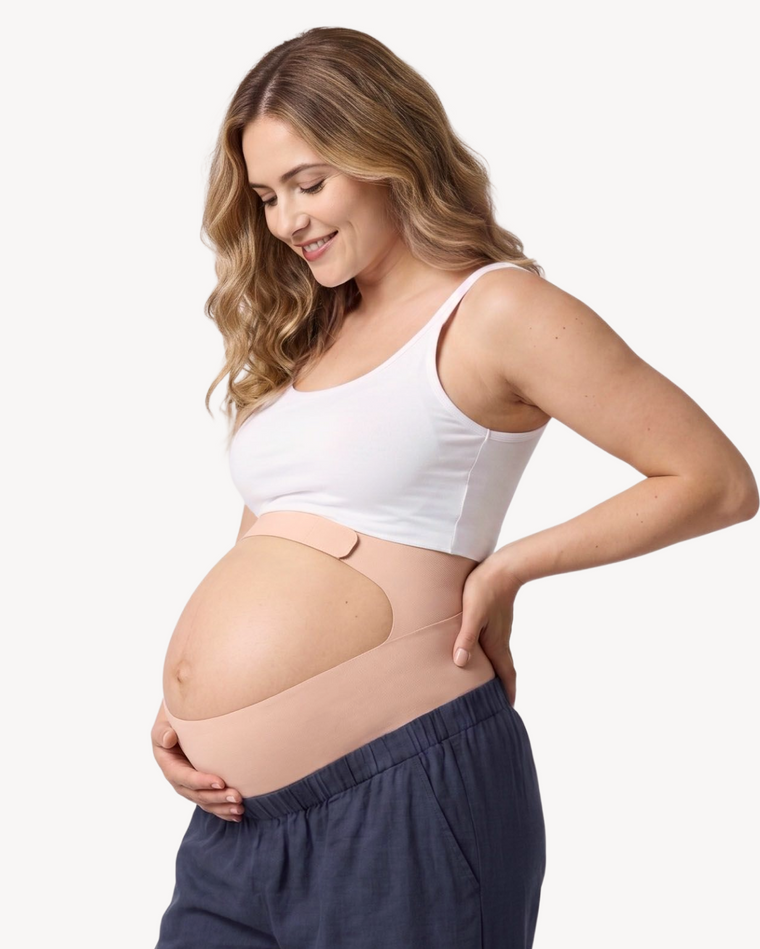
For moms carrying more weight in front, whether from a larger-than-average baby or from carrying twins or triplets, a band that only supports the pelvis often is not enough. Past a certain point, the lower back starts taking on the strain instead, and pelvic-only support will not fix that. This is where a Momcozy Go As You Grow™ Maternity Belly Band can make more sense. It lifts and cradles a heavier bump from underneath and it supports your back, so the strain does not just shift from one spot to another. That matters clinically for anyone dealing with real low back pain on top of pelvic discomfort. It also carries some of the weight across your shoulders through its racerback design, instead of leaving it all on your low back, and the straps adjust as your bump keeps growing. I personally like that the fabric breathes, since a band you find uncomfortable is a band you will stop wearing, no matter how well it is engineered.

If you’re not sure which band is right for you, browse the full range in Momcozy's pregnancy belly bands collection to find the support that fits your body and stage of pregnancy.
At the end of the day, I want patients to give themselves permission to use whatever support helps them feel better, and to find something they will actually wear.
How can you tell if belly pain is a sign of labor?
True labor contractions follow a pattern. They come regularly, get closer together over time, and grow stronger. They do not ease with rest or a position change. You often feel a tightening that starts in the back and wraps to the front. If you notice this before 37 weeks, or at full term with contractions getting closer and stronger, contact your provider.
Contractions can also come and go throughout pregnancy without going anywhere. Since it is truly difficult to know what real labor pain feels like until you have felt it, I always recommend getting checked out if you’re unsure.
Does round ligament pain last more than a few minutes?
Typically, no. Round ligament pain is usually brief, lasting seconds up to a couple of minutes. It fades once you stop the movement that triggered it. If it lasts much longer or becomes constant, mention it to your provider.
Is upper stomach pain in pregnancy a sign of something serious?
Not always, but it is something I pay closer attention to in the second half of pregnancy. Upper belly pain, under the right ribs or in the pit of the stomach, can be a sign of preeclampsia. It is usually checked alongside your blood pressure and other symptoms like headache, vision changes, or swelling. Heartburn and a growing uterus crowding your stomach can also cause upper belly discomfort. This is far more common and much less concerning. Whether other symptoms show up alongside the pain is usually what tells the two apart.
Conclusion
Sharp belly pain while pregnant can be unsettling in the moment. But in most cases, it has a simple explanation rooted in the normal changes your body goes through when growing a human. Knowing the difference between round ligament pain, pelvic girdle pain, Braxton Hicks, an umbilical hernia, and the rarer but more serious causes gives you the information to feel confident instead of anxious. You do not need to diagnose yourself. You should never feel like you are overreacting by reaching out to your provider. I say this as a doctor and as someone who needed several pregnancies of my own to fully believe it. Pair that knowledge with a little support, whether that is a belly band, a pregnancy ball, or a well-placed pillow at night, and a changing body becomes a lot easier to live with.








