


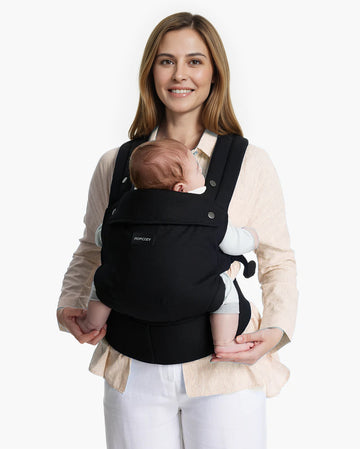
A baby carrier that works well for one caregiver may feel completely different to another person. The difference is not necessarily the carrier itself. Fit is a relationship between the carrier's geometry, the wearer's torso length, waist placement, shoulder path, the baby's position, and how everything behaves during movement. For a broader safety reference before making adjustments, review the baby carrier safety checklist.
This matters most when one carrier is shared between caregivers. A parent may have one strap setting that feels stable, while a partner, grandparent, or another caregiver finds that the waistband shifts, the shoulder straps migrate, or the load feels uneven. The natural temptation is to remember the first person's settings and hand over the carrier exactly as it was left.
That approach can save a few seconds, but it does not prove that the carrier fits the next wearer. For a shared caregiver baby carrier fit, the better approach is to hand over the carrier—not the settings. Each caregiver should reset the carrier for their own body, place the baby according to the current instructions, and verify the fit before walking away from the starting point.
Key Takeaways
- A baby carrier fit for different body types depends on waistband stability, torso length, shoulder path, baby position, and movement—not copied strap lengths.
- Each caregiver should independently reset the carrier because the same settings can sit differently on different bodies.
- Body type is a useful diagnostic variable, not a verdict about whether a particular carrier will work.
- A thick lumbar panel or padded area does not establish support by itself; the entire fit system needs to work together.
- Always check the baby's current developmental and safety requirements before adjusting the carrier for a new wearer.
- Start with the observed fit signal, test one relevant adjustment, and then recheck.
- A waistband that rolls, shoulder migration, an off-center baby, or pressure that appears after walking can all be reasons to reassess the setup.
- A 20–30-minute recheck can reveal fit drift that is not obvious during a static mirror check. It is an observation window, not a safety threshold or comfort guarantee.
- Saved strap marks can be useful starting references, but they are not proof that the carrier fits the next caregiver.
- If safe positioning or a stable, tolerable fit cannot be reproduced, stop rather than continuing to tighten or modify the carrier.
- The next decision may be to refit the existing carrier, consider another option, buy later, use an alternative format, follow the manual, or seek qualified help.

Why the Same Carrier Feels Different on Different Bodies
A carrier does not interact with a person based on height alone.
Two caregivers can be the same height and still have different torso lengths, waist shapes, shoulder widths, or preferred waistband positions. Conversely, caregivers with noticeably different heights may find that the same carrier can work for both when each person independently adjusts it.
That is why labels such as petite, tall, broad-shouldered, or short-torso should be treated as starting points for observation rather than automatic product verdicts.
The useful question is not simply, "What body type am I?"
The more useful question is:
What is the carrier doing on my body?
Is the waistband stable? Are the shoulder straps staying where they should? Is the baby centered? Does the carrier remain comfortable when you walk? Does the fit change after sitting and standing? Can you reach the adjustment points without struggling?
Those observations are more useful than assuming that a particular body category must require a particular carrier.
What a Measurement Can Predict—and What Only a Fit Check Can Show
Measurements can help you anticipate potential issues, but they cannot tell you everything about real-world fit.
Torso length can affect how the carrier's upper structure relates to the wearer's shoulders and waist. Waist shape can affect how a waistband sits and whether it tends to roll or migrate. Shoulder width can influence how the straps feel and whether they remain in their intended path.
However, a measurement taken before buying cannot fully reproduce what happens when a baby is inside the carrier and the caregiver starts walking. Movement changes the relationship between the wearer, carrier, and baby.
Clothing changes it too. A thin shirt and a bulky layer can produce different contact points. A caregiver who is standing still may have a different experience from one who is walking through a grocery store, lifting a diaper bag, or repeatedly sitting and standing.
For that reason, measurements should be treated as clues. A real fit check is the verification step. This approach is especially important for shared caregivers. One person's successful setup should not become another person's assumed setup.
Recheck Baby and Carrier Fit Without Rewriting the Safety Guide
Adult comfort matters, but it cannot override the baby's current fit and the manufacturer's instructions.
When a new caregiver puts on the same carrier, the first question should not be, "How can I make this feel better on my back?"
It should be:
Is the baby still positioned appropriately within the carrier's current approved configuration?
The exact requirements depend on the carrier and the baby's developmental stage, so the current product instructions should remain the authority for detailed positioning.
As a general verification point, the caregiver should be able to check that the baby's face remains visible, the airway is not obstructed, the baby is appropriately supported, and the carrier is being used according to the manufacturer's guidance.
If the baby appears lower simply because a caregiver loosened the carrier to reduce pressure, that is not a successful adjustment. The adult may feel better temporarily, but the change could create a different fit problem.
This is why baby fit and caregiver fit need to be checked together.
Momcozy's baby carrier safety checklist can be used for the broader safety requirements, while its baby carrier positions by age guide is the appropriate destination when age, developmental stage, or carrying position becomes the main question.
This article does not replace those resources. Its purpose is narrower: helping different caregivers repeat the fit process for the same carrier.
Safety May Constrain the Adjustment That Feels Best to the Adult
Sometimes the adjustment that feels most comfortable to an adult is not the adjustment that should be used.
For example, a caregiver might loosen the carrier because the waistband feels restrictive. If that change causes the baby to sit lower or changes the intended positioning, the solution is not to keep loosening it. Instead, return to the carrier's instructions and reassess the setup. The baby's positioning is the hard boundary. Adult comfort should be optimized within that boundary.
This is also why a carrier should not be modified simply because one wearer cannot reproduce another person's settings. The correct response is to reset the carrier and determine whether the approved configuration can accommodate the new wearer.
Why One Carrier Can Feel Different on a Different Wearer
Support does not come from one component alone.
A carrier may have a structured waistband, padded shoulder straps, a cross or back connection, a supportive panel, or a lumbar feature. Those components can contribute to how the carrier feels, but their effect depends on how the entire system interacts with the caregiver and baby.
Think of the carrier as a connected load path.
The waistband provides one point of contact. The shoulder straps provide another. The carrier's back or cross structure connects those areas. The baby occupies space between the wearer and the carrier, and the baby's position changes how the load is experienced.
If one part shifts, another part may compensate. That is why adding more padding is not automatically the answer to a fit problem.
More Structure Can Help One Wearer and Feel Different to Another
A more structured carrier may feel stable to one person because the carrier maintains a predictable shape around their torso.
Another person may experience that same structure differently.
For example, a shorter-torso wearer may notice the relationship between the upper carrier and shoulders more strongly. Someone with a different waist shape may notice the waistband more. Another caregiver may have difficulty reaching an adjustment point even though the carrier technically has a wide adjustment range.
These differences do not automatically make one caregiver compatible and another incompatible. They simply identify areas that need to be checked. The same principle applies to lumbar features.
A built-in lumbar component may be part of the carrier's design, but it should not be treated as proof that the carrier will relieve pain, correct posture, or produce a particular medical outcome.
The useful test is still the fit:
Is the carrier stable? Is the baby appropriately positioned? Is the load reasonably distributed? Do the straps stay in place? Does the setup remain usable during movement?
That is a more reliable decision framework than choosing a feature and assuming the outcome.
For broader comparisons of carrier support features, readers can be routed to Momcozy's baby carrier back-support selection guide rather than turning this article into another product comparison.
Body or Fit Signal → First Adjustment to Test
The most useful way to troubleshoot a shared carrier is to start with the signal you actually observe.
A signal does not prove a cause.
A rolling waistband, for example, can have more than one possible explanation. So can shoulder pressure or a baby who appears to sit too low.
Use the following matrix as a starting point for controlled testing rather than as a universal prescription.
|
Observed signal |
First adjustment to test |
What not to infer |
Route-out condition |
|
Waistband rolls |
Reset waistband height and stability before changing shoulder straps. Check clothing and the carrier manual. |
It does not automatically mean the caregiver's body size is the problem or that more padding is needed. |
If it cannot remain stable within the approved setup, follow the manual or consider another format. |
|
One shoulder feels loaded |
Check baby centering, strap path, and left/right tension. Avoid simply tightening the painful side. |
It does not prove that more tension is better. |
If reach or mobility prevents balanced adjustment, seek fit help or consider an alternative. |
|
Baby drifts lower |
Re-seat the baby and remove slack according to the manual. Verify the panel or seat and face visibility. |
It does not automatically mean the carrier is too small or that the baby should simply be pulled tighter. |
If appropriate positioning cannot be reproduced, stop and follow the manual or safety guidance. |
|
Abdominal pressure |
Check waistband contact, height, clothing, duration, and postpartum recovery context. |
It is not a diagnosis and does not prove that the carrier supports recovery. |
Stop for wound discomfort or persistent symptoms and seek appropriate professional guidance. |
|
Fit becomes uneven after walking |
Repeat the reset while standing and inspect movement and strap migration. |
It does not prove that the original static mirror check was sufficient. |
If drift repeats despite correct setup, consider product non-fit or qualified fit review. |
|
Baby feels comfortable but adult leans back |
Check closeness, baby height, waistband placement, and overall load path before changing positions. |
Baby comfort does not automatically confirm adult fit. |
If posture changes or discomfort persists, stop and reassess rather than forcing longer wear. |
The important pattern is consistent: Observe → adjust one variable → move → recheck.
Do not turn one symptom into a product verdict.
Shared Caregiver Reset: Do Not Hand Over Strap Settings
When several people share a carrier, the simplest mistake is also one of the easiest to make: leaving the carrier exactly as the previous caregiver used it.
Instead, establish a repeatable reset. The exact sequence may vary by carrier, so the current manual should always take priority. But the decision process can be organized from the carrier's base upward.
Step 1: Check the Manual and Carrier Condition
Before using the carrier, confirm the baby's current size and developmental guidance and inspect the carrier.
Look at the buckles, webbing, fabric, straps, and adjustment points.
If something looks damaged or behaves differently from normal, do not attempt to solve the issue through fit adjustments.
Step 2: Establish the Waistband
Start with the base of the carrier.
Place and secure the waistband according to the manufacturer's instructions. Check that it is stable and that it is not obviously rolling, shifting, or creating an inappropriate pressure point.
Do not immediately adjust the shoulder straps to compensate for an unstable base.
Step 3: Position the Baby
Place the baby according to the current instructions for the carrier and the baby's stage.
Check the baby's overall position before focusing on your own comfort.
Step 4: Adjust Each Shoulder Strap
Treat the left and right sides as separate adjustment points.
The goal is not necessarily identical strap lengths.
The goal is an appropriate, balanced fit for the current wearer and baby.
One caregiver's strap length may be different from another caregiver's while both setups remain correct.
Step 5: Check the Cross or Back Connection
If the carrier uses a cross or back connection, secure and adjust it according to the instructions.
Make sure the webbing remains flat and the adjustment points are appropriately positioned.
Do not invent a different configuration simply because another caregiver uses one.
Step 6: Use a Mirror or Photo
A mirror can reveal things that are difficult to feel.
A front view can help identify obvious asymmetry. A side view can provide another perspective on the carrier's relationship to the baby's position and the caregiver's body.
A photo can also be useful when the caregiver is learning how the carrier should look when correctly adjusted.
Step 7: Walk and Recheck
Do not stop after the static check.
Take a short walk.
Notice what moves.
Then stop and check the carrier again.
If one adjustment makes the fit worse, return to the last stable setup rather than tightening every strap.
This sequence makes how to adjust one baby carrier for different caregivers much more practical because it gives every wearer the same decision process without requiring identical settings.
Shared Caregivers Need a Reset, Not a Handoff of Numbers
Imagine two caregivers sharing one carrier during an outing.
The first caregiver finishes carrying the baby and passes the carrier to the second caregiver. The first caregiver says, "Just leave the straps here." That sounds efficient. But the second caregiver's torso, shoulders, waist, and preferred carrying position may be different.
Instead, the handoff should be:
"Here is the carrier. Reset it for yourself."
That does not mean the first caregiver's settings are useless. They can serve as a starting reference. But they should not be treated as proof that the carrier fits the second wearer.
Create a Simple Handoff Reference
For households that regularly share one carrier, a simple handoff card or note can reduce confusion.
It might record:
- baby's current stage;
- the carrier model;
- each caregiver's general starting point;
- waistband reference;
- seat or panel setting where applicable;
- strap routing;
- and any recurring fit signal to watch.
However, the card should also say:
"Starting reference only—complete your own fit check."
That distinction is important.
A saved strap mark can speed up the process, but it cannot account for clothing, posture, baby position, or a caregiver's changing body.
Before Switching
The outgoing caregiver can:
- tell the next caregiver the baby's current stage;
- leave the carrier in an inspectable state;
- point out any fit issue they observed;
- and avoid tightening everything specifically for the next person.
The outgoing caregiver should not diagnose the problem for the incoming wearer.
For example, instead of saying, "You need to tighten the left strap," it is more useful to say, "The carrier felt uneven after walking."
That gives the incoming caregiver information without prescribing a setting that may not work for them.
After Switching
The incoming caregiver should:
- Confirm the baby still meets the current product guidance.
- Adjust the waistband for their own body.
- Confirm the seat or panel configuration.
- Adjust the shoulder straps.
- Check the baby's position.
- Check face visibility and airway.
- Walk briefly.
- Recheck the fit.
That is the shared-caregiver reset.
It may take slightly longer than simply handing over the carrier, but it creates a much more reproducible process.
Treat Body Type as a Fit Signal, Not a Carrier Verdict
Body type can help explain why two caregivers experience the same carrier differently, but it should not become a shortcut for deciding who can or cannot use a particular carrier.
A short-torso wearer may notice shoulder migration.
A caregiver with a different waist shape may notice that the waistband behaves differently.
A postpartum wearer may be more sensitive to abdominal contact.
A broad-shouldered caregiver may notice the shoulder path or cross connection differently.
These are observations—not fixed outcomes.
For Petite or Short-Torso Wearers
If the main issue is shoulder migration or the relationship between the upper carrier and the shoulders, start by checking the waistband, torso-to-panel relationship, strap path, and baby's height.
Do not simply tighten the shoulder straps harder.
If the reader needs a detailed petite or no-slip adjustment method, route them to Momcozy's petite no-slip fit guide, because that existing resource owns the deeper petite-specific solution.

For Postpartum Wearers
Abdominal pressure should be treated as a fit signal rather than a diagnosis.
Check:
- where the waistband sits;
- how much direct pressure is present;
- clothing layers;
- how long the carrier has been worn;
- and whether the wearer is still experiencing postpartum sensitivity.
A carrier should not be presented as a solution for postpartum recovery.
If there is wound discomfort, persistent pain, worsening symptoms, numbness, weakness, or another concern affecting safe care, stop and seek appropriate professional guidance.
The key point is that the same carrier can feel different at different stages of the caregiver's own recovery.
Why a 20–30 Minute Recheck Matters
A carrier can feel fine when first put on and become noticeably different after walking.
That is why a static mirror check should not be the only observation.
The 20–30-minute period is useful as an observation window, not as a safety threshold or guarantee that the carrier will remain comfortable for every person.
A practical recheck can happen at several points.
At Setup
Check:
- waistband stability;
- baby's position;
- face visibility;
- shoulder strap path;
- centering;
- and obvious pressure.
After Several Minutes of Movement
Walk normally.
Notice whether:
- the carrier migrates;
- the waistband shifts;
- one shoulder begins carrying more load;
- the baby settles differently;
- or the wearer changes posture.
Around 10 Minutes
Pause and identify whether anything has changed.
Do not automatically tighten the carrier.
First identify what moved.
Around 20–30 Minutes
Perform another complete check.
This is where some fit differences become easier to recognize.
A wearer may discover that a carrier felt balanced while standing but becomes uneven after walking. Another may notice pressure that did not appear during the first few minutes.
That information is useful because it identifies fit drift.
The next step is not necessarily to replace the carrier.
Return to the reset process.
Ask:
- Was the waistband stable?
- Did the baby remain appropriately positioned?
- Did one strap migrate?
- Did the carrier shift because of movement?
- Did clothing change the contact point?
- Was the original adjustment appropriate for this wearer?
If the same issue continues after a controlled reset, the carrier may simply not be a good fit for that caregiver's particular use.
Do not push through increasing discomfort just to reach a time target.
The 20–30-minute window is a way to observe the carrier in real use—not a requirement to continue carrying when something feels wrong.
When the Same Carrier May Not Be the Right Option for This Wearer
The purpose of a reset is not to prove that every caregiver can use the same carrier.
Sometimes the correct conclusion is that the current setup does not meet the caregiver's needs.
There are several possible outcomes.
|
Outcome |
Use when |
|
Refit Existing Carrier |
The carrier remains within current guidance and a stable, appropriate fit can be achieved after resetting it. |
|
Consider/Buy |
Current official product evidence matches the baby and each intended caregiver can reproduce the fit during movement. |
|
Buy Later |
The baby is not yet within confirmed guidance, the wearer is still recovering, or a hands-on fit trial is not currently available. |
|
Use Alternative Format |
The approved geometry, reach, support, or adjustment range does not match the caregiver's real task. |
|
Follow Manual |
The question concerns an exact position, mode, limit, cleaning method, or accessory. |
|
Seek Professional Help |
Persistent or worsening symptoms occur, or safe fit cannot be achieved. |
This is where a product such as the PureHug Ergonomic Baby Carrier can be considered as a criteria-based example, rather than as the automatic answer.
The current US product page describes features including three sizes, padded adjustable shoulder and waist straps, an X-shaped back design, and built-in EVA lumbar support. However, the supplied product evidence also identifies unresolved specification conflicts, including different weight figures and unclear carry-mode details. Those details should be confirmed against the current US manual and product page before publication or purchase-specific claims are made.
That means this article should not claim that PureHug fits every body type, should not declare a universal best carrier, and should not infer an unconfirmed carrying mode.
If a reader is ready to compare current Momcozy options after completing the fit framework, they can browse the Momcozy baby carrier collection.
The collection should be the next step—not the starting answer.

How to Route to the Right Existing Momcozy Resource
A useful shared-caregiver article should also know when to stop.
If the question becomes a complete safety question, route to the baby carrier safety guide.
If the question becomes primarily about developmental stage or carrying position, route to baby carrier positions by age.
If the problem is specifically a petite or short-torso no-slip issue, route to the petite fit guide.
If the reader wants to compare carrier categories, route to the baby carrier types comparison.
If persistent back discomfort or symptom-related questions become the focus, route to how to relieve back pain from carrying your baby rather than turning this article into a treatment guide.

The stopping rule is simple:
Do not keep tightening the carrier or keep walking just to prove that the setup works.
If safe positioning cannot be verified, remove the baby safely and reassess.
If the carrier itself appears damaged, follow the manufacturer's instructions.
If repeated attempts do not produce a stable, tolerable setup, consider another format or seek qualified babywearing assistance.
If the caregiver experiences persistent or worsening pain, numbness, weakness, wound discomfort, or symptoms that interfere with safe care, professional assessment is more appropriate than another carrier adjustment.
Frequently Asked Questions
Can two caregivers share one baby carrier?
Yes, a carrier may be shared when its current instructions and size requirements are appropriate for the baby and each caregiver can independently reproduce an appropriate fit.
Shared use does not mean shared strap settings.
Each caregiver should reset the waistband, straps, baby position, and other applicable adjustments for their own body.
Should I copy the other caregiver's strap lengths?
Only as a starting reference.
A strap length that works for one person does not prove that it will work for another.
Torso length, shoulder width, waist placement, clothing, baby position, and movement can all change the result.
What if the waistband rolls only after I sit down?
Treat the rolling as a fit signal.
Reset the carrier while standing, check the approved waistband placement, consider whether clothing is affecting the fit, and then test normal sit-to-stand movement.
If the waistband repeatedly rolls despite correct setup, reassess whether the carrier is appropriate for that wearer.
Can I add a lumbar accessory to make the carrier more comfortable?
Only if the manufacturer explicitly approves the accessory.
Do not assume that adding a third-party pad or support will improve the carrier.
An added component can alter the way the carrier sits, changes the adjustment points, or interacts with buckles and straps.
What if my baby seems comfortable but I am not?
Check the baby's safety and positioning first.
Then reset the caregiver's fit.
Baby comfort does not automatically confirm that the adult fit is appropriate, just as adult comfort does not override the baby's positioning requirements.
If you cannot achieve a stable, tolerable configuration, consider an alternative or seek qualified help.
What if I cannot try a carrier before buying it?
Use the current product page and manual as the primary sources for specifications.
Check the return or trial policy where available.
Also identify your own fit variables before buying, including torso length, waist placement, shoulder path, and the type of carrying you expect to do.
Online reviews can provide useful experiences, but they cannot guarantee that the same carrier will fit your body in the same way.
Does a saved strap mark make switching caregivers faster?
It can make the initial setup faster, but it does not replace a fit check.
A saved mark can tell the next caregiver where the previous wearer started. It cannot tell them whether the waistband is stable, whether the baby is positioned correctly, or whether the carrier remains comfortable during movement.
What if one caregiver is petite and another is much taller?
Do not assume that one carrier setting will work for both.
Each caregiver should reset the carrier for their own torso and waist relationship.
The shorter caregiver may need to pay particular attention to the relationship between the waistband, shoulder path, and carrier panel, while the taller caregiver may have different adjustment needs.
The important point is to observe the actual fit rather than relying on body labels.
What if the carrier feels good at first but becomes uncomfortable after 20 minutes?
That is a reason to investigate fit drift.
Check whether the waistband moved, a shoulder strap migrated, the baby settled differently, or the wearer changed posture.
The 20–30-minute period is an observation window, not a target that you need to push through.
If discomfort increases, stop and reassess.
When should I stop and seek help?
Stop when safe positioning cannot be verified, the carrier is damaged, or repeated adjustments do not produce a stable setup.
For the caregiver, persistent or worsening pain, numbness, weakness, wound discomfort, or symptoms that interfere with safe care are reasons to seek appropriate professional guidance.
Conclusion
The right question for a shared carrier is not, "Which carrier fits my body type?" It is: "Can each caregiver independently reproduce a stable, appropriate fit for this baby, this body, and this real-world task?" That distinction changes how you approach a shared baby carrier.
Instead of handing over strap numbers, hand over the carrier and repeat the fit check. Start with the current manual and the baby's requirements. Establish the waistband, position the baby, adjust each shoulder strap, secure the carrier's applicable connection points, check the baby's position, and then test the setup while moving.
For readers ready to explore available options, the Momcozy baby carrier collection can be the next step after the fit criteria are clear. A shared carrier does not need one permanent set of settings. What it needs is a repeatable process: reset, verify, move, recheck, and decide.








