


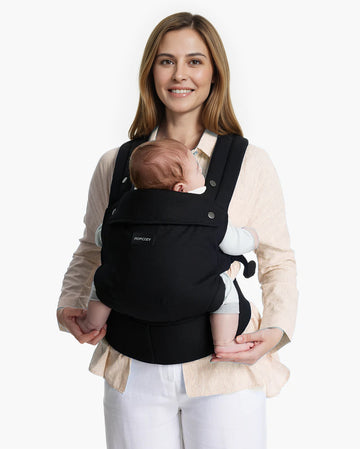
If you are wondering how a baby carrier fits a tall dad, the answer is not simply to lower the carrier because the wearer is taller.
A tall caregiver still needs to start with the baby's position. The baby should be held securely, close to the wearer and easy to see. From there, the caregiver can work backwards through the waistband, torso length and shoulder straps to find a setup that works.
This matters because two people who are the same height can have very different body proportions. One may have a longer torso, another broader shoulders, and another a larger waist. Those differences can change where the carrier sits and how the straps feel.
For tall or long-torso caregivers, the biggest adjustment is often the relationship between the waistband and the baby's height. Some carrier guidance recommends a higher waistband for smaller babies or adults with longer torsos so the baby stays high enough to be close and visible.
The goal is not to find a carrier labelled “for tall dads.” It is to find a setup that allows both the baby and caregiver to remain properly positioned within the carrier's instructions.
If you are still comparing carrier styles after checking your fit, you can look at baby carriers for different caregiver body types and then use the fit points below.
Key Takeaways
- A tall dad should not automatically wear the baby lower just because he is taller.
- Height and torso length are different. Torso length, shoulder shape, waist circumference and strap reach can all affect fit.
- For a smaller baby or a caregiver with a long torso, the waistband may need to sit higher so the baby stays high and close, depending on the carrier's instructions.
- If the baby is sitting too low, tightening the shoulder straps alone may not solve the problem.
- Check the waistband, baby's final height and shoulder-strap path before making several adjustments at once.
- The baby should remain snug, supported and easy to monitor, with the face unobstructed.
- A carrier can have plenty of adjustment points and still be a poor match for a particular body shape.
- If the correct fit cannot be achieved within the carrier's allowed settings, trying another setup, getting a professional fit check or choosing another carrier can be a reasonable next step.
- A product's “tall dad” label, if one exists, should not be treated as proof that it will fit every tall or long-torso caregiver.

Does a Tall Dad Need a Different Baby Carrier?
Not necessarily.
Being tall does not automatically mean that a caregiver needs a larger, longer or specially designed baby carrier. What matters more is whether the carrier has enough usable adjustment for the caregiver's body and whether the baby can be positioned correctly.
This is one reason that choosing a carrier based only on height can be misleading.
Imagine two caregivers who are both around the same height. One may have a relatively short torso and longer legs. The other may have a longer torso and shorter legs. If both put on the same carrier, the waistband and shoulder straps may sit differently on their bodies.
The same thing can happen with shoulder width and waist circumference.
A tall dad may have:
- A long torso
- Broad shoulders
- A narrow waist
- A larger waist circumference
- A combination of several of these
- Or none of these characteristics
So “tall” is useful for describing the problem people are searching for, but it is not a complete measurement for carrier fit.
The first step is figuring out which problem you actually have.
Height vs. body proportions: what matters more?
For carrier fitting, it is useful to separate overall height from the individual body areas that actually interact with the carrier.
Height tells you how tall the person is.
Torso length describes the distance between the upper body and the area where the waistband sits. A longer torso can affect how far the baby's position is from the caregiver's shoulders.
Shoulder width can influence where shoulder straps naturally sit and whether the straps feel close to the neck or underarms.
Waist circumference is another separate consideration. If the main problem is that the waistband does not accommodate the caregiver's body comfortably, that is a different fitting question from having a long torso.
This distinction is important because the solution is not always “get a bigger carrier.”
Sometimes the problem is simply that the carrier has been positioned too low.
Other times, the carrier may genuinely not work well with the caregiver's proportions.
The first step is figuring out which problem you actually have.
Height vs. Torso Length: Why the Same Height Can Fit Differently
A long torso can change the way a baby carrier sits even when the caregiver's overall height is not dramatically different from someone else's.
Think about the carrier as a connection between two areas: the baby's body and the caregiver's body.
The baby's position depends partly on where the waistband or lower carrier structure sits. The shoulder straps then connect that lower structure to the caregiver's upper body.
If the torso is longer, there can be more vertical space between the shoulders and the waistband. If the caregiver simply wears the waistband low because it feels like a natural “hip belt” position, the baby may end up lower than intended.
This is why some carrier guidance specifically addresses long-torso adults. Ergobaby's published guidance, for example, says that smaller babies or adults with long torsos may need to wear the waist belt higher so the baby is close enough to kiss.
That does not mean every carrier should be worn at exactly the same body landmark.
Different carriers have different construction, adjustment systems and instructions.
Long torso vs. broad shoulders vs. larger waist: three different fit questions
|
Body characteristic |
What it can affect |
Question to ask |
|
Long torso |
Vertical relationship between waistband, shoulders and baby |
Is the baby sitting too low even though the carrier is tightened? |
|
Broad shoulders |
Shoulder-strap position and routing |
Do the straps sit securely without pulling toward the neck or underarms? |
|
Larger waist |
Waistband circumference and adjustment |
Can the waistband close and stay stable within the manufacturer's range? |
These problems can overlap, but they are not interchangeable.
If circumference is the main concern, you can also refer to the plus-size babywearing fit guide for additional guidance.
This article is mainly focused on tall and long-torso fit rather than covering every possible body type.
The 3 Fit Signals to Check First: Waistband, Baby Height, Shoulder Path
When a carrier feels wrong, it can be tempting to pull every strap until everything feels tight.
A better approach is to check three things in order:
- Where is the waistband?
- Where is the baby?
- How are the shoulder straps sitting and routing?
|
Signal |
What good looks like |
Common tall-torso problem |
First action |
|
Waistband |
Stable and positioned according to the carrier instructions |
Worn too low, causing baby to sit low |
Re-check the allowed waistband position |
|
Baby height |
Baby is high, close and easy to monitor |
Baby sits around the stomach or lower |
Re-seat baby after correcting the waistband |
|
Shoulder path |
Straps are secure and reasonably symmetrical |
Straps are maxed out, near the neck or underarms, or overly tight |
Check routing, slack and adjustment range |
Why this order matters
The waistband or lower part of the carrier helps establish the baby's position.
If it starts too low, tightening the shoulder straps may pull the upper carrier closer to the caregiver while the baby remains too low.
That can create a frustrating cycle. The caregiver notices the baby is low, tightens the straps, feels more pressure around the shoulders and still does not get the baby into the right position.
Instead, think about the problem from the bottom up.
If the baby is low, ask what is causing the low position first.
Check the waistband.
Then check the baby's seat and position.
Then remove obvious slack.
Only after that should you make further shoulder-strap adjustments.
Waistband Placement on a Long Torso: Start With Baby Height, Not Hip Height
This is often one of the biggest sources of confusion for tall caregivers.
People who are used to wearing backpacks may expect a waist belt to sit around the hips. A front baby carrier does not necessarily use the waistband in exactly the same way.
For a smaller baby and a caregiver with a longer torso, the waistband may need to sit higher than the caregiver first expects so the baby remains high and close.
The important point is that there is no universal body landmark that works for every carrier.
Use the carrier's instructions, the baby's size and stage, and the baby's final position to guide the adjustment.
If the baby is sitting too low, a simple diagnostic sequence can help:
- Re-check the waistband.
- Raise it if the carrier's instructions allow that adjustment.
- Re-seat the baby.
- Remove obvious slack.
- Re-check the baby's height and overall position.
Only after these steps should you continue adjusting the shoulder straps.
What if the higher waistband feels uncomfortable?
A higher waistband can feel unfamiliar, especially if the caregiver expected the carrier to sit around the hips.
There is a difference between something feeling unusual and a setup being consistently uncomfortable or unstable.
If the allowed setup repeatedly creates uncomfortable pressure, slips out of position or makes the required baby position difficult to achieve, do not simply force the carrier into place.
That may be a sign that the carrier and the caregiver's body proportions are not a good match.
The goal is not to make one particular carrier work at any cost. The goal is to find a setup that follows the carrier's instructions while keeping the baby properly positioned and the caregiver reasonably comfortable.
Baby Height: Keep Baby High, Close, Supported, and Easy to See
Once the waistband is in a workable position, look at the baby.
The caregiver's height is not a reason for the baby to sit lower.
A tall dad still needs to be able to monitor the baby easily. The baby should be high, close and supported, with the face unobstructed.
A useful practical cue is that the baby should be close enough to kiss. This is a cue rather than a fixed measurement, because every carrier and caregiver combination is different.
Check the baby from the front and side.
Look for:
- A secure and supported seat
- A baby who is not obviously slumping
- A face that remains visible and unobstructed
- No unnecessary loose fabric around the baby's face
- A position that remains stable when the caregiver moves
If the baby starts low, do not assume the solution is simply to tighten everything.
Return to the waistband and seating position first.
What changes as the baby gets older?
As babies grow, their size and developmental stage can change which carrier settings or positions are appropriate.
Always follow the specific carrier's instructions for the baby's stage and size. For a broader explanation of changing carry positions, see the guide to baby carrier positions by age.

Shoulder Straps and Broad Shoulders: Fix the Path, Not Just the Tightness
Shoulder straps can be another source of confusion for tall or broad-shouldered caregivers.
The important thing is not simply how tight the straps are.
Look at the entire strap path.
Ask:
- Are the straps pulling toward the neck?
- Are they digging into the underarms?
- Is one side much tighter than the other?
- Is there very little adjustment left?
- Does the carrier shift when the caregiver moves?
- Is the baby still low even though the straps are very tight?
- Is the caregiver tightening the straps mainly because the waistband position is not working?
Tightening a strap does not automatically improve the fit.
If the waistband is too low, the caregiver may compensate by pulling the shoulder straps tighter. This can create pressure around the upper body without solving the original problem.
Signs the straps are “too tight in the wrong place”
A strap can be tight without the overall carrier being well fitted.
For example, the caregiver may notice pressure around the neck while the baby is still sitting too low.
Another possibility is that the straps feel extremely tight because they are being used to compensate for slack somewhere lower in the carrier.
If this happens, loosen the urge to keep tightening and return to the earlier fit points.
For caregivers who are comparing how different carriers work for dads and multiple caregivers, a shared-fit guide for dads and caregivers can provide additional context without replacing the carrier's own instructions.
A 5-Step Tall-Dad Fit Check Before You Walk Out the Door
Once the carrier is adjusted, take a few minutes to run through the same checks each time.
1. Confirm the baby's stage and the allowed carry
Start by checking whether the baby's age, size and developmental stage match the position you are using.
The carrier manual should take priority over general advice.
If the carrier has specific settings for different baby sizes, use the setting appropriate for your baby.
2. Set the waistband
Put the waistband where the carrier instructions allow and where the baby can reach the intended height.
For a long-torso caregiver with a smaller baby, this may mean a higher waistband than the caregiver expected.
Do not use a universal body landmark as a substitute for the carrier's instructions.
3. Seat the baby and remove obvious slack
Once the waistband is stable, seat the baby properly.
Check that the carrier fabric is supporting the baby as intended and that there is no obvious excess slack.
Do not immediately pull the shoulder straps as tight as possible.
4. Adjust the shoulders evenly and check the face
Adjust the shoulder straps according to the carrier's instructions.
Check the strap path and symmetry.
Then look at the baby again.
The face should remain visible and unobstructed, and the baby should stay in a secure, supported position.
5. Move around and check again
Before heading out, walk around for a few minutes.
Sit down if appropriate.
Stand again.
Notice whether the waistband moves, whether the baby drops lower, whether the straps shift or whether pressure develops in one area.
A carrier can feel fine while standing still and feel different once the caregiver starts moving.
|
Symptom |
Area to re-check |
|
Baby sits too low |
Waistband and baby seat |
|
Shoulder straps feel extremely tight |
Waistband position and excess slack |
|
Strap pulls toward the neck |
Shoulder-strap path |
|
Waistband keeps moving down |
Waistband stability and allowed placement |
|
Baby's position changes while walking |
Overall fit and slack |
|
Correct position seems impossible |
Caregiver/carrier compatibility and carrier instructions |
What if two caregivers share the same carrier?
A single carrier can potentially work for caregivers with different body shapes, but each person should adjust it for their own body.
Do not assume that the settings used by a shorter caregiver will also work for a taller caregiver.
The waistband, shoulder straps and other adjustment points may need to be changed every time the carrier changes hands.
For a broader look at carrier considerations for dads, you can refer to the shared-fit guide for dads and caregivers.

When the Carrier Still Doesn't Fit: Try Another Setup, Get a Fit Check, or Change Format
Sometimes a carrier simply does not work well for a particular body shape.
That does not automatically mean the caregiver is using it incorrectly.
A carrier can have several adjustment points and still have a poor fit for a specific combination of caregiver and baby.
Some signs include:
- The shoulder straps remain close to their adjustment limits.
- The waistband will not stay in its intended position.
- The baby continues to sit too low after careful adjustment.
- The baby cannot remain in the required position.
- The caregiver experiences persistent pressure or slipping.
- The carrier only feels secure when it is pulled excessively tight.
- The adjustment needed for the baby appears to conflict with the carrier's instructions.
One unsuccessful adjustment does not necessarily mean the carrier is wrong for you.
Try going through the fitting process slowly.
If the carrier allows a particular adjustment, make one change at a time and then reassess the baby's position.
If possible, a try-on with the actual baby can be useful when done safely and according to the carrier's instructions. A qualified babywearing educator, retailer or appropriate fit-support service may also be able to help identify whether the problem is the waistband, strap path, baby position or overall carrier compatibility.
Another option is to consider a different carrier format.
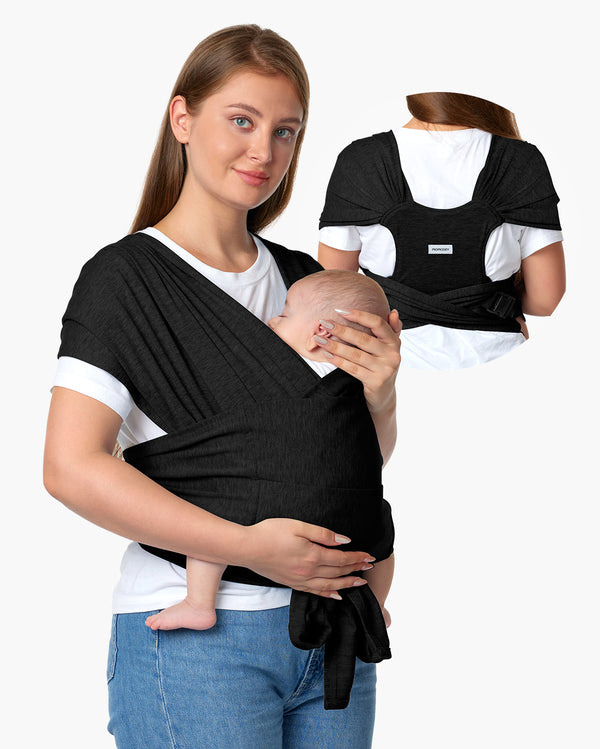
Depending on your baby's stage and the carrier's intended use, this might mean looking at newborn carriers, wrap baby carriers or hip seat carriers rather than assuming the original carrier has to work.
Member price
De$34.99$39.99

The purpose of these options is not to create a ranking. Different formats simply provide different construction and adjustment systems.
Why “one size fits all” is not a useful promise
Caregivers come in different shapes and proportions.
Even two people with the same height can have different torso lengths, shoulder widths and waist measurements.
That means a carrier can offer many adjustment points without fitting every person equally well.
A more useful question than “Does this carrier fit tall dads?” is:
Can this carrier achieve the required baby position and a stable caregiver fit within its allowed adjustments?
If the answer is yes, the next step is refining the fit.
If the answer is no, another setup, carrier or format may be worth considering.
How Momcozy Fits Into This Decision
The PureHug ergonomic baby carrier is one example of a front baby carrier that can be considered after the basic fit questions have been worked through.
The current product information describes PureHug as a lightweight carrier with adjustable padded shoulder and waist straps, an X-shaped back design and EVA lumbar support. It also provides three baby-size settings and is designed for babies within its published age and weight range.

These features can give caregivers several points to adjust as their baby grows.
However, those features should not be treated as proof that the carrier will automatically fit every tall dad.
A product having adjustable straps does not tell you the exact maximum adjustment available for every caregiver.
Likewise, an X-shaped back does not automatically make a carrier better for every broad-shouldered wearer. Lumbar support is a support feature, but it does not replace correct baby positioning or a properly fitted waistband.
The current product information also does not establish that PureHug is specifically designed for tall dads or that it will fit every long-torso caregiver.
What to verify before buying PureHug for a tall caregiver
|
PureHug feature |
What it tells you |
What it does not prove |
|
X-shaped back |
The carrier uses a particular shoulder-strap design |
That every tall or broad-shouldered caregiver will find it comfortable |
|
Adjustable padded shoulder straps |
The shoulder area can be adjusted |
The exact maximum strap length for every body type |
|
Adjustable waist strap |
The waist area has adjustment |
That every waist size or torso proportion will fit equally well |
|
EVA lumbar support |
The carrier includes a support feature |
That it can correct a poor overall fit |
|
Three baby-size settings |
The carrier provides settings as baby grows |
That every caregiver-and-baby combination will fit |
|
Published baby weight range |
Shows the intended baby range |
That the carrier will fit every caregiver within that baby range |
Before buying, check the latest product instructions for the exact adjustment range and approved setup.
If your main concern is whether the carrier can accommodate your body proportions, the most useful information is the actual caregiver adjustment range rather than the word “tall.”
Why X-back is one option
An X-shaped back can change how the shoulder straps sit across the caregiver's upper body.
That may feel different from another carrier's strap configuration.
But strap design is not a universal answer to broad shoulders or long torsos.
The important question is whether the straps can be adjusted according to the carrier's instructions while keeping the baby properly positioned.
Lumbar support comes after fit
Lumbar support can be a useful product feature, but it should not be used as a reason to overlook the rest of the fit.
If the baby is too low, the waistband is unstable or the straps are being pulled excessively tight, additional support around the lower back does not fix those underlying positioning problems.
Fit comes first.
Frequently Asked Questions
Can a tall dad simply wear the baby lower?
No.
A caregiver's height does not mean the baby should automatically sit lower.
Start with the baby's required position and the carrier's instructions. For a long-torso caregiver, a higher waistband may sometimes be appropriate for a smaller baby if the carrier allows it.
Does a taller parent always need longer shoulder straps?
No.
Height alone does not tell you how much shoulder-strap length someone needs.
Torso length, shoulder width, strap routing and the carrier's adjustment range can all affect the result.
A tall caregiver with a relatively short torso may fit differently from another caregiver of the same height with a longer torso.
Can one carrier fit a short mom and a tall dad?
It can, depending on the carrier and the two caregivers' body proportions.
Each caregiver should adjust the carrier for their own body rather than using the previous caregiver's settings.
The waistband, shoulder straps and other adjustment points may need to be changed between users.
For more information on sharing a carrier between caregivers, see the shared-fit guide for dads and caregivers.
Should a long-torso caregiver always wear the waistband under the chest?
No.
There is no single waistband landmark that applies to every carrier.
Some carrier guidance recommends a higher waistband for smaller babies or adults with longer torsos, but the carrier's own instructions should determine the allowed setup.
The final check is the baby's position and the stability of the carrier.
What if the waistband feels comfortable but the baby is still too low?
Go back through the fit in order.
Check the waistband position, the baby's seat, obvious slack and the carrier's available settings.
Then check the shoulder-strap path.
Do not assume that pulling the shoulder straps tighter will solve a low baby position.
Does lumbar support fix poor fit?
No.
Lumbar support is a feature of the carrier. It does not replace correct positioning.
If the baby is too low, the waistband slips or the straps are being used to compensate for another adjustment problem, those issues should be addressed first.
Is a “tall dad” carrier automatically better for tall parents?
Not necessarily.
The more useful question is whether the carrier's adjustment range works for the specific caregiver and baby.
A carrier marketed around a certain body type is not automatically a fit for everyone in that group.
What if my torso fits but my shoulders do not?
Treat these as separate fit questions.
A carrier may work well around the torso but still have an awkward shoulder-strap path for a particular caregiver.
Check the allowed routing, adjustment range and where the straps sit.
What if the carrier feels fine at first but becomes uncomfortable after walking?
Re-check the fit after movement.
The waistband may have shifted, the baby may have settled lower or the straps may have changed position.
A short movement check before leaving can reveal problems that are not obvious while standing still.
Should I buy a carrier before trying it?
If you have the opportunity to try the carrier safely with the actual baby and within the manufacturer's instructions, that can make it easier to judge the fit.
Pay attention to the complete setup rather than judging the carrier only by how it looks on the package or whether it is described as suitable for tall caregivers.
Conclusion
If you are asking how a baby carrier fits a tall dad, the answer starts with the baby, not the caregiver's height.
The baby should be positioned securely, high and close enough to monitor easily. From there, check the waistband, especially if the caregiver has a long torso and the baby is smaller. Then look at the baby's seat and the shoulder-strap path.
If not, trying another setup, getting a fit check or looking at another carrier format can be a practical next step. For caregivers still comparing options, explore baby carriers for different caregiver body types and focus on the actual adjustment range and baby position rather than choosing based on height alone.








